Orthopedics Hyperguide Review | Dr Hutaif General Ortho -...
Key Takeaway
This interactive board review contains 100 randomly selected orthopedic surgery questions with clinical images, immediate feedback, and detailed references.
Orthopedics Hyperguide Review | Dr Hutaif General Ortho -...
Comprehensive 100-Question Exam
00:00
Start Quiz
Question 1
To decrease volumetric wear in ultra-high molecular weight polyethylene (UHMWPE) acetabular liners, cross-linking is performed via irradiation. What is the primary mechanical trade-off of utilizing highly cross-linked polyethylene compared to conventional UHMWPE?
Explanation
Question 2
Denosumab is utilized in the treatment of osteoporosis and giant cell tumor of bone. Which of the following best describes its specific molecular mechanism of action?
Explanation
Question 3
During the normal human gait cycle, at which specific phase is the anterior tibial muscle maximally active?
Explanation
Question 4
A 28-year-old male sustains a severe closed tibial shaft fracture. Which of the following pressure measurements most accurately indicates the need for an emergent four-compartment fasciotomy?
Explanation
Question 5
A 13-year-old obese boy presents with left knee pain, a limp, and obligate external rotation of the left hip with passive flexion. Radiographs confirm a moderate slipped capital femoral epiphysis (SCFE). Which of the following is the most significant risk factor for the subsequent development of a contralateral SCFE?
Explanation
Question 6
A 15-year-old boy presents with a destructive diaphyseal lesion in the femur with a 'periosteal onion-skinning' appearance. Biopsy shows a sheet of uniform small round blue cells. Which chromosomal translocation is most characteristic of this tumor?
Explanation
Question 7
When designing a cortical screw to maximize pullout strength in osteopenic bone, which of the following geometric modifications will be most effective?
Explanation
Question 8
A patient arrives at the trauma bay with flaccid paralysis below the C6 level, profound bradycardia (HR 45), and hypotension (BP 80/50). The extremities are remarkably warm and well-perfused. What is the primary pathophysiological mechanism causing the hypotension?
Explanation
Question 9
During a classic open carpal tunnel release, the surgeon must identify and protect the recurrent motor branch of the median nerve. According to anatomical studies, what is the most common anatomical course of this motor branch in relation to the transverse carpal ligament?
Explanation
Question 10
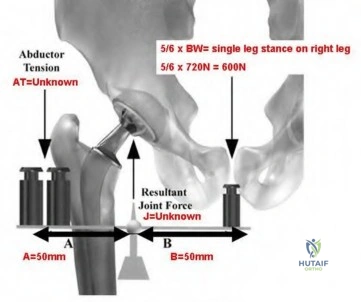
Increasing the femoral head offset during a total hip arthroplasty primarily has which of the following biomechanical effects on the hip joint?
Explanation
Question 11
Staphylococcus epidermidis is a frequent and tenacious pathogen in prosthetic joint infections, primarily due to its ability to form a robust biofilm. Which phase of biofilm formation critically involves the production of poly-N-acetylglucosamine (PNAG)?
Explanation
Question 12
A 65-year-old male presents with deep, aching thigh pain and increasing hat size. Labs show elevated alkaline phosphatase with normal calcium and phosphate levels. A core biopsy of the femur is most likely to reveal which of the following histological patterns?
Explanation
Question 13
Following a closed femur fracture treated with a locked intramedullary nail, fracture healing occurs primarily via endochondral ossification. During the hard callus formation phase, which specific collagen type is synthesized predominantly by hypertrophic chondrocytes to facilitate cartilage matrix calcification?
Explanation
Question 14
According to the Sunderland classification of peripheral nerve injuries, a second-degree injury corresponds to which of the following physiological descriptions?
Explanation
Question 15
The primary, vital blood supply to the adult femoral head is derived from branches of which of the following vessels?
Explanation
Question 16
Rivaroxaban is frequently prescribed for venous thromboembolism (VTE) prophylaxis following major orthopedic adult reconstruction surgery. What is its specific mechanism of action within the coagulation cascade?
Explanation
Question 17
In the pathogenesis of Charcot neuropathic osteoarthropathy in diabetic patients, the 'neurovascular theory' suggests that autonomic neuropathy drives the disease process through which of the following mechanisms?
Explanation
Question 18
When comparing bone-patellar tendon-bone (BPTB) autograft to multiple-strand hamstring autograft for ACL reconstruction, the BPTB graft is most uniquely and consistently associated with which of the following postoperative morbidities?
Explanation
Question 19
In the pathophysiology of Rheumatoid Arthritis, inflammatory cytokines drive joint destruction. Which cytokine is primarily responsible for inducing the robust expression of RANKL on synovial fibroblasts, thereby promoting aggressive osteoclast-mediated marginal bone erosions?
Explanation
Question 20
A 4-month-old infant with developmental dysplasia of the hip (DDH) has failed 6 weeks of compliant Pavlik harness treatment, and the affected hip remains completely dislocated and irreducible on ultrasound. What is the most appropriate next step in management?
Explanation
Question 21
According to Perren's strain theory, what maximum percentage of interfragmentary strain allows for the direct formation of lamellar bone during fracture healing?
Explanation
Question 22
Which of the following alterations to a cortical screw design most significantly increases its pullout strength?
Explanation
Question 23
A 12-year-old child presents with recurrent fractures and is noted to have a "rugger jersey" spine on radiographs. Genetic testing reveals a mutation in the carbonic anhydrase II gene. What is the primary cellular dysfunction in this disorder?
Explanation
Question 24
During the stance phase of gait, a patient demonstrates a sudden backward thrust of the trunk immediately following heel strike. Which nerve is most likely compromised?
Explanation
Question 25
In normal adult articular cartilage, which zone contains the highest concentration of collagen, the lowest concentration of proteoglycans, and chondrocytes aligned parallel to the joint surface?
Explanation
Question 26
A 50-year-old patient receives a demineralized bone matrix (DBM) allograft for a diaphyseal nonunion. The primary mechanism by which DBM aids in fracture healing is mediated by which of the following processes?
Explanation
Question 27
What type of collagen is the predominant structural component of the annulus fibrosus of the intervertebral disc?
Explanation
Question 28
When a viscoelastic material like a tendon is subjected to a constant deformation (strain) over time, the force required to maintain that deformation gradually decreases. What is this biomechanical phenomenon called?
Explanation
Question 29
Which of the following best describes the molecular mechanism of action of Teriparatide in the treatment of osteoporosis?
Explanation
Question 30
Galvanic corrosion in orthopedic implants occurs when dissimilar metals are placed in contact within a conductive fluid environment. Which combination of metals is generally considered the most susceptible to this type of severe corrosion?
Explanation
Question 31
A muscle contraction in which the muscle generates tension while actively lengthening is defined as which of the following?
Explanation
Question 32
Articular cartilage acquires its primary compressive stiffness from the interaction between water and which of the following extracellular matrix components?
Explanation
Question 33
A 4-year-old child presents with bowing of the long bones, widening of the physes, and cupping of the metaphyses on X-ray. Laboratory studies show hypophosphatemia, elevated alkaline phosphatase, and normal serum calcium. What is the most likely diagnosis?
Explanation
Question 34
Bone behaves as a viscoelastic material. Because of this property, how does an intact long bone respond to a rapidly applied, high-strain-rate load compared to a slowly applied load?
Explanation
Question 35
During the intracellular synthesis of collagen, which vitamin is required as an essential cofactor for the hydroxylation of proline and lysine residues?
Explanation
Question 36
What specific radiographic finding is considered classic for scurvy (Vitamin C deficiency) in the pediatric population?
Explanation
Question 37
Which type of joint lubrication is most heavily relied upon by human articular joints during the stance phase of normal walking, when loads are highest and sliding speeds are relatively low?
Explanation
Question 38
A 65-year-old male with a history of renal cell carcinoma presents with a large, destructive lytic lesion in his proximal femur. He is scheduled for prophylactic intramedullary nailing. What is the most critical preoperative step prior to the surgical stabilization of this specific metastasis?
Explanation
Question 39
What is the principal mechanism by which Non-Steroidal Anti-Inflammatory Drugs (NSAIDs) are theorized to impair fracture healing?
Explanation
Question 40
A biomechanical study evaluates the effect of a new total hip arthroplasty implant design on hip joint forces. Moving the center of rotation of the acetabulum medially and inferiorly accomplishes which of the following?
Explanation
Question 41
When evaluating the viscoelastic properties of ligaments and tendons, which of the following best describes the biomechanical phenomenon of 'creep'?
Explanation
Question 42
Titanium alloys are frequently selected for orthopedic implants due to their biocompatibility. Compared to stainless steel alloys, titanium is characterized by which of the following mechanical properties?
Explanation
Question 43
A 4-year-old child presents with diffuse bone pain, gingival bleeding, and metaphyseal radiolucent bands on radiographs. The underlying molecular defect involves a failure in which of the following critical intracellular processes?
Explanation
Question 44
Skeletal muscle fibers are differentiated based on their functional and metabolic capabilities. Which of the following characteristics accurately describes Type I skeletal muscle fibers?
Explanation
Question 45
Bone morphogenetic proteins (BMPs) play a crucial role in osteoinduction during fracture healing. They initiate intracellular signaling primarily by binding to transmembrane receptors and activating which of the following downstream pathways?
Explanation
Question 46
A new diagnostic biomarker for periprosthetic joint infection is being evaluated in different hospital populations. If the prevalence of the infection in the tested population increases, which of the following statistical parameters will correspondingly increase?
Explanation
Question 47
Tranexamic acid (TXA) is widely utilized in total joint arthroplasty to minimize perioperative blood loss. Which of the following best describes its primary pharmacological mechanism of action?
Explanation
Question 48
Nitrogen-containing bisphosphonates, such as alendronate, are first-line treatments for osteoporosis. At the cellular level, what is the principal mechanism by which they decrease bone resorption?
Explanation
Question 49
Normal articular cartilage possesses remarkable biomechanical properties to withstand physiological joint loads. The cartilage matrix derives its ability to resist high compressive loads primarily from which of its structural components?
Explanation
Question 50
In the context of internal fixation biomechanics, maximizing the radius of a solid intramedullary nail will increase its torsional rigidity by a factor proportional to the radius raised to what power?
Explanation
Question 51
Following rigid internal fixation of a transverse radius fracture with a dynamic compression plate resulting in absolute stability, successful bone healing occurs primarily via which of the following biological mechanisms?
Explanation
Question 52
During an electromyography (EMG) evaluation of a patient with a traumatic peripheral nerve injury, the presence of fibrillation potentials and positive sharp waves typically indicates which of the following neural states?
Explanation
Question 53
A patient with end-stage renal disease presents with intractable bone pain. Laboratory evaluation reveals hypocalcemia, hyperphosphatemia, and markedly elevated parathyroid hormone (PTH). The most likely advanced skeletal manifestation in this patient is characterized histologically by:
Explanation
Question 54
During the development of a periprosthetic joint infection, biofilm formation protects the offending bacteria from host immune defenses and systemic antibiotics. What is the initiating biological step in the formation of a bacterial biofilm on an orthopedic implant?
Explanation
Question 55
When applying a bridging plate to stabilize a highly comminuted diaphyseal femur fracture, increasing the working length of the plate has what specific biomechanical effect on the construct?
Explanation
Question 56
During hardware removal, a surgeon notes significant degradation around a stainless steel screw that was inadvertently placed through a titanium plate. This accelerated localized degradation is primarily an example of which type of corrosion?
Explanation
Question 57
Polymethylmethacrylate (PMMA) bone cement is frequently utilized for the fixation of total joint arthroplasty components. Which of the following statements is true regarding its fundamental biomechanical properties and clinical function?
Explanation
Question 58
Understanding the dynamic joint reaction forces across the hip is critical for arthroplasty design and rehabilitation. During a normal gait cycle, the greatest joint reaction force across the hip occurs during which specific phase?
Explanation
Question 59
A 65-year-old male presents with a pathologic fracture of the proximal humerus. Subsequent systemic workup reveals hypercalcemia, normocytic anemia, and Bence-Jones proteinuria. What is the characteristic radiographic appearance of the skeletal lesions associated with this pathology?
Explanation
Question 60
Deep vein thrombosis (DVT) prophylaxis is a critical component of postoperative orthopedic care. Which of the following commonly utilized oral prophylactic agents exerts its anticoagulant effect via direct, reversible inhibition of thrombin (Factor IIa)?
Explanation
Question 61
Which enzyme is primarily secreted by the osteoclast ruffled border to degrade the organic matrix of bone?
Explanation
Question 62
A surgeon places a titanium screw through a stainless steel plate. What type of corrosion is most likely to occur at the interface of these two metals?
Explanation
Question 63
A 65-year-old man presents with a bowing deformity of his tibia and an elevated serum alkaline phosphatase. A bone biopsy reveals a mosaic pattern of lamellar bone. What is the primary cellular defect initiating this condition?
Explanation
Question 64
Which of the following screw design modifications will most effectively increase the pullout strength of a cortical screw?
Explanation
Question 65
Tranexamic acid (TXA) is widely used in orthopedic surgery to reduce perioperative blood loss. Which of the following best describes its primary mechanism of action?
Explanation
Question 66
A 30-year-old sustains a closed midshaft humerus fracture with an immediate complete radial nerve palsy. At what time point after the injury will electromyography (EMG) first show fibrillation potentials in the brachioradialis muscle?
Explanation
Question 67
In prosthetic joint infections, Staphylococcus epidermidis evades the host immune system and antibiotics primarily through biofilm formation. What is the major structural component of this biofilm?
Explanation
Question 68
A 15-year-old boy undergoes neoadjuvant chemotherapy followed by wide resection for a distal femur osteosarcoma. Which of the following is the most important prognostic factor for long-term survival in this patient?
Explanation
Question 69
During the normal phases of tendon healing, which biochemical change during the remodeling phase is primarily responsible for the increased tensile strength of the tissue?
Explanation
Question 70
A patient is prescribed low-molecular-weight heparin (LMWH) for deep vein thrombosis prophylaxis following a total hip arthroplasty. What is the primary molecular target of this medication?
Explanation
Question 71
A 4-year-old boy presents with multiple recurrent fractures and blue sclerae. Genetic testing reveals a mutation in the COL1A1 gene. The defective protein normally follows which structural configuration in the extracellular matrix?
Explanation
Question 72
Which of the following factors is most strongly associated with the development of avascular necrosis (AVN) following surgical pinning of a slipped capital femoral epiphysis (SCFE)?
Explanation
Question 73
A 25-year-old man presents with a severely comminuted tibia fracture. His blood pressure is 120/80 mmHg. What compartment pressure measurement most reliably confirms the indication for an emergent fasciotomy?
Explanation
Question 74
In rheumatoid arthritis, progressive destruction of subchondral bone is driven by hypertrophic synovial tissue known as pannus. Which cell type in the pannus is primarily responsible for driving osteoclastogenesis via high RANKL expression?
Explanation
Question 75
Demineralized bone matrix (DBM) is frequently used as a bone graft extender in spine surgery. Which of the following properties does DBM inherently possess to aid in bone healing?
Explanation
Question 76
A 50-year-old patient with end-stage renal disease develops renal osteodystrophy. This condition is primarily driven by the kidneys' inability to perform which critical step in Vitamin D metabolism?
Explanation
Question 77
A surgeon uses a bridge plating technique for a comminuted femoral shaft fracture. How does increasing the working length of the plate affect the biomechanical construct?
Explanation
Question 78
A 32-year-old woman presents with knee pain. Radiographs reveal an eccentric, lytic epiphyseal lesion extending to the subchondral bone of the proximal tibia. Biopsy confirms a Giant Cell Tumor of bone. What is the most widely accepted surgical treatment?
Explanation
Question 79
Articular cartilage possesses a highly organized structural matrix to resist compressive and shear forces. In which zone of articular cartilage are the type II collagen fibers oriented perpendicular to the joint surface?
Explanation
Question 80
A 68-year-old man presents with severe back pain. Plain radiographs reveal multiple "punched-out" lytic lesions in his skull and spine. If a technetium-99m bone scan is performed, what is the most likely expected finding for these specific lesions?
Explanation
Question 81
Perren's strain theory dictates the type of bone healing based on the mechanical environment. What percentage of strain is optimal to induce secondary bone healing via callus formation?
Explanation
Question 82
When combining different orthopedic implants, galvanic corrosion can occur due to differences in electrochemical potential. Which combination of metals is most likely to result in significant galvanic corrosion if placed in direct physical contact?
Explanation
Question 83
A 4-year-old child presents with frequent fractures, blue sclerae, and dentinogenesis imperfecta. Genetic testing is most likely to reveal a defect in which of the following collagens?
Explanation
Question 84
Which of the following laboratory profiles is most characteristic of active Paget disease of bone in an otherwise healthy patient?
Explanation
Question 85
During the single-limb stance phase of normal gait, what is the approximate force transmitted across the hip joint, expressed as a multiple of body weight (BW)?
Explanation
Question 86
A 15-year-old boy presents with a painful mass around his distal femur. Radiographs show a sunburst periosteal reaction and Codman's triangle. What is the most significant prognostic factor for survival in this patient?
Explanation
Question 87
In the structure of normal articular cartilage, which zone is characterized by the highest concentration of proteoglycans and the lowest concentration of water?
Explanation
Question 88
In the pathogenesis of periprosthetic joint infections, which step is considered the critical threshold for the development of a mature, antibiotic-resistant biofilm?
Explanation
Question 89
When evaluating a patient with suspected cervical radiculopathy, which electromyography (EMG) finding is the earliest indicator of acute axonal injury following a nerve root compression?
Explanation
Question 90
A patient with osteopetrosis suffers from severely dense, brittle bones due to defective osteoclast function. Which specific cellular component or mechanism is most commonly defective in these osteoclasts?
Explanation
Question 91
During the remodeling phase of tendon healing, the biomechanical strength of the tendon increases significantly. This is primarily mediated by which of the following processes?
Explanation
Question 92
Fretting and crevice corrosion are most commonly observed at which specific interface in modern total hip arthroplasty?
Explanation
Question 93
An orthopedic researcher conducts a randomized controlled trial comparing two surgical techniques but finds no statistically significant difference, despite a true difference existing in the population. To reduce the chance of this Type II error in future studies, which modification should be made?
Explanation
Question 94
Tranexamic acid (TXA) is widely used in total joint arthroplasty to reduce perioperative blood loss. What is the specific mechanism of action of TXA?
Explanation
Question 95
A 30-year-old female presents with knee pain and a lytic epiphyseal lesion extending to the articular surface of the proximal tibia. Biopsy reveals multinucleated giant cells in a background of mononuclear stromal cells. Which cell type is the true neoplastic component of this tumor?
Explanation
Question 96
During embryonic limb development, which signaling center is primarily responsible for the anterior-posterior patterning (e.g., thumb to small finger differentiation) of the developing limb bud?
Explanation
Question 97
In a patient with a tibia fracture and suspected acute compartment syndrome, which pressure measurement parameter is the most reliable threshold for indicating the need for emergent fasciotomy?
Explanation
Question 98
Which of the following systemic antibiotics exhibits the highest penetration into both cortical and cancellous bone, making it particularly useful for treating chronic osteomyelitis?
Explanation
Question 99
A pediatric patient with suspected X-linked hypophosphatemic rickets presents with bowing of the lower extremities. Which laboratory finding is the hallmark of this specific disease process?
Explanation
Question 100
According to the Nachemson studies on in vivo intervertebral disc pressure, which of the following activities or positions generates the highest pressure in the L3-L4 intervertebral disc?
Explanation
None
