Orthopedic Board Review MCQs (2026 Edition) - Part 2
Orthopedic Board Review MCQs (2026 Edition) - Part 2
Comprehensive 100-Question Exam
00:00
Start Quiz
Question 1
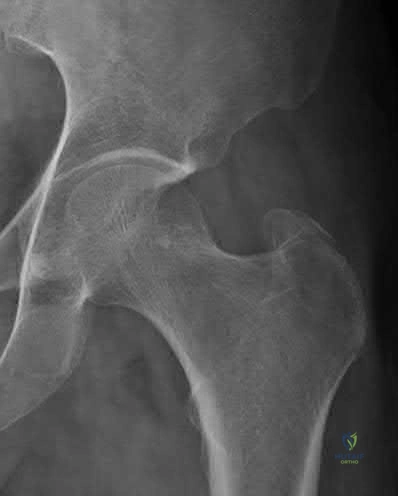
A 65-year-old male presents with groin pain 5 years after a primary THA using a metal-on-polyethylene bearing with a large diameter titanium femoral head and a modular cobalt-chromium neck. Inflammatory markers are normal. Aspiration yields fluid with 300 WBCs/uL and 50% PMNs. MRI with MARS reveals a solid soft tissue mass and fluid collection. What is the most likely diagnosis, and what serum markers should be checked?
Explanation
Question 2
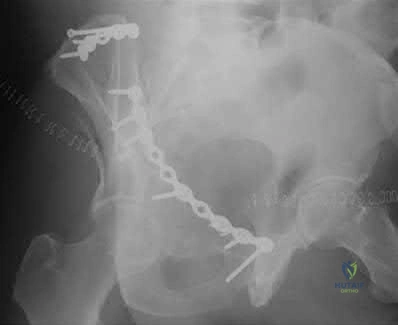
A 32-year-old female presents with a distal femur fracture following an MVC. CT reveals a coronal plane fracture of the lateral femoral condyle. What is the optimal surgical approach and standard fixation strategy for this specific fragment?
Explanation
Question 3
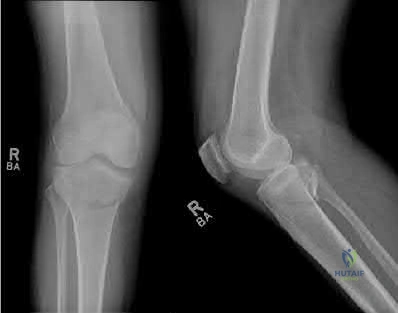
A 28-year-old female presents with a lytic lesion in her distal femur abutting the joint. Biopsy confirms a Giant Cell Tumor of bone. She is treated with Denosumab prior to surgery. What is the mechanism of action of Denosumab, and what is the characteristic histological change seen after treatment?
Explanation
Question 4
A 12-year-old boy with a BMI of 35 presents with left groin pain and an obligate external rotation of the hip with flexion. Radiographs show a severe left slipped capital femoral epiphysis (SCFE). When considering prophylactic pinning of the contralateral asymptomatic right hip, which of the following represents the strongest indication?
Explanation
Question 5
An 82-year-old male presents after a low-energy fall with neck pain. CT reveals a Type II odontoid fracture with 2 mm of posterior displacement. He is neurologically intact. What is the most appropriate management, considering his age and fracture characteristics?
Explanation
Question 6
A 19-year-old female collegiate soccer player undergoes ACL reconstruction using a bone-patellar tendon-bone (BTB) autograft. Compared to hamstring autograft, which of the following is an expected long-term outcome associated with BTB autograft?
Explanation
Question 7
During a primary posterior-stabilized total knee arthroplasty, after making the standard bone cuts, the trial components are inserted. The knee is tight in extension but balanced in flexion. Which of the following is the most appropriate next step?
Explanation
Question 8
Which of the following Bone Morphogenetic Proteins (BMPs) is NOT correctly paired with its clinical application, carrier, or mechanism?
Explanation
Question 9
A 25-year-old male sustains a laceration to the volar aspect of his index finger at the level of the middle phalanx, just proximal to the DIP joint. Examination reveals an inability to flex the DIP joint, but PIP flexion against resistance is intact. In which flexor tendon zone did the injury occur, and what is the optimal surgical timing?
Explanation
Question 10
A 45-year-old female is struck by a motor vehicle and sustains an anteroposterior compression (APC) type III pelvic ring injury. She remains hemodynamically unstable despite a pelvic binder and initial fluid resuscitation. What is the most appropriate next step in management?
Explanation
Question 11
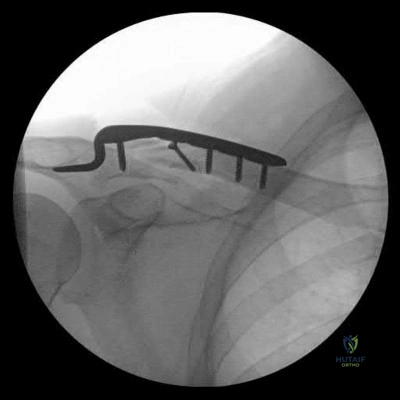
A 6-month-old female presents with a neglected developmental dysplasia of the hip (DDH). Ultrasound and plain radiographs confirm a dislocated left hip. She has never received treatment. What is the most appropriate initial management?
Explanation
Question 12
Articular cartilage is divided into four structural zones. Which zone is characterized by the highest concentration of proteoglycans, lowest concentration of water, and collagen fibers oriented perpendicular to the articular surface?
Explanation
Question 13
A 15-year-old male presents with distal femur pain and a sunburst periosteal reaction on radiographs. Biopsy confirms high-grade intramedullary osteosarcoma. Which of the following factors is the most important prognostic indicator for his long-term survival?
Explanation
Question 14
A 24-year-old football player sustains a hyperplantarflexion injury to his midfoot. Radiographs show a 3 mm diastasis between the base of the first and second metatarsals. He is diagnosed with a purely ligamentous Lisfranc injury. What is the currently recommended surgical treatment for this specific type of injury?
Explanation
Question 15
A 60-year-old male presents with worsening clumsiness in his hands and a wide-based gait. Physical examination reveals positive Hoffman's sign and hyperreflexia. MRI shows multi-level cervical spondylotic myelopathy with anterior compression from C3 to C6 and preservation of cervical lordosis. What is the preferred surgical intervention?
Explanation
Question 16
A 40-year-old male presents with an acute Achilles tendon rupture. He is treated nonoperatively with an early functional rehabilitation protocol. Compared to surgical repair, what are the expected complication rates regarding re-rupture and wound complications?
Explanation
Question 17
A 22-year-old male collegiate baseball pitcher complains of anterior shoulder pain during the late cocking phase of throwing. An MRI arthrogram reveals a SLAP tear. He undergoes arthroscopic SLAP repair. Which of the following is the most likely postoperative complication that could end his pitching career?
Explanation
Question 18
A 26-year-old male presents with a proximal pole scaphoid fracture. The vascular supply to the scaphoid makes this region susceptible to avascular necrosis. Which vessel provides the primary blood supply to the proximal pole of the scaphoid?
Explanation
Question 19
When considering bearing surfaces in total hip arthroplasty, which of the following combinations has the lowest volumetric wear rate in laboratory testing?
Explanation
Question 20
A 28-year-old male sustains a closed comminuted tibial shaft fracture. He develops severe pain out of proportion to his injury and pain with passive stretch of his hallux. Compartment pressure monitoring is obtained. Which of the following criteria is the most reliable threshold for diagnosing acute compartment syndrome and indicating the need for fasciotomy?

Explanation
Question 21
A 65-year-old male presents with progressive clumsiness in his hands and a broad-based gait. Physical examination reveals a positive Hoffmann's sign bilaterally and hyperreflexia in the lower extremities. MRI of the cervical spine demonstrates multi-level spondylotic cord compression from C3 to C6. Sagittal alignment is neutral, and the patient denies any significant neck pain. What is the most appropriate surgical intervention?
Explanation
Question 22
A 12-year-old boy presents with thigh pain and swelling. Radiographs show a permeative diaphyseal lesion of the femur with an 'onion-skin' periosteal reaction. Biopsy confirms small, round, blue cells that stain positive for CD99. Which of the following chromosomal translocations is most characteristic of this pathology?
Explanation
Question 23
A 45-year-old female with a BMI of 35 presents with acute medial knee pain after a deep knee flexion maneuver. MRI confirms a complete radial tear at the medial meniscus posterior root footprint. What is the primary biomechanical consequence of this specific injury pattern if left untreated?
Explanation
Question 24
A 30-year-old male sustains a severe inversion injury to his ankle in an MVC. Radiographs and CT demonstrate a Hawkins III fracture of the talar neck.
Which of the following arteries, providing the predominant blood supply to the talar body, is most likely disrupted in this injury?
Explanation
Question 25
According to the 2018 International Consensus Meeting (ICM) criteria, which of the following findings serves as a definitive 'major criterion' for the diagnosis of a periprosthetic joint infection (PJI)?
Explanation
Question 26
A 13-year-old obese male presents with left hip pain and an obligatory external rotation of the hip during passive flexion. Slipped capital femoral epiphysis (SCFE) is confirmed. Prophylactic pinning of the asymptomatic contralateral hip is most strongly indicated if the patient has a concomitant diagnosis of:
Explanation
Question 27
A 40-year-old male is brought to the trauma bay following a crush injury. He is hemodynamically unstable. Pelvic radiographs demonstrate an anteroposterior compression (APC) type III injury with a widely open symphysis pubis. Where is the optimal anatomical placement of a circumferential pelvic sheet or binder to reduce pelvic volume?
Explanation
Question 28
During a flexor tendon repair in Zone II of the hand, maintaining the integrity of the flexor tendon sheath and pulley system is crucial. Which two pulleys are considered the most critical to preserve in order to prevent bowstringing of the flexor tendons?
Explanation
Question 29
A 65-year-old male undergoes arthroscopic repair of a massive rotator cuff tear. Preoperative MRI demonstrated significant tendon retraction. Which of the following preoperative imaging findings is the strongest independent predictor of structural failure following repair?
Explanation
Question 30
A 25-year-old professional football player suffers a hyper-plantarflexion injury to his midfoot. Weight-bearing radiographs demonstrate widening between the first and second metatarsals.
Anatomically, the critical structure injured in this pattern (the Lisfranc ligament) connects which two bony structures?
Explanation
Question 31
Understanding the microanatomy of the physis is essential in pediatric orthopedics. In Slipped Capital Femoral Epiphysis (SCFE), the mechanical failure primarily occurs through which cellular zone of the physis?
Explanation
Question 32
A 32-year-old female presents with a highly unstable, vertically oriented (Pauwels type III) femoral neck fracture following a fall from height. What is the most biomechanically advantageous construct for internal fixation of this specific fracture pattern to minimize shear forces?
Explanation
Question 33
A surgeon utilizing the direct lateral (Hardinge) approach for a total hip arthroplasty splits the gluteus medius muscle. To avoid iatrogenic injury causing a postoperative Trendelenburg gait, the superior splitting of the gluteus medius must not extend beyond what distance proximal to the greater trochanter?
Explanation
Question 34
An infant is diagnosed with idiopathic clubfoot (talipes equinovarus) and is set to undergo serial casting using the Ponseti method. What is the correct chronological sequence of deformity correction using this technique?
Explanation
Question 35
A 55-year-old male presents with severe unremitting thigh pain. Radiographs demonstrate a destructive diaphyseal lesion with prominent endosteal scalloping and cortical breakthrough. Biopsy reveals a lobular architecture of atypical cartilaginous cells in a myxoid matrix. Which of the following is the standard treatment for a conventional grade II chondrosarcoma?
Explanation
Question 36
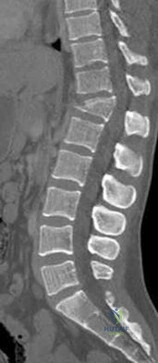
A 10-year-old restrained passenger in a high-speed MVC sustains a flexion-distraction injury (Chance fracture) of the L2 vertebra.
This specific spinal fracture pattern in pediatric patients has a high concomitant association with which of the following injuries?
Explanation
Question 37
While most scapular fractures are treated non-operatively, surgical fixation of a scapular neck fracture is typically indicated when the glenopolar angle (GPA) falls below which of the following thresholds?
Explanation
Question 38
Intravenous Vancomycin is frequently used as prophylaxis or treatment in orthopedic surgery for MRSA infections. What is the specific cellular mechanism of action of this antibiotic?
Explanation
Question 39
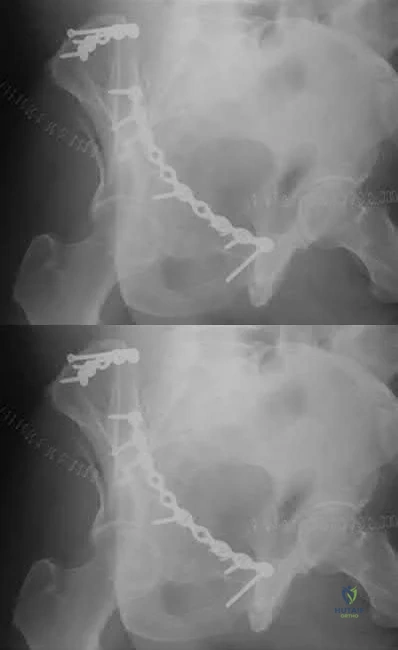
A 25-year-old male is brought to the trauma bay hemodynamically unstable following a motorcycle collision. Pelvic radiograph reveals an APC-III pelvic ring injury.
Despite application of a pelvic binder and initial fluid resuscitation, he remains hypotensive. What is the most common anatomical source of hemorrhage in this specific injury pattern?
Explanation
Question 40
A 45-year-old male is brought to the ED after a motorcycle crash. He is hypotensive with a mechanically unstable pelvis (APC type III). A pelvic binder is applied. Where is the optimal anatomical position for the pelvic binder to maximize reduction and minimize complications?
Explanation
Question 41
A 12-year-old obese male presents with left knee pain and an antalgic gait. Radiographs confirm a mild, stable slipped capital femoral epiphysis (SCFE) on the left. Which of the following is an absolute indication for prophylactic pinning of the contralateral asymptomatic hip?
Explanation
Question 42
A 22-year-old collegiate soccer player undergoes primary ACL reconstruction using a bone-patellar tendon-bone (BTB) autograft. Six months postoperatively, she complains of anterior knee pain and a palpable click when extending the knee from 30 degrees to full extension. What is the most likely etiology?
Explanation
Question 43
A 68-year-old female presents with progressive clumsiness in her hands and a broad-based gait. MRI shows multilevel cervical spondylotic myelopathy from C3 to C6 with preservation of cervical lordosis. There is no significant anterior compression. What is the most appropriate surgical approach?
Explanation
Question 44
A 72-year-old male is 1 year status post a posterior-stabilized total knee arthroplasty. He complains of a painful catching sensation at the anterior knee when extending from a flexed position. Radiographs show well-fixed components with appropriate sizing. What is the most appropriate management?
Explanation
Question 45
A 45-year-old manual laborer presents with chronic radial-sided wrist pain. Radiographs reveal a scaphoid nonunion with radioscaphoid arthritis and capitolunate arthritis, but the radiolunate joint is preserved. This corresponds to a Stage III SNAC wrist. What is the most appropriate surgical intervention?
Explanation
Question 46
A 38-year-old male sustains a high-energy Schatzker VI tibial plateau fracture. The limb is grossly swollen, and ABI is 0.8. A CT angiogram reveals an intimal tear of the popliteal artery without complete occlusion, but distal pulses are diminished. What is the correct sequence of management?
Explanation
Question 47
A 14-year-old male presents with a painful mid-shaft femur mass. Radiographs show a permeative, diaphyseal lytic lesion with an "onion-skin" periosteal reaction. Core biopsy reveals small round blue cells. Cytogenetics demonstrate a t(11;22) translocation. What is the fusion protein generated by this translocation?
Explanation
Question 48
A 6-year-old female falls from monkey bars and sustains a Gartland type III extension-type supracondylar humerus fracture. On examination, the hand is pink and well-perfused, but the radial pulse is absent. What is the next best step in management?
Explanation
Question 49
A 28-year-old male sustains an acute, primarily ligamentous Lisfranc injury involving the first, second, and third tarsometatarsal joints after a severe twisting injury to the foot. Prospective randomized studies suggest which of the following treatments provides the best functional outcomes for this specific injury pattern?
Explanation
Question 50
Recombinant human bone morphogenetic proteins (rhBMPs) are commonly used to enhance bone healing. Which specific intracellular signaling molecules are directly phosphorylated by the BMP receptor complex to translocate to the nucleus and activate osteogenic gene transcription?
Explanation
Question 51
A 60-year-old female experiences recurrent posterior dislocations following a primary total hip arthroplasty via a posterior approach. Intraoperative evaluation during revision surgery reveals that the acetabular component is placed in 30 degrees of inclination and 0 degrees of anteversion. What is the optimal target for acetabular component positioning to minimize dislocation risk?
Explanation
Question 52
A 19-year-old competitive swimmer presents with bilateral shoulder pain and a sensation of "slipping" in all directions. Examination reveals a positive sulcus sign bilaterally that does not decrease with external rotation. What is the first-line treatment?
Explanation
Question 53
A 30-year-old carpenter suffers a laceration to the volar aspect of his index finger at the level of the proximal phalanx (Zone II). He undergoes surgical repair with a 4-strand core suture and an epitendinous repair. What is the most critical biomechanical benefit of adding a peripheral epitendinous suture?
Explanation
Question 54
A 72-year-old male presents with bilateral lower extremity pain and cramping that worsens with walking and improves with sitting. To differentiate neurogenic claudication from vascular claudication, a bicycle test is performed. Which of the following findings is characteristic of neurogenic claudication?
Explanation
Question 55
A 13-year-old obese male presents with a 3-week history of left knee pain and an antalgic gait. Exam shows obligatory external rotation of the left hip upon flexion. Radiographs confirm a severe left slipped capital femoral epiphysis (SCFE). Which of the following parameters is the strongest indication for prophylactic pinning of the asymptomatic contralateral hip?
Explanation
Question 56
A 42-year-old male is brought to the trauma bay after a motorcycle collision. He is hemodynamically unstable with a heart rate of 120 bpm and BP of 80/50 mmHg. Pelvic radiograph reveals an APC-III pelvic ring injury. A pelvic binder is applied. To maximize reduction of the symphysis pubis and control hemorrhage, at what anatomic level should the pelvic binder be centered?
Explanation
Question 57
A 45-year-old manual laborer presents with chronic wrist pain. Radiographs reveal a scaphoid nonunion advanced collapse (SNAC) pattern with radioscaphoid and midcarpal arthritis, but preservation of the radiolunate articulation. Which of the following is the most appropriate surgical intervention?
Explanation
Question 58
A 68-year-old female presents with a feeling of her knee "giving way" 2 years after a primary posterior-stabilized total knee arthroplasty. On examination, the knee is stable in extension but opens 12 mm to varus and valgus stress when flexed to 90 degrees. What is the most likely cause of this isolated flexion instability?
Explanation
Question 59
A 55-year-old male of Asian descent presents with progressive clumsiness in his hands and a broad-based gait. Imaging shows multi-level ossification of the posterior longitudinal ligament (OPLL) from C3 to C6 causing severe cord compression. His cervical alignment demonstrates 15 degrees of kyphosis. What is the most appropriate surgical approach?
Explanation
Question 60
A 9-year-old male sustains a mid-substance ACL tear. He is Tanner Stage 1 with wide-open physes. Conservative management fails, and he experiences recurrent instability. Which surgical technique minimizes the risk of growth arrest and angular deformity?
Explanation
Question 61
A 15-year-old female undergoes neoadjuvant chemotherapy followed by wide resection of a distal femur osteosarcoma. Histologic evaluation of the resected tumor specimen is performed to assess the extent of necrosis. According to the Huvos grading system, what percentage of tumor necrosis is the threshold for a "good" response to chemotherapy, correlating with improved survival?
Explanation
Question 62
A 54-year-old male with poorly controlled diabetes presents with a swollen, erythematous, and warm right foot. He denies fever or open wounds. Radiographs show periarticular fragmentation, subluxation of the tarsometatarsal joints, and debris. According to the Eichenholtz classification, what stage does this represent, and what is the standard initial treatment?
Explanation
Question 63
A 6-week-old female infant born breech undergoes a screening hip ultrasound. The Graf classification reveals an alpha angle of 45 degrees and a beta angle of 80 degrees. What does this indicate, and what is the most appropriate management?
Explanation
Question 64
In total joint arthroplasty, highly cross-linked ultra-high-molecular-weight polyethylene (UHMWPE) is subjected to irradiation to improve wear resistance. However, irradiation creates free radicals that can cause oxidative degradation. Which post-irradiation thermal treatment completely eliminates free radicals but significantly reduces the mechanical properties (e.g., yield strength) of the polyethylene?
Explanation
None
