Orthopedic On Review | Dr Hutaif General Orthopedics Re -...
14 Apr 2026
108 min read
101 Views

Key Takeaway
This interactive board review contains 100 randomly selected orthopedic surgery questions with clinical images, immediate feedback, and detailed references.
Orthopedic On Review | Dr Hutaif General Orth...
00:00
Start Quiz
Question 1High Yield
Figures 1 through 4 are the MRI scans of a 24-year-old former collegiate basketball player who injured his left knee while playing recreational basketball 10 days prior to presentation. He landed from a jump awkwardly and reported that his knee gave out. He heard a pop at the time of injury and was unable to continue playing. He complains of medial and lateral knee pain and difficulty with weight bearing. On physical examination, he has a moderate effusion and his range of motion is from 10° to 80°. Ligament examination reveals a 2B Lachman, negative posterior drawer as well as negative varus and valgus stress testing. What is the diagnosis?
Explanation
58
The MRI scans reveal an acute ACL rupture with pivot shift contusions in the lateral tibiofemoral compartment and a bucket handle tear of the medial meniscus. Additionally, there is likely a radial tear of the lateral meniscus at the anterior horn/body junction (Figure 4). Figure 1 shows a bucket handle tear of the medial meniscus with the posterior horn displaced anteriorly. Figure 3 shows a double posterior cruciate ligament sign. Figure 2 shows the ACL tear and Figure 4 shows the pivot shift contusions. There is no evidence of PCL injury on examination or imaging.
Question 2High Yield
Based on this patient's history and examination, what is the best next step?
Explanation
- Obtain blood cultures
Question 3High Yield
Flexion and extension of the elbow occur about an axis of rotation that
Explanation
The elbow mimics a true hinge and flexes and extends around an axis that is centered in the centers of the trochlea and capitellum. The medial epicondyle is not perfectly isometrically placed; rather the axis of rotation passes through a point on the anteroinferior aspect of the medial epicondyle. Application of a hinged external fixator is possible because of the fact that there is a single axis of rotation.
REFERENCES: Morrey BF (ed): The Elbow and Its Disorders, ed 2. Philadelphia, PA, WB Saunders, 1993, pp 53-54.
London JT: Kinematics of the elbow. J Bone Joint Surg Am 1981;63:529-535.
Morrey BF, Chao EY: Passive motion of the elbow joint. J Bone Joint Surg Am 1976;58:501-508.
REFERENCES: Morrey BF (ed): The Elbow and Its Disorders, ed 2. Philadelphia, PA, WB Saunders, 1993, pp 53-54.
London JT: Kinematics of the elbow. J Bone Joint Surg Am 1981;63:529-535.
Morrey BF, Chao EY: Passive motion of the elbow joint. J Bone Joint Surg Am 1976;58:501-508.
Question 4High Yield
Figures 1 and 2 are the MRIs obtained from a 58-year-old woman who has symptoms of neurogenic claudication. You elect to treat the patient with a lateral lumbar interbody fusion with posterior pedicle screw instrumentation but no direct neural decompression. When deciding on this treatment option, you consider that
Explanation
■
In degenerative spondylolisthesis, indirect decompression of the spinal canal has been shown to be an effective treatment option. Malham and associates conducted a prospective study of 122 patients and reported an unplanned return to the operating room in 11 patients (9%). When reviewing these cases retrospectively, the authors felt that failure of indirect decompression should have been anticipated based on radiographic findings in 10 of these 11 patients who had high-grade, unstable spondylolisthesis or substantial bony lateral recess stenosis. Sato and associates reported an increase in the spinal canal area of 20%, whereas Castellvi and associates reported only a 9% increase. Park and associates reported that positioning the cage within the anterior one-third of disk space is better for achieving the restoration of the segmental angle without compromising the indirect neural decompression, if the cage was high enough.
Question 5High Yield
A 12-year-old boy has had left thigh pain for the past 4 months. Examination shows lack of internal rotation and abduction, and external rotation with hip flexion. A radiograph is shown in Figure 87. What is the most appropriate treatment?
Explanation
DISCUSSION: The patient has a stable slipped capital femoral epiphysis (SCFE). Preferred treatment of
stable SCFE is in situ pinning. In situ fixation of stable SCFE has an extremely low rate of osteonecrosis. Gentle postural reduction with hip capsulotomy or surgical dislocation of the hip with reduction has been
aPdvRoEcFaEteRdRfEoDr uRnsEtaSbPlOe NSSCEF: E2.
REFERENCES: Aronson DD, Peterson DA, Miller DV: Slipped capital femoral epiphysis: The case for
2010 Pediatric Orthopaedic Examination
ook • 73
internal fixation in situ. Clin Orthop Relat Res 1992;281:115-122.
Loder RT, Richards BS, Shapiro PS, et al: Acute slipped capital femoral epiphysis: The importance of physeal stability. J Bone Joint Surg Am 1993;75:1134-1140.
Figure 88a Figure 88b
stable SCFE is in situ pinning. In situ fixation of stable SCFE has an extremely low rate of osteonecrosis. Gentle postural reduction with hip capsulotomy or surgical dislocation of the hip with reduction has been
aPdvRoEcFaEteRdRfEoDr uRnsEtaSbPlOe NSSCEF: E2.
REFERENCES: Aronson DD, Peterson DA, Miller DV: Slipped capital femoral epiphysis: The case for
2010 Pediatric Orthopaedic Examination
ook • 73
internal fixation in situ. Clin Orthop Relat Res 1992;281:115-122.
Loder RT, Richards BS, Shapiro PS, et al: Acute slipped capital femoral epiphysis: The importance of physeal stability. J Bone Joint Surg Am 1993;75:1134-1140.
Figure 88a Figure 88b
Question 6High Yield
Figure 87 is the clinical photograph of a woman who plans to have carpal tunnel release surgery on her right upper extremity. The literature indicates that elevated risk for late-onset lymphedema after elective hand surgery is associated with

Explanation
A 2015 study by Baltzer and associates assessed risk for developing late-onset upper extremity lymphedema after elective hand surgery among women previously treated for same-sided breast cancer who did not have presurgical lymphedema. The study concluded that lymphedema is uncommon and self-limited following elective hand surgery among breast cancer survivors. This study also showed that use of a tourniquet appears to be safe for elective hand surgery for this population. Also, a combination of radiation therapy and axillary node surgery and a shorter
interval between hand surgery and breast cancer treatment appears to put these women at higher risk for late-onset lymphedema after elective hand surgery.
RECOMMENDED READINGS
83. [Baltzer,HL, et al. Late Onset Upper Extremity Lymphedema Following Elective Hand Surgery in Breast Cancer Survivors. J Hand Surg Am. 2015 Sep: (40):9.Supplement,pg e4. DOI: ](http://dx.doi.org/10.1016/j.jhsa.2015.06.014)http://dx.doi.org/10.1016/j.jhsa.2015.06.014 (accessed on 06/06/2016).
84. Habbu R, Adams JE. Role of elective hand surgery and tourniquet use in patients with prior breast cancer treatment. J Hand Surg Am. 2011 Sep;36(9):1537-9; quiz 1540. doi: 10.1016/j.jhsa.2011.06.020. Epub 2011 Aug 6. Review. PubMed PMID: 21820817.
interval between hand surgery and breast cancer treatment appears to put these women at higher risk for late-onset lymphedema after elective hand surgery.
RECOMMENDED READINGS
83. [Baltzer,HL, et al. Late Onset Upper Extremity Lymphedema Following Elective Hand Surgery in Breast Cancer Survivors. J Hand Surg Am. 2015 Sep: (40):9.Supplement,pg e4. DOI: ](http://dx.doi.org/10.1016/j.jhsa.2015.06.014)http://dx.doi.org/10.1016/j.jhsa.2015.06.014 (accessed on 06/06/2016).
84. Habbu R, Adams JE. Role of elective hand surgery and tourniquet use in patients with prior breast cancer treatment. J Hand Surg Am. 2011 Sep;36(9):1537-9; quiz 1540. doi: 10.1016/j.jhsa.2011.06.020. Epub 2011 Aug 6. Review. PubMed PMID: 21820817.
Question 7High Yield
A 60-year-old man with previous right knee injury now has progressive pain over the last 2 years, despite physical therapy, low impact exercise and steroid injection. Figures 1 and 2 show his current radiographs. What is the best next step?
Explanation
Traditionally, patients with tibiofemoral arthritis and previous patellectomy have been treated with posterior-stabilized knee arthroplasties. There have been some reports suggesting that cruciate-retaining knee arthroplasties may have similar results. This patient has advanced tibiofemoral arthritis, and the only reasonable option listed is posterior stabilized knee arthroplasty. Constrained knee replacement offers no advantage in the absence of varus/valgus instability. The patient does not have knee instability and would not require a hinged prosthesis.
50
50
Question 8High Yield
A 25-year old right-hand dominant professional baseball pitcher complains of posteromedial right elbow pain that is worsened by throwing. He also reports occasional paresthesias in his small and ring finger after lengthy bullpen sessions. On examination, he is tender along the medial olecranon and complains of pain when extending the elbow >/- 20° of extension. He has negative valgus stress, moving valgus stress, and milking maneuver tests. He is stable to varus stress, chair rise, and lateral pivot shift tests. Radiographs reveal a small osteophyte along the posteromedial border of the olecranon. What is the most likely diagnosis?
Explanation
The patient has valgus extension overload. This is a spectrum of pathologies, often seen in pitchers, that begins with posteromedial impingement between the medial olecranon and posterior trochlea during forceful elbow extension. As a result, a medial olecranon osteophyte is typically the first notable imaging finding. As pathology increases, there can be progressive damage to the medial collateral ligament (MCL), degeneration of the radiocapitellar articulation, and neuritis of the ulnar nerve. VPMRI is often associated with a large anteromedial coronoid fracture and posterior band MCL rupture. VPLRI occurs when the lateral collateral ligament complex is ruptured. Olecranon bursitis presents with focal swelling or a fluid collection over the posterior aspect of the olecranon.
Question 9High Yield
..Figure 59 is the MRI scan of a 30-year-old fire fighter who dislocated his left shoulder during work activities. His shoulder was reduced in the emergency department. After 8 weeks of physical therapy, he continues to have apprehension when lifting and pushing the fire hose back into the truck. He has normal rotator cuff strength and a negative sulcus sign. What treatment option will allow this patient to return to work as soon as possible?
Explanation
- Posterior labral repair
CLINICAL SITUATION FOR QUESTIONS 60 AND 61
A 10-year-old left-hand-dominant baseball pitcher has had left elbow pain for 6 weeks. His pain primarily is located medially, and he states that it is worst during the late cocking/early acceleration phase of his pitch. Recently he noticed that he is not able to throw as fast as usual. He decreased his pitch count by half during the last 2 weeks without significant improvement in his symptoms. When he is not pitching, he does not have significant pain. Radiographs show widening of the medial epicondyle physis.
CLINICAL SITUATION FOR QUESTIONS 60 AND 61
A 10-year-old left-hand-dominant baseball pitcher has had left elbow pain for 6 weeks. His pain primarily is located medially, and he states that it is worst during the late cocking/early acceleration phase of his pitch. Recently he noticed that he is not able to throw as fast as usual. He decreased his pitch count by half during the last 2 weeks without significant improvement in his symptoms. When he is not pitching, he does not have significant pain. Radiographs show widening of the medial epicondyle physis.
Question 10High Yield
Long strut allografts are not indicated in the initial treatment of reverse obliquity subtrochanteric fractures.
5-Addition of a de-rotation screw would not change the stability of the fixation construct.
A 34-year-old female sustains a proximal third tibia fracture as an isolated injury and elects to undergo operative treatment with intramedullary nailing. Which of the following operative techniques would help to best avoid a procurvatum deformity of the tibia?
5-Addition of a de-rotation screw would not change the stability of the fixation construct.
A 34-year-old female sustains a proximal third tibia fracture as an isolated injury and elects to undergo operative treatment with intramedullary nailing. Which of the following operative techniques would help to best avoid a procurvatum deformity of the tibia?


Explanation
The semiextended position for intramedullay nailing of proximal tibia shaft fractures has shown to cause less complications of flexion deformity and malunion. Proximal third tibia fractures are often times difficult to reduce anatomically due to the tendency for both valgus and flexion deformity at the fracture site. The semiextended position helps to eliminate the tendency for
the fracture to flex, due to the avoidance of excessive knee flexion during the reduction. Illustration A is an example of semiextended positioning for tibial nailing. Illustration B shows radiograph utilizing posterior blocking screws to prevent procurvatum deformity.
Tornetta et al looked at the semiextended intramedullary nailing of proximal tibia fractures. Of the 24 patients nailed using this technique, 19 had no anterior angulation, while only 5 had less than 5 degrees of flexion deformity.
In their study, Kubiak et al also advocate the semiextended position for tibial nailing. They note better control of fracture alignment and stabilization especially in the sagittal plane, and better ability to obtain imaging and maintenance of reduction during nail insertion and locking.
Incorrect answers:
would help to avoid valgus deformity. Answer 3 would worsen the flexion deformity.
Answer 4 would worsen the flexion deformity and drive the nail posterior in distal segment.
Answer 5 would not affect flexion deformity.
Which of the following cannulated screw configurations used in the treatment of subcapital femoral neck fractures is optimal?
1) Inverted triangle pattern with the inferior screw posterior to midline and adjacent to the calcar
2) Inverted triangle pattern with the inferior screw anterior to midline and adjacent to the calcar
3) Triangle pattern with the superior screw posterior to midline and adjacent to the calcar
4) Inverted triangle pattern with the inferior screw posterior to midline and central in the femoral neck
5) Inverted triangle pattern with the inferior screw anterior to midline and central in the femoral neck
The strongest portion of the femoral neck is the posterior inferior neck in the region of the femoral calcar. The optimal biomechanical configuration includes an inverted triangle pattern with the single screw in the inferior aspect of the femoral neck adjacent to the calcar.
Booth et al performed a cadaveric study comparing central versus calcar (cortical-adjacent) fixation. The results demonstrated significant improved stability, load, stiffness, and displacement in all tested parameters for the group with calcar-adjacent screw fixation.
Lindequist and Törnkvist performed a Level 4 study of 72 femoral neck fractures. They found that all 5 of their nonunions had screws placed greater than 3mm from the femoral calcar. Additionally, 16 of 18 fractures healed in the group of displaced fractures where both the fixating screws were placed within 3 mm from the femoral neck cortex.
Gurusamy et al performed a Level 4 study of 395 patients undergoing femoral neck fixation. They found a reduced spread of the screws on the lateral view was associated with an increased risk of nonunion of the fracture.
Illustration A depicts the optimal configuration of an inverted triangle with the single screw being inferior and all of the screws being cortical adjacent.
A 63-year-old female sustained a distal radius and associated ulnar styloid fracture 3 months ago after being involved in a motor vehicle collision. Radiographs obtained at the time of injury are shown in Figure A. She underwent open reduction and fixation of the distal radius fracture, and current radiographs are shown in Figure B. At the time of the index operation, there was no distal radioulnar joint instability after plating of the radius. Which of the following is true post-operatively regarding this patient's ulnar styloid fracture?
1) Worse outcomes on the Mayo wrist score are expected without fixation
2) Chronic distal radioulnar joint instability can be expected to occur without fixation
3) Wrist function depends on the level of ulnar styloid fracture and initial displacement
4) Grip strength and wrist range of motion are improved with fixation
5) There is no adverse effect on wrist function or stability without fixation
An accompanying ulnar styloid fracture in patients with stable fixation of a distal radial fracture has no apparent adverse effect on wrist function or stability of the distal radioulnar joint.
Kim et al evaluated 138 patients who underwent surgical treatment of an unstable distal radial fracture, without fixation of an associated ulnar styloid fracture if present. Postoperative evaluation included measurement of grip strength and wrist range of motion; calculation of the modified Mayo wrist score; as well as testing for instability of the distal radioulnar joint at a mean of 19 postoperatively. They did not find a significant relationship between wrist functional outcomes and ulnar styloid fracture level or the amount of displacement.
af Ekenstam et al performed prospective and randomized study of two different treatments of extraarticular Colles' fracture with a fractured ulnar styloid. In one group, the ulnar styloid was left alone, and in the other group it was transfixed and/or the triangular ligament was repaired after closed reduction of the fractured radius. They concluded that repair of the ulnar styloid complex in extraarticular fractures of the distal radius is not better than conventional treatment.
Each of the following are guidelines for management of a domestic violence victim EXCEPT:
1) Socioeconomic status should not preclude evaluation for domestic violence
2) Interview the patient outside the presence of other non-medical personnel
3) Federal law mandates photographs be taken of injuries
4) Document your opinion if the patient’s injuries are not consistent with the offered explanation
5) Physicians should check requirements to see if there is mandatory reporting statute in their state
It is important to fully document the abuse as it has been described to you, however there is no federal law mandating photographic documentation of domestic violence injuries. Photographs may be taken but only with the patient's permission. Disclosure of a diagnosis of abuse to any third party and reporting it to the authorities should be done only with the abused patient’s knowledge and consent, unless there is a mandatory reporting statue in the particular state of practice. Being a female, age 19-29, pregnant, or of a low
socioeconomic status (
An otherwise healthy 34-year-old female undergoes an elective L5-S1 microdiscectomy. At her 4 week followup, she is noted to have drainage from her wound. Labs reveal a CRP of 30 mg/L (normal
1) CRP 20 mg/L, ESR 40 mm/hr
2) CRP 15 mg/L, ESR 20 mm/hr
3) CRP 6 mg/L, ESR 10 mm/hr
4) CRP 1 mg/L, ESR 25 mm/hr
5) CRP 8 mg/L, ESR 5 mm/hr
A normalized C-reactive protein (CRP) value (60 years, smoking, diabetes, previous surgical infection, increased body mass index, and alcohol abuse were all statistically significant preoperative risk factors for developing a post-op wound infection.. The most likely procedure to be complicated by an infection was a combined anterior/posterior spinal fusion performed in a staged manner under separate anesthesia. Infections were primarily monomicrobial and the most common organism cultured from the wounds was Staphylococcus aureus.
Illustration A shows the CRP trends in the study by Khan et al. with postoperative wound infections after spinal surgery treated with IV antibiotics. ER refers to early responder while LR refers to late responder. At the 4-week time point, 16 patients have shown clinical improvement with no fevers, wound drainage, erythema, or need for wound packing. The other 5 patients, referred to as late responders, have shown one or more clinical signs of infection in addition to having an elevated CRP. At 20 weeks, both early and late responders both have shown normalized CRP levels and no clinical evidence of infection. Illustration B shows the ESR trends in the those which demonstrated incomplete normalization of ESR values despite resolution of infection.
Incorrect Answers:
Answer 1, 2, 3, 5: CRP levels > 3 mg/L are elevated and indicate incomplete response to infection
A 25-year-old man is struck by car while crossing the street. His injuries include the closed left tibial shaft fracture shown in Figure A. He is a smoker, but is otherwise healthy. Intramedullary nailing is performed without initial complications. Which of the following puts this patient at greatest risk for tibial nonunion?
1) Use of anti-inflammatories post-operatively
2) Post-operative gapping at the fracture site
3) Presence of an associated fibular fracture
4) History of smoking
5) Mechanism of injury
Post-operative gapping at the fracture site significantly increased the risk of reoperation due to nonunion or malunion.
Bhandari et al performed a retrospective study to identify which prognostic factors were associated with an increased risk of reoperation for nonunion in surgically treated tibial shaft fractures. They examined over 200 fractures, and found the presence of an open fracture wound (RR 4.32), lack of cortical continuity between the fracture ends following fixation (RR 8.33), and the presence of a transverse fracture (RR 20.0) were the three variables most predicitive of reoperation.
Audige et al analyzed 416 patients with operatively treated tibial shaft fractures who were followed for at least 6 months. They found that the greatest risk for delayed healing or nonunion was the presence of an open injury, fractures of the distal 1/3 of the tibia, and postoperative gapping at the
fracture site (The risk of healing problems was doubled for fractures of the distal shaft and for fractures showing a postoperative diastasis).
Figure A is a radiograph of a healthy, independent 51-year-old male. He is treated with immediate open reduction internal fixation to prevent which of the following complications?
1) Fracture non-union
2) Avascular necrosis
3) Skin necrosis
4) Plantar flexion weakness
5) Ankle stiffness
Figure A shows an avulsion fracture of the calcaneal tuberosity. Immediate open reduction and internal fixation is required to prevent wound complications.
Displaced avulsion fractures of the calcaneal tuberosity should be managed urgently to prevent necrosis of the soft tissues overlying the heel. In these injuries, the Achilles tendon is securely attached to the fractured tuberosity. Urgent closed reduction and casting is usually not possible due to the power and proximal pull of the triceps surae. Surgical fixation is required. The best treatment modality is open reduction and bone-to-bone fixation with screws. Closed reduction and percutaneous pinning fixation is not strong enough to provide a stable fixation of the tuberosity.
Lui reported on avulsion fractures of the bony insertion of the Achilles tendon at the calcaneus. He stated that screw fixation alone is not sufficient for repair of these injuries. His technique involved two suture anchors used capture the small bone fragment to the calcaneus. This allowed for the pull of the triceps surae to be neutralized and early physical therapy.
Hess et al. looked at a case series of calcaneal tuberosity avulsion fractures that were treated in a delayed fashion. All three patients with posterior tuberosity calcaneal avulsion fractures developed skin necrosis because of a delay in treatment.
Figure A shows a displaced posterior tuberosity calcaneal avulsion fracture. Illustration A shows skin breakdown overlying the posterior tuberosity calcaneal avulsion fracture.
Incorrect Answers:
Answer 1: The amount of displacement is an indication for fixation, however urgent treatment does not improve union rates with these fractures.
Answer 2: Tuberosity calcaneal avulsion fractures rarely disrupt the blood supply to the avulsion fragment and are not associated with avascular necrosis.
Answer 3: Plantar flexion weakness is a known complication of these injuries despite many treatment options.
Answer 4: Ankle stiffness is most commonly related to surgical fixation methods and post-operative immobilization and delayed rehabilitation.
A 22-year-old male presents 4 weeks following open reduction and internal fixation of his unstable ankle fracture. He has had three days of increasing pain, swelling and the new onset of purulent drainage from the mid-portion of the lateral incision. Laboratory values, including white blood cell count, sedimentation rate, and C-reactive protein are elevated. Current radiographs are seen in Figures A and B. On examination the wound probes deep and likely involves the lateral plate. What is the best step in management at this time?
1) Suppression with broad spectrum oral antibiotics until fracture healing
2) Suppression with broad spectrum intravenous antibiotics until fracture healing
3) Surgical debridement, removal of internal fixation, culture specific antibiotics, casting until fracture healing
4) Surgical debridement, maintenance of internal fixation, culture specific antibiotics until fracture healing
5) Wound culture in the office and suppression with culture specific antibiotics until fracture healing
The patient is presenting with an acute deep infection following open reduction and internal fixation of an unstable ankle fracture. Recent studies have shown that a protocol of early aggressive surgical debridement, maintenance of internal fixation and culture specific antibiotics can be effective at achieving fracture healing.
Management of early postoperative infection following open reduction and internal fixation can be challenging. Effective treatment typically involves a combination of surgical debridement and culture specific antibiotics. Removing internal fixation prior to fracture healing can lead to additional insult to the soft tissue and ongoing inflammation secondary to fracture instability. Recently published protocols have shown effective treatment with maintenance of implants and culture specific antibiotics following early, aggressive surgical debridement.
Berkes et al. performed a multi-center retrospective study of 121 patients with acute postoperative infection (defined as less than 6 weeks from surgery) following internal fracture fixation. The authors demonstrated a 71% rate of success (defined by maintenance of implants until fracture healing) with a protocol of debridement and suppression with culture specific antibiotics. Risk factors for failure of this technique include open fractures and the use of an intramedullary nail for fracture fixation.
Figures A and B show an ankle status post open reduction and internal fixation of a lateral malleolus fracture. There are no signs of loosening of fixation or cortical erosions concerning for osteomyelitis.
Illustrations A and B are weight bearing X-rays that demonstrate the same fracture, now healed, after debridement and culture specific antibiotics.
Illustrations C and D demonstrate the same fracture after elective removal of implants at 10 months following the index procedure. Intraoperative cultures at the time of hardware removal were negative for recurrent infection.
Incorrect answers:
Answers 1 and 2: Broad spectrum antibiotics without surgical debridement would not be effective in dealing with the infection in this clinical scenario with purulence tracking to the level of the plate
Answer 3: Surgical debridement and antibiotics would control the infection adequately, however removal of fracture fixation in an unstable fracture would lead to instability, soft tissue inflammation and likely malunion or nonunion that would require complex revision
Answer 5: Although culture specific antibiotics are an improvement over broad spectrum, again surgical debridement in conjunction with antibiotics is the most appropriate choice in this scenario. Intraoperative deep cultures in a sterile environment are preferred over cultures obtained in the office.
A 28-year-old male sustained an ankle injury 3 months ago, and was treated with closed management and splinting; a current x-ray is shown in Figure A. Which of the following is the most important factor in deciding between a joint sacrificing and a joint preserving operation for this patient at this time?
1) Workers' Compensation involvement
2) Gender
3) Date of injury
4) Degree of tibiotalar arthritis
5) Degree of deformity
This patient presents with malunion after sustaining a bimalleolar ankle fracture. Surgical treatment options consist of osteotomy for deformity correction with internal fixation (joint preserving) versus fusion (joint sacrificing) with the primary determinant being the amount of ankle arthritis present.
When treating ankle malunions, the decision to perform deformity correction and preserve the joint versus fusing the joint is dependent on signs of progressive, advanced tibiotalar arthritis on radiographs.
Yablon and Leach followed 26 patients following corrective fibular osteotomy following malunion and noted excellent results at a mean follow-up of 7 years. All but 3 returned to preinjury level of activity and had desired outcomes following deformity correction.
Reidsma et al. prospectively followed 57 patients with a minimum follow-up of 10 years following corrective osteotomy and fixation for ankle fracture malunions. Good to excellent results were obtained for 85% of the cohort. The authors concluded that those ankle fracture malunions with none to minimal arthritic changes should still receive corrective osteotomy to prevent further progression of arthritis.
Yablon et al. following 53 patients for 6-9 months, reported on the importance of anatomic restoration of the lateral malleolus when fixing bimalleolar ankle fractures. With anatomic reduction and fixation, no progression of arthritis was noted with return to function.
Figure A is an AP radiograph of a right ankle fracture malunion. Incorrect answers:
Answers 1-3, 5: Factors such as age, gender, and degree of deformity are not
as important as the presence of advanced arthritis that may suggest requiring a joint sacrificing fusion procedure. The date of injury may portend a poor outcome (the longer from the date of injury/subsequent malunion), but is not the most important factor in deciding between corrective osteotomy versus fusion.
A 45-year-old male presents after falling off of a ladder. Radiograph is shown in Figure A. Which of the following is the appropriate sequence in management?
1) Closed reduction, splint application, computed tomography (CT) scan, delayed open reduction and internal fixation
2) Closed reduction, cast application, close observation
3) Splint application, CT scan, application external fixator, delayed open reduction and internal fixation
4) Splint application, application external fixator, CT scan, delayed open reduction and internal fixation
5) Splint application, acute open reduction and internal fixation
This patient has sustained a pilon fracture, with severe comminution and impaction at the articular surface.
The correct sequence of management includes (1) immediate splinting, (2) application of an external fixator, (3) restoration of length alignment and rotation with temporizing external fixation, (4) computed tomography, followed by (5) definitive fixation once soft tissues are amenable.
Tornetta and Gorup analyzed the use of preoperative CT scans in comparison to radiographs in preparation for fixing pilon fractures. The authors noted increased recognition of intra-articular fragments, comminution and noted a high percentage of operative planning changes following CT analysis.
Furthermore, the authors recommended CT scans AFTER external fixation, for even better fragment characterization.
Marsh et al. in their instructional course lecture provide tips and tricks in successful management of pilon fractures. One of the highlighted points include staged, delayed treatment of pilon fractures via spanning external fixator as well as highlighting the importance of obtaining the CT after restoring length and alignment.
Figure A exhibits a radiograph of a comminuted, impacted, shortened pilon fracture.
Incorrect answers:
Answer 1: With such a short, impacted fracture, external fixation as a temporizing measure is recommended to help calm the soft tissue envelope. Answer 2: Closed treatment is not accepted in this type of fracture, due to the high incidence of arthritis and malunion.
Answer 3: CT scan should be obtained AFTER external fixation, not before. Answer 5: This high-energy injury likely has severe soft tissue injury, which is not amenable to acute fixation.
A 45-year-old male with long-standing diabetes sustains the injury shown in Figure A. He has a BMI of 38, established peripheral neuropathy, and his most recent HbA1c is 8.8. What is the most appropriate definitive management option of Figures B through F?
1) Figure B
2) Figure C
3) Figure D
4) Figure E
5) Figure F
Open reduction and internal fixation (ORIF) remains the mainstay of treatment for ankle fractures in patients with diabetes.
ORIF for ankle fractures in diabetics can be augmented with increased density of fixation to account for notable, pathologic bone. Specifically, multiple quadricortical syndesmotic screws, bicortical medial malleolar screws, and stiffer plates are all viable options. Furthermore, due to delayed healing properties, prolonged immobilization may also be required to avoid fixation failure.
Guo et al. performed a cohort controlled comparison between diabetics and non-diabetic patients with operative ankle fractures. Although they hypothesized that there would be more complications in the diabetic group, there was no statistical differences in fixation failure or complications when adhering to treatment principles for diabetics (including prolonged non-weight bearing for 10-12 weeks and increased density of fixation).
Chaudhary et al. review the notable complications following ankle fracture treatment in patients with diabetes. In reviewing the literature, the authors recommend ORIF with meticulous soft tissue handling, increased density of fixation, and prolonged immobilization as the mainstay of diabetic ankle fracture treatment. External fixation and frames, while treatment options, should be reserved for salvage or infectious clinical scenarios.
Figure A depicts a bimalleolar ankle fracture. Figure B depicts a cam walker.
Figure C depicts a cast. Figure D standard fixation for ankle fracture for a patient without diabetes. Figure E exhibits definitive fixation with additional screws to increase construct stability. Figure F depicts a ring fixator.
Incorrect Answers:
Answers 1,2: Non-operative treatment is not appropriate for this fracture pattern
Answer 3: Figure D, typically used for those without diabetes is less appropriate for this patient/clinical scenario.
Answer 5: While external fixation and a ring fixator may be utilized, ORIF should be attempted first, however, as it provides stiffer fixation.
Distraction bone block arthrodesis alone would most likely help a patient suffering from a painful calcaneus fracture malunion with all of the following except:
1) Low talar declination angle
2) Hindfoot varus alignment
3) Subtalar arthritis
4) Talonavicular subluxation
5) Peroneal impingement
Distraction bone block arthrodesis in isolation would be unlikely to improve pain related to peroneal impingement. Lateral wall exostectomy would likely be needed for this, and should be concomitantly performed in most cases.
Calcaneal fracture malunions demonstrate several common patterns. Patients may manifest pain from anterior tibiotalar impingement (a result of a low talar declination angle), difficulty with shoe wear due to shortening and widening of the hindfoot, painful talonavicular subluxation, subfibular impingement, and post-traumatic subtalar osteoarthritis. The distraction bone block arthrodesis procedure was developed to eliminate the pain of subtalar arthritis while simultaneously normalizing hindfoot height by inserting a contoured structural bone graft into the subtalar joint. The procedure can correct pathologic hindfoot varus/valgus and restore a normal talocalcaneal angle, thereby improving symptomatic post-traumatic pes planus. The procedure alone does not address lateral wall blowout causing subfibular or peroneal impingement, which requires lateral wall exostectomy. Lateral wall exostectomy therefore should be done in addition to address this issue.
Carr et al. first reported the use of subtalar distraction bone block arthrodesis for salvage of post-traumatic subtalar arthritis following calcaneus fractures. In their 16 patient series, distraction of the subtalar joint with insertion of the bone block allowed for correction of talocalcaneal angle, restoration of hindfoot height, and improvement in symptoms related to tibiotalar impingement.
Clare et al. evaluated a treatment protocol for calcaneal malunions based upon the classification of Stephens and Sanders. Type II and III malunions were treated with subtalar bone-block arthrodesis and other concomitant procedures. They found that their treatment protocol was effective for pain relief, re-establishing a plantigrade foot, and improving function. The most difficult component of the case was restoration of calcaneal height.
Braley et al. evaluated isolated lateral decompression in the treatment of symptomatic calcaneal malunions without concomitant subtalar arthrodesis. These 11 patients had persistent lateral sided pain and their malunions did demonstrate subtalar involvement. The authors reported 9 of the 11 patients had a satisfactory outcome with lateral decompression alone. They concluded that a lateral decompression in management of symptomatic malunions with lateral-sided symptoms is an essential consideration.
Incorrect Answers:
Answer 1: Talar declination angle describes the relative plantar- or dorsiflexion of the talus relative to the ground.
Answer 2: Hindfoot alignment can be improved with distraction arthrodesis. Answer 3: Arthrodesis addresses painful subtalar arthritis.
Answer 4: Restoration of the normal talocalcaneal angle can be achieved, which can also normalize the talonavicular relationship.
A 31-year-old patient has had activity related lateral ankle pain for 4 months. She underwent the procedure shown in Figure A approximately 8 months ago. What surgical technique has most likely resulted in this patients pain?
1) Failure to recognize the most distal screw penetrating the joint surface
2) Low posterior plating with prominent distal screw
3) Failure to recognize an associated syndesmosis disruption
4) Fracture malreduction causing shortening of the fibula
5) Failure to use a longer plate with the lag screw positioned outside the plate
Figure A shows a low posterior plate with a prominent screw head in the most distal hole of the plate. This fixation technique is correlated with peroneal pathology, which usually presents months after fixation when the patient increases their activity level.
The two most common fixation techniques of lateral malleolus fractures are (1) lag screw plus lateral neutralizing plating and (2) posterolateral antiglide plating. The disadvantages of the lateral plating includes the risk of intraarticular screws distally, prominent lateral hardware, and poor distal screw fixation. To overcome these complications, posterolateral antiglide plating allows for bicortical distal fixation with no articular perforation. However, low placement of the plate with a prominent screw head in the most distal hole is associated with symptomatic peroneal pathology. If the most distal screw is not prominent, or absent, this is less likely to cause peroneal complications.
Weber et al. examined the effect of antiglide plate and screw positioning on peroneal tendon pathology. They showed that low posterior plating and large screw heads caused significant retromalleolar pain in most patients. To decrease peroneal pathology, they state that the distal end of the plate should stay proximal to the osteosynovial peroneal groove. Radiologically this level
corresponds to the junction of the proximal and middle thirds of the lateral malleolus.
Figure A shows a posterior positioned 5 hole 1/3 tubular plate. There is no articular screw penetration and the fracture is healed in an anatomical position. The distal aspect of the plate is is the distal third of the lateral malleolus.
Incorrect Answers:
Answer 1: The most distal screws rarely penetrates the joint with the use of fibular antiglide plates. In addition, there is no evidence of screw penetration in this patient.
Answer 3: A missed syndesmosis disruption would usually show some radiographic findings. The tibiofibular clear space is usually most sensitive, which is measured radiographically by the distance from the lateral border of the posterior malleolus in the distal tibia to the medial border of the fibula. As a general rule, it is considered normal if the measurement is less than approximately 6 mm on both AP and mortise views.
Answer 4: The fracture reduction looks anatomic. The talocrural angle, 'dime' sign and “Shenton's line” of the ankle all normal.
Answer 5: The construct used to fix this isolated lateral trans-syndesmotic fracture is acceptable. The one-third tubular plate, which is placed posterolaterally on the fibula as an antiglide plate, indirectly reduces the fracture and acts as a buttress to resist the posterior and proximal displacement of the distal fragment. Insertion of a lag screw through the plate is a described technique.
A 35-year-old painter falls from a ladder sustaining an isolated fracture of his left calcaneus. Months later at follow-up, he is noted to have pain and a catching sensation in his medial foot with active flexion of the great toe. What is the most likely initial injury leading to this complication?
1) Displaced calcaneal beak fracture
2) Displaced fracture of the calcaneal tuberosity
3) Comminuted posterior facet fracture
4) Fracture of the sustentaculum tali
5) Lateral wall blowout fracture
A known complication of fractures of the sustentaculum tali is stenosis (delayed) or injury (acute) of the flexor hallucis longus (FHL) tendon. Stenosis
can cause pain and popping with great toe flexion.
Fractures of the calcaneus often occur after falls from height, and in addition, may be associated with vertebral fractures due to the high-impact mechanism. The FHL tendon runs directly underneath the sustentaculum tali on the medial calcaneus and can be injured causing frank tears or delayed stenosis. These fractures may be missed on ankle or foot plain films alone, and advanced imaging should be ordered if clinical suspicion for calcaneus fractures exists given mechanism and location of pain/swelling.
Komiya et al. present a case report of direct impalement of the FHL tendon in the tunnel under the sustentaculum tali. Though this particular complication is quite rare, such a report highlights the relevant anatomy and structures at risk as well as demonstrates the need for a good clinical exam as the injury was not noted on imaging but the concern was raised on physical exam of FHL involvement.
Della Rocca et al. report their 19-patient series on operatively managed isolated sustentaculum tali fractures. They report a high rate of associated ipsilateral foot injuries (14 patients) and describe fixation using a medial approach and retracting the flexor tendons and neurovascular bundle.
Illustration A is an axial CT image from Della Rocca (2009) et al. showing a representative sustentaculum tali fracture
Incorrect Answers:
Answer 1 - beak fractures are posterior, anatomically related to the Achilles tendon insertion, not the FHL tendon.
Answer 2 - FHL tendon is not associated with the tuberosity.
Answer 3 - FHL tendon runs anterior to the posterior facet and would unlikely be involved in that injury.
Answer 5 - FHL tendon runs medially, not laterally.
A 30-year-old male patient involved in a hang-gliding accident sustains a knee dislocation with multiligamentous knee injury and transection of his peroneal nerve. He undergoes multiple reconstructive surgeries. Two years later, he continues to have a foot drop and dynamic tendon transfer is recommended. This treatment most commonly involves transferring a tendon from which native insertion point to which new insertion point?
1) Plantar distal phalanges to medial navicular
2) Medial navicular to dorsal lateral cuneiform
3) Plantar 1st metatarsal to dorsal lateral cuneiform
4) 5th metatarsal base to dorsal medial cuneiform
5) Plantar distal phalanx of the hallux to dorsal distal phalanx of hallux
Dynamic tendon transfer to restore active dorsiflexion of the foot involves transferring the posterior tibial tendon (PTT) insertion on the medial navicular to the dorsal lateral cuneiform.
Common peroneal nerve (CPN) injuries following traumatic knee dislocation are common, with an incidence of 25-40%. CPN palsy is characterized by foot drop
due to loss of ankle dorsiflexors with a steppage gait and eventual development of a supinated equinovarus foot secondary to the unopposed pull of the PTT. Nonsurgical management involves use of an ankle-foot orthosis and physical therapy. Surgical options include acute primary repair, nerve grafting with either autologous sural nerve or nerve conduits and dynamic tendon transfer. The PTT is harvested from its insertion at the navicular, passed through the interosseous membrane (IOM) and anchored to the lateral cuneiform (see Illustration A). The classic bridle procedure involves concomitant anastamosis of the PTT to the tibialis anterior (TA) and peroneus longus (PL) tendons.
Garozzo et al reported a case series of 62 patients with post-traumatic CPN palsy who underwent a one-stage procedure consisting of nerve repair and PTT transfer. Nerve repair combined with PTT transfer improved postoperative outcomes compared to nerve repair alone. At 2-year follow up, neural regeneration was demonstrated in 90% of patients. The authors hypothesized that poor outcomes following nerve repair alone are due to force imbalance between the functioning flexors and paralyzed extensors, which is somewhat equalized by performing a PTT transfer at time of repair.
Niall et al reviewed 55 patients with traumatic knee dislocation and reported a 41% incidence of CPN injury, exclusively associated with dislocations involving disruption of the posterior cruciate ligament (PCL) and posterolateral corner (PLC). Complete neurologic recovery was found in only 21% of patients. The best prognosis was found with lesions in continuity, less than 7cm of nerve involvement, and short conduction block and muscle activity on nerve conduction and EMG studies.
Vigasio et al described a dynamic tendon transfer technique for traumatic complete CPN injury, involving transfer of the PTT to the TA rerouted to a new origin at the lateral cuneiform to restore ankle dorsiflexion and flexor digitorum longus (FDL) to the extensor digitorum longus (EDL) and extensor hallucis longus (EHL) to restore digit dorsiflexion. Rerouting the TA towards the transferred PTT ensures the PTT harvest length is sufficient. This avoids excessive tensioning of the PTT, which may limit tendon excursion and result in a static tenodesis rather than dynamic function, as well as the need for PTT lengthening which may decrease strength of the transfer
Illustration A is a series of intraoperative photographs demonstrating PTT transfer from Garg et al. An incision is made distal to the medial malleolus and the PTT is harvested subperiosteally (A). The PTT is delivered through a second incision ~15cm proximal to the medial malleolus (B-C). The PTT is then passed through the interosseous membrane and out a third incision over the anterior
fibula (D). Lastly, the PTT is passed through a fourth incision over the dorsal midfoot and anchored to the lateral cuneiform (E).
Incorrect Responses:
Answer 1: Transferring the FDL (insertion = plantar distal phalanges) to the medial navicular is used for correction of flexible flatfoot deformity arising from PTT insufficiency. Some surgeons transfer the FDL to the medial navicular at the time of PTT transfer to the dorsum of the foot, to compensate for loss of PTT function and minimize risk of flatfoot development.
Answers 3: Transferring the PL (insertion = plantar 1st metatarsal) is not recommended, as this muscle is innervated by the CPN via the superficial peroneal nerve and therefore would not be functional.
Answer 4: Transferring the peroneus brevis (PB; insertion = 5th metatarsal base) is not recommended, this muscle is innervated by the CPN via the superficial peroneal nerve and therefore would not be functional.
Answer 5: Transferring the flexor hallucis longus (FHL; insertion = plantar distal phalanx of the hallux) to the insertion of the EHL (dorsal distal phalanx of hallux) is recommended for correction of claw toe deformity and would not help restore foot dorsiflexion in this patient.
Which of the following represents the most common complication following operative treatment of the injury shown in Figure A?
1) Figure B
2) Figure C
3) Figure D
4) Figure E
5) Figure F
This patient has a displaced talar neck fracture. The most common complication is post-traumatic arthritis.
Complications after treatment of displaced talar neck fractures are common. Both tibiotalar and subtalar arthritis occur, with subtalar arthritis being the most common. Osteonecrosis is also common, but post-traumatic arthritis is the most common.
Lindvall et al. reviewed 26 displaced talar fractures treated with internal fixation and found that post-traumatic arthritis was the most common complication, occurring in 100% of patients. Osteonecrosis was found in 13 of 26 patients (50%).
Vallier et al. reviewed patients presenting with talar neck fractures and found post-traumatic arthritis in 21 of 39 patients (54%). Osteonecrosis was found in 19 of 39 patients (49%).
Figure A shows a displaced talar neck fracture. Figure B shows talar neck nonunion (arrow) and osteonecrosis of the talar body. Figure C is an AP of the same patient shown in Figure B and again shows osteonecrosis of the talar body. Figure D shows subtalar arthritis after internal fixation of a talar neck fracture via medial malleolar osteotomy. Figure E shows a clinical photo of a patient with a varus malunion after talar neck fracture. Figure F shows a wound dehiscence.
Incorrect answers:
Answers 1, 2, 4, 5. These are all known complications of surgical treatment of displaced talar neck fractures but occur less frequently than post-traumatic arthritis.
A 25-year-old woman began training for a marathon and she reports a 2-week history of heel pain. She has pain throughout the day that worsens with prolonged weight-bearing. On exam, the location of
maximal tenderness is indicated by the white arrow in Figure A. The patient denies point tenderness at the location of the yellow arrow in Figure A. Which of the following MRI images (Figures B to F) would you expect to find in this patient?
1) Figure B
2) Figure C
3) Figure D
4) Figure E
5) Figure F
The clinical presentation is consistent with a stress fracture of the calcaneus. The T1 MRI shows a fracture line within the calcaneus which is consistent with
a calcaneal stress fracture.
Calcaneal stress fractures most commonly occur in long-distance runners and military recruits. Usually, they are caused by overload and inability of bone formation to match resorption. Patients usually begin a rapid increase of activity level from a prior sedentary lifestyle. Patients complain of heel pain that persists throughout the day. The pain is located along the medial and lateral walls of the calcaneus. Diagnosis can be made with radiographs 2-3 weeks after symptom onset by the appearance of a sclerotic line. If the diagnosis is uncertain, MRI may be obtained.
Gehrmann et al. performed a review of stress fractures in the foot. They report that most studies of calcaneal stress fractures are from military recruits.
Primary treatment includes rest, avoidance of weight-bearing, and physical therapy. Patients usually return to full duty between 8 and 10 weeks. Recruits with inadequate treatment had a recurrence of symptoms. They conclude that most studies are from the 1940’s and 1950’s and lack any significant detail into specific treatment protocols.
Sormaala et al. performed a retrospective study in which they reviewed MRIs in all military recruits who had exercise-induced heel pain, over an eight-year period. They report that only 15% of injuries were visible on radiographs and a portion of patients had stress fractures of another tarsal bone. They conclude that a majority of calcaneal stress fractures occur in the posterior part of the bone, but some fractures may be found in the middle and anterior parts. They recommend obtaining an MRI if a radiograph is negative in a patient with exercise-induced foot or heel pain.
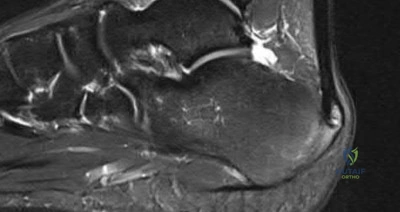
Figure A demonstrates the most common area of tenderness and pain of a calcaneal stress fracture, indicated by the white arrow, while the yellow arrow points to the area of tenderness consistent with plantar fasciitis. Figure B is a sagittal T2-weighted MRI demonstrating plantar fasciitis. Figure C is a sagittal T1-weighted MRI demonstrating a calcaneal stress fracture. Figure D is an axial T1-weighted MRI demonstrating a mass on the medial aspect of the calcaneus consistent with a ganglion cyst. Figure E is a sagittal T1-weighted MRI of the foot demonstrating an intraosseous lipoma within the calcaneus. Figure F is a sagittal T2-weighted MRI demonstrating insertional Achilles tendinopathy.
Illustration A demonstrates the most common etiologies of plantar foot pain.
Incorrect Answers:
Answer 1: Figure B, a sagittal T2-weighted MRI, demonstrates plantar fasciitis. Symptoms of plantar fasciitis are sharp heel pain, usually worse in the morning. Tenderness is usually found on the plantar aspect of the foot.
Answer 3: Figure D, an axial T1-weighted MRI, demonstrates a ganglion cyst in the tarsal tunnel. Symptoms of tarsal tunnel syndrome include sharp burning pains in the foot and parasthesias and numbness in the plantar foot.
Answer 4: Figure E, a sagittal T1-weighted MRI, demonstrates an intraosseous lipoma. Intraosseous lipomas are usually incidental findings.
Answer 5: Figure F, a sagittal T2-weighted MRI, demonstrates insertional Achilles tendinitis. This usually presents with pain over the insertion of the Achilles. It may have a relapsing and remitting course, which worsens with activity.
A 35-year-old male fell and sustained an open talar neck fracture. He underwent operative fixation of his fracture. He presents at 2 months after surgery. He denies any constitutional symptoms and his pain is well controlled. On exam, his wounds are well healed with no erythema. Imaging is shown in Figure A. What can the patient be told about his condition?
1) Hawkins sign is positive. The likelihood of developing osteonecrosis is high
2) Hawkins sign is positive. The likelihood of developing osteonecrosis is low
3) Hawkins sign is negative. The likelihood of developing osteonecrosis is high
4) Hawkins sign is negative. The likelihood of developing osteonecrosis is low
5) He has developed chondrolysis
This patient has a positive Hawkins sign, which signifies that he is unlikely to develop osteonecrosis.
A subchondral radiolucency of the talar dome after a talar neck fracture is known as the Hawkins sign. It is an indication that the talar body is viable. It usually appears by 6-8 weeks after injury and is best seen on the mortise view. If the Hawkins sign is present, it is unlikely that the patient will develop osteonecrosis.
Early writes a review on talus fracture management. He reports that talar neck fractures occur through the extra-articular portion of the talus and represent nearly half of talus fractures. The mechanism of injury is a combined ankle dorsiflexion followed by axial compression of the tibiotalar joint. He concludes that anatomic reduction gives the patient the best chance of a good outcome.
Leduc et al. wrote a review on posttraumatic avascular necrosis of the talus. They note that AVN is diagnosed on plain radiography by the absence of the Hawkins sign. They report that CT can also reveal characteristic talar AVN patterns and can be used to confirm radiographic findings. CT helps to assess subtle depression, collapse, fragmentation, and arthritic changes. MRI remains the most sensitive technique for detecting osteonecrosis of the talus, especially in the early stages. They conclude that although there are many published treatments of AVN of the talus, outcome studies are still lacking.
Tezval et al. performed a retrospective review to determine the prognostic reliability, sensitivity, and specificity of the Hawkins sign. They found that in all patients who developed osteonecrosis, none had the Hawkins sign present. In all patients that exhibited a Hawkins sign, none developed osteonecrosis. They determined the sensitivity of the Hawkins sign to be 100% while the specificity was 57.5%. They conclude that if a full or partial positive Hawkins sign is detected, it is unlikely that AVN will develop.
Figure A demonstrates the Hawkins sign with subchondral radiolucency which is noted by arrows in Illustration A.
Incorrect Answers:
Answers 1, 3, 4: The patient has a positive Hawkins sign, therefore the chance of developing osteonecrosis is low.
Answer 5: Chondrolysis is characterized by rapid destruction of articular cartilage on both sides of the joint which leads to loss of joint space
A 25-year-old male presents to the emergency department after a lawnmower accident with traumatic loss of his great toe. On examination, his wound is grossly contaminated with soil. In addition to a cephalosporin and an aminoglycoside, penicillin is given. Which of the following is true with regards to the organism that penicillin is targeting in this injury?
1) It is an Aerobic, Gram-positive rod
2) It is an Anaerobic, Gram-positive coccus
3) It is an Anaerobic, Gram-negative rod
4) It is Catalase positive
5) It may cause botulism
The organism being covered with penicillin is Clostridia spp. Clostridium botulinum is a Gram Positive Bacilli that is the cause of botulism.
Clostridia spp, is a Gram-positive, obligate anaerobic spore-forming rod that is found in soil and gut flora. It produces gas by the fermentation of glucose and
may cause gas gangrene. Common bacteria of this genus are C. perfringens (most common), C. tetani (causes tetanus), C. difficile, and C. botulinum (causes botulism). If wounds are grossly contaminated with soil, penicillin is given to cover against Clostridia.
Decoster et al. performed a review of traumatic foot wounds. They report that lawnmower injuries to the foot are relatively common. IV antibiotic therapy should be initiated with a broad-spectrum cephalosporin and an aminoglycoside to provide coverage against Gram-negative organisms.
Penicillin should be given to protect against Clostridial infection. They conclude that irrigation and debridement is indicated initially followed by packing of open wounds. Repeat debridements are necessary as nonviable tissue demarcates. If major reconstructive procedures are necessary, they should be delayed as they have a high rate of failure if performed too soon.
Cross et al. wrote a review on treatment principles in the management of open fractures and they note that in open fractures with soil contamination, additional coverage should be added for anaerobic bacteria, typically Clostridia. Another member of the genus Clostridia is C. tetani, the causative agent of tetanus. Vaccine status for tetanus must also be assessed in these situations as well.
Illustration A is a radiograph demonstrating soft tissue swelling and subcutaneous emphysema, consistent with gas gangrene. Illustration B is a clinical photograph of gas gangrene evidenced by edema, discoloration, ecchymosis, and hemorrhagic bullae. Illustration C is a pathology slide of C. perfringens, a Gram-positive rod.
Incorrect Answers:
Answers 1, 2, 3: Clostridia are Gram-positive, obligate anaerobes. Answer 4: Clostridia are catalase negative.
All of the following are ways that a negative pressure dressing is beneficial to wound healing EXCEPT:
1) Accelerated granulation tissue formation
2) Removes excess proteins and electrolytes from wound
3) Reducing anaerobic colonization
4) Causes cells to release vascular endothelial growth factor by mechanical force
5) Causes an increase in capillary afterload
Negative pressure dressings or vacuum-assisted wound closures (VAC) apply a negative pressure to the wound bed which allows a decrease in capillary afterload which produces a better inflow of blood.
VAC dressings exert their positive effects on wound healing in multiple ways. Firstly, they remove interstitial fluids, which have been found to contain inhibitory factors that suppress the formation of fibroblasts, vascular endothelial cells, and keratinocytes. This also eliminates the formation of any superficial purulence or slime which also reduces the potential for anaerobic colonization. Removal of excess fluid also pulls out excess proteins and electrolytes to help maintain and osmotic and oncotic gradient. VACs allow arterioles to dilate which produces a proliferation of granular tissue. Also, there is a decrease in capillary afterload, (the pressure against which the heart must overcome to eject blood), which promotes better inflow of blood. Lastly, applying a mechanical force to the surrounding soft tissues allows the edges of the wound to be drawn towards the center, uniformly. This decreases the size of the wound over time. The micromechanical forces exerted on individual cells causes a release in local growth factors, such as vascular endothelial growth factor (VEGF), which stimulate wound healing.
Herscovici et al. applied VAC dressings to 21 consecutive patients with open, high-energy soft tissue injuries. They found that wounds averaged 4.1 sponge changes and the device was used for an average of 19.3 days. 12 wounds avoided the need for further treatment. Only 9 patients required free tissue transfer. They concluded that the VAC is a viable treatment adjunct for the treatment of open, high-energy injuries.
Clare et al. reported their experience with the VAC dressing in the treatment of non-healing, diabetic and dysvascular wounds. They retrospectively reviewed 17 patients with non-healing wounds of the lower extremity. 9 had diabetes and 8 had severe peripheral vascular disease. The average length of treatment
was 8.2 weeks and 14/17 wounds successfully healed, and only 3 failed VAC treatment. They concluded that the VAC dressing is an acceptable option for wound care of the lower extremity.
Illustration A is a photo of an open wound being treated with a VAC dressing. Incorrect Answers:
Answers 1, 2, 3, and 4 are all ways that VAC dressings are beneficial to wound
healing.
Which of the following is true regarding anterior sternoclavicular joint dislocations?
1) Reduction may result in tracheal injury
2) They are usually stable following closed reduction
3) They require fusion to hold the reduction
4) They are rarely symptomatic when left unreduced
5) They should be treated acutely with medial clavicle excision
From the Bicos article, “Anterior SC joint instability should primarily be treated conservatively. The patients should be informed that there is a high risk of persistent instability with nonoperative or operative care, but that the persistent instability will be well tolerated and have little functional impact in the vast majority. Therefore, operative intervention for anterior SC joint instability is mainly cosmetic in nature."
An otherwise healthy 45-year-old female slips and falls with immediate right ankle pain. Stress examination of the right ankle is shown in Figure A. Which of the following is the most important for achieving a satisfactory outcome following open reduction internal fixation for this injury?
1) Weight-bearing before 3 weeks.
2) Medial clear space >5mm
3) Talocrural angle of 83 degrees
4) Tibiofibular clear space of >6mm
5) Talar tilt of >5 degrees
Anatomic reduction of a rotational ankle fracture is considered the most important factor in achieving a satisfactory outcome. A talocrural angle of 83 degrees suggests an anatomic reduction has been achieved.
Unstable rotational ankle fractures should be treated surgically in order to achieve anatomic reduction (if the fracture is not overly comminuted) as well as restore length, rotation, and alignment. Satisfactory outcomes can be best achieved when these surgical goals are achieved. Postoperative protocols
regarding immobilization and weight bearing may be somewhat variable depending on surgeon preference, fracture pattern, modifiable patient factors, and non-modifiable patient factors.
Lin et al. performed a systematic review of randomized studies looking at postoperative immobilization and rehabilitation following ankle fractures. They found that after surgical fixation, starting exercise in a removable brace improved pain, ankle range of motion, and improved activity limitations but led to a higher rate of adverse events. Early weight-bearing improved ankle range of motion as well. They concluded that there is limited evidence to support removable braces, early weight-bearing, and no immobilization following surgical fixation of ankle fractures.
Reidsma et al. retrospectively reviewed 57 malunited ankle fractures treated with revision osteotomy with a minimum of 10 years of follow-up. They found that 85% of patients had good or excellent outcomes and that prolonged time to reconstructive surgery led to a worse outcome. They concluded that reconstructive surgery should be performed early in the setting of a malunited ankle fracture even with early arthritic changes.
Figure A shows a displaced Weber B fibula fracture with medial joint space widening on stress examination. Illustration A shows intraoperative imaging following open reduction internal fixation of the same patient. Illustration B demonstrates the talocrural angle and medial clear space parameters in an anatomically reduced ankle.
Incorrect Answers:
Answer 1: Nonweightbearing for at least 6 weeks is common; however, some studies have shown improved outcomes in range of motion if weight-bearing is started early in the immobilization period.
Answer 2, 4, and 5: Postoperatively the parameters of the medial clear space
Which of the following arteries supplies the surgical flap in the extensile open treatment of the injury shown in Figure A?
1) Lateral calcaneal branch of the anterior tibial artery
2) Lateral calcaneal branch of the peroneal artery
3) Lateral malleolar branch of the peroneal artery
4) Lateral malleolar branch of the dorsalis pedis artery
5) Lateral malleolar branch of the anterior tibial artery
This patient has a displaced calcaneal fracture that is commonly treated through a lateral extensile approach. The flap of the lateral extensile approach is supplied by the lateral calcaneal branch of the peroneal artery.
Intraarticular fractures of the calcaneus represent approximately 2% of all fractures and are commonly the result of high-energy trauma such as motor vehicle accidents and falls. Successful operative treatment of these injuries depends on the anatomic reduction of the articular surface; restoration of the alignment, height, and length of the calcaneus; and avoidance of complications. These fractures are usually treated with a lateral extensile approach. The artery which provides blood supply to this flap is the lateral calcaneal branch of the peroneal artery. It is critical to maintain the integrity of this vessel in order to avoid complications.
Borrelli et al. performed a study to describe the arterial blood supply of the subcutaneous tissues of the lateral hindfoot and to define the relationships between these arteries and the lateral extensile incision. The lateral calcaneal artery appeared to be responsible for the blood supply to the corner of the flap.
Figure A demonstrates a displaced fracture of the calcaneus. Illustration A depicts the arteries on the lateral foot (PA: peroneal artery, LCA: lateral calcaneal artery, LMA: lateral malleolar artery, LTA: lateral tarsal artery). Illustration B (Borrelli et al.) is a lateral radiograph of the hindfoot and ankle that demonstrates skin staples placed along the surgical incision and vascular clips placed along the path of each artery. Illustration C is a clinical photograph of the lateral extensile approach.
Incorrect Answers:
Answer 1: The lateral calcaneal artery is a branch of the peroneal artery, not the anterior tibial artery.
Answers 3-5: The lateral malleolar artery is a branch of the anterior tibial artery. It does not supply the flap of the lateral extensile approach.
A 25-year-old male presents following a motor vehicle collision with a Glasgow Coma Scale of 7. Subsequent imaging in the trauma bay demonstrates a bifrontal cerebral contusion, an L4 burst fracture, multiple rib fractures, an LC-1 type pelvic ring injury, a femoral shaft fracture, and an open ipsilateral tibial shaft fracture. He is intubated and an intracranial pressure monitor is placed which consistently measures 30mm Hg. He is normotensive with a lactate of 1.5 after 2 liters of crystalloid and 1 unit of packed red blood cells. Which of his injuries would most dictate a temporizing approach with external
fixation of his femoral shaft fracture instead of reamed intramedullary nailing?
1) L4 burst fracture
2) Bifrontal cerebral contusion
3) Open ipsilateral tibia fracture
4) LC1 pelvic ring injury
5) Rib fractures
In the setting of a severe closed head injury such as a bifrontal cerebral contusion with elevated intracranial pressures, external fixation of a femoral shaft fracture is indicated to limit the risk of intraoperative hypotension and decreased cerebral perfusion pressure.
Immediate reamed nailing remains the standard treatment for the vast majority of femoral shaft fractures, however patients with multiple injuries with incomplete resuscitation and patients with severe intracranial trauma may benefit from a damage control approach with external fixation.
Anglen et al retrospectively reviewed the intracranial pressure (ICP) and cerebral perfusion pressure (CPP) in patients undergoing femoral nailing. The authors found a significant decrease in intraoperative CPP, especially in those patient undergoing femoral nailing in the first 24 hours, however they were unable to demonstrate a link between the decreased CPP and poor patient outcomes.
Pietropaoli et al examined the effects of intraoperative hypotension on patients with blunt head trauma. The authors found that 32% of patients experienced intraoperative hypotension (systolic blood pressure less than 90mm Hg) and those patients with a hypotensive episode had an 82% mortality and significantly worse outcomes on the Glasgow Outcomes Scale.
McKee et al conducted a retrospective cohort study comparing matched groups of patients with femoral shaft fractures with and without a closed head injury. In contrast to previous studies, the authors found no significant difference in outcome between the groups including mortality, hospital length of stay or neuropsychologic testing.
Illustration A shows a femoral shaft fracture treated with external fixation. Incorrect Answers:
Answer 1, 3-5: Immediate reamed nailing would not change the outcome of any of these injuries
A 22-year-old left hand dominant laborer sustains the injury shown in Figures A and B as the result of a fall from a ladder. Which of the following has been shown to be true regarding operative versus nonoperative treatment of this injury?
1) Decreased chance of nonunion with nonoperative treatment
2) Improved Constant and DASH scores with operative treatment at all time points
3) Increased symptomatic malunion rate with operative treatment
4) No change in shoulder abduction strength
5) Increased time to union with operative treatment
Surgical management of displaced, shortened clavicle fractures is associated with a decreased rate of nonunion and malunion. General recommendations for surgical treatment include shortening of greater than 2 centimeters.
Kim et al. review clavicle fracture treatment history and current indications. They report that although previous thought was that nearly all clavicle fractures should be treated nonoperatively, outcomes can be improved with fixation of certain clavicle fracture patterns.
COTS et al. performed a multicenter, randomized controlled trial of 132 patients with a displaced midshaft fracture of the clavicle. They found that Constant and DASH scores were improved in the operative fixation group at all points in time, with union time being 28 weeks in the nonoperative group and
16 weeks in the operative group. Malunion was higher in the nonoperative group as well.
McKee et al. reviewed 30 patients who underwent closed treatment of a displaced midshaft clavicle fracture. They found that range of motion of the shoulder was maintained but the strength of the shoulder was decreased to 81% for flexion, 82% for maximum abduction, 81% for maximum external rotation, and 85% for maximum internal rotation. Endurance for these movements was also significantly decreased as compared to the contralateral side.
Figure A shows a clinical photo of a patient with a clavicle fracture. Figure B shows a displaced, comminuted clavicle fracture.
Incorrect Answers:
Answer 1: Operative treatment increases the union rate.
Answer 3: Operative treatment decreases the rate of symptomatic malunion. Answer 4: Operative treatment increases shoulder abduction strength.
Answer 5: Time to union is decreased with operative treatment.
A 45-year-old female presents to the office wearing a right upper arm splint with radiographs shown in Figure A and B. She sustained an isolated closed injury to the right arm 9 days ago. Her soft-tissues and neurological examination are normal. What would be the most appropriate treatment for this injury?
1) Continue current splint for 6 weeks
2) Continue current splint for 3 weeks and transition to hanging arm sling for additional 3 weeks
3) Transition to functional brace for additional 6-8 weeks
4) Open reduction internal fixation with compression plating
5) Staged procedure with humeral external fixator, then open reduction internal fixation with compression plating
Figures A and B show radiographs on a minimally displaced humeral shaft fracture. The most appropriate treatment for this injury would be functional bracing (Sarmiento) for an additional 6-8 weeks or until healed.
Commonly accepted parameters for closed treatment include less than 30 degrees of varus angulation, 20 degrees of anterior/posterior angulation, and 3 cm of shortening. Functional bracing has become the gold standard for humeral shaft fractures as it consistently shows excellent healing results as well as preventing the complication of shoulder +/- elbow stiffness associated with joint spanning splints or slings.
Sarmiento et al. treated 922 patients with humeral diaphysis fractures with a prefabricated brace. They found a 97% rate of union with the use of the brace. In addition, only 2% of the patients had lost more than 25 degrees of shoulder motion at the time of brace removal.
Koch et al. reviewed 67 humeral shaft fractures that were treated by Sarmiento bracing in a 15-year period. Fifty-eight cases (87%) had healed clinically at a mean of 10 weeks. Among 9 patients with delayed or nonunion leading to operative intervention, there were 6 cases with transverse fractures
Figures A and B show a moderately displaced right humeral shaft fracture with 13 degrees of AP angulation, 10 degrees of varus/valgus angulation and no shortening, treated in a coaptation splint. A nondisplaced proximal humeral fracture is also seen. Illustration A shows an image taken of a patient wearing the sarmiento brace.
Incorrect Answers:
Answer 1,2: Joint spanning splints or slings have not shown to be superior to functional bracing. They are associated with joint stiffness post removal.
Answer 4: Operative indications are: associated vascular injuries, bilateral humeral shaft fractures, polytrauma patient (including paraplegia), injury to the brachial plexus, pathological fractures, floating elbow, and floating shoulder.
Answer 5: Staged operative procedure would be indicated in open fractures or significant deformity with soft-tissue swelling.
Which of the following is an appropriate initial step in the management of a multiply injured patient with an unstable pelvic ring fracture and hemodynamic instability?
1) Application of an external fixator
2) Pelvic angiography
3) Pelvic packing
4) Application of a pelvic binder
5) Percutaneous Iliosacral screws
Patients with multiple injuries including a pelvic ring fracture who present with hemodynamic instability should have a pelvic binder or circumferential pelvic sheet placed as part of their initial resuscitation.
A systematic approach to search for sources of bleeding and control ongoing hemorrhage is necessary for patients who present with hemodynamic changes in the setting of a pelvic ring fracture. Management of continued hypotension after pelvic binder placement is controversial and varies among trauma centers.
Krieg et al. prospectively evaluated 16 patients with unstable pelvic ring injuries initially managed with a novel circumferential compression device. The authors found substantial reduction in pelvic width with the use of this
compressive device in patients with volume expanding pelvic ring fractures.
Croce et al. retrospectively compared patients with unstable pelvic ring injuries who were treated with either emergent pelvic fixation (EPF) or a pelvic orthotic device (POD). The authors found that those patients treated with POD had decreased transfusion requirements and shorter length of hospital stay.
Routt et al describe their technique for circumferential pelvic antishock sheeting (CPAS). The authors provide an illustrative case and discuss the potential advantages of sheet application versus other techniques of pelvic stabilization.
Illustration A is the initial AP radiograph of a patient with a pelvic fracture and hemodynamic instability. The pelvic binder was placed in the field prior to arrival. Illustration B demonstrates the same patient in the angiography suite after removal of the pelvic binder. Note the increased widening of bilateral SI joints, greater on the left than the right.
Incorrect Answers:
Answer 1: External fixation of pelvic ring fractures can be used to assist with resuscitation but pelvic binder application should be attempted first
Answer 2: The use of pelvic angiography is controversial and institution specific however some centers utilize pelvic angiography as part of the algorithm for management of ongoing hemorrhage.
Answer 3: Pelvic packing is utilized in some centers to control ongoing pelvic hemorrhage however it is not used as initial management of patients with hemodynamic instability
Answer 5: Percutaneous iliosacral screws can also be utilized as a form of resuscitation however they should not be used as as first line of management
A 19-year-old female sustains the injury shown in Figures A thru C as the result of a motor vehicle collision. Which of the following is the most common cause of death with this type of pelvic injury pattern?
1) Hypovolemic shock
2) Spinal injury
3) Solid organ rupture
4) Acute respiratory distress syndrome
5) Closed head injury
The injury pattern described in the question and images is a lateral compression pelvic ring injury. Of the choices provided, the most common associated cause of death is a closed head injury.
Pelvic ring disruptions are the result of high energy blunt trauma and are associated with other significant injuries in greater than 50% of the cases. These injuries may involve neurovascular structures and other organ systems.
Burgess et al. retrospectively reviewed their pelvic ring injuries and reported their classification system based upon the vector of force involved and the quantification of disruption from that force, i.e., lateral compression, anteroposterior compression, vertical shear, and combined mechanical injury. Overall blood replacement was highest in anterior-posterior patterns. Mortality was also highest in anteroposterior patterns. The most common identifiable cause of death in patients with lateral compression fractures is closed head injury. In contrast, the identifiable cause of death in patients with anteroposterior compression injuries is combined pelvic and visceral injury.
Watnik et al. reviewed lower urinary tract injuries and noted that they occur in as much as 25% of patients with pelvic ring disruptions. They also report that early repair of bladder injury can facilitate the placement anterior pelvic fixation, in efforts to minimize infection.
Smith et al. reviewed hemodynamically unstable pelvic ring fracture patients and found that there is a positive association of blood replacement requirements and mortality. They also reported that death within the first 24 hours after admission was most often a result of acute blood loss while death after the first day was most often caused by multi-organ failure.
Figure A shows an AP pelvic radiograph with evident anterior pelvic ring fractures. Figure B and C are axial CT cuts showing the posterior and anterior ring fractures, respectively. This fracture pattern is consistent with a lateracl compression mechanism.
Incorrect Answers:
Answer 1-4: These options are less commonly reported as causes of death than closed head injury in a lateral pelvic ring injury mechanism.
A 67-year-old male is involved in a motor vehicle accident and presents with the closed orthopedic injuries shown in Figures A and B. He is also noted to have a grade 1 splenic laceration and lung contusion. He is cleared by the trauma team, and undergoes early total care with reamed femoral and tibial nailing. A tourniquet is used for the tibial nailing portion of the case, and the tibial isthmus is over reamed to accept a larger nail. The use of a tourniquet in this case has been most clearly shown to be associated with which of the following?
1) Tibia shaft necrosis post-operatively
2) Increased pulmonary morbidity post-operatively
3) Increased cortical bone temperature during reaming
4) Increased nonunion rates
5) Decreased pain post-operatively
In patients with multitrauma, combining reamed femoral nailing with fracture fixation (ie. tibial shaft) under tourniquet control has been shown to increase pulmonary morbidity.
Limb reperfusion after tourniquet ischemia causes pulmonary microvascular injury. Similarly, microembolization, like that associated with reamed femoral nailing, can induce pulmonary microvascular injury. Both processes result in increased pulmonary capillary membrane permeability and edema, and ultimately increased pulmonary morbidity.
Karunakar et al showed in a canine model that there is no significant difference in the heat generated during reaming with and without a tourniquet. The factor that made the most difference was related to the size of the reamer used compared with the diameter of the isthmus. They concluded that the risk of
thermal necrosis appears to be related more to the process of intramedullary reaming than to the tourniquet.
Giannoudis and associates performed a prospective randomized trial on 34 patients to measure the rise of temperature during reaming of the tibia before intramedullary nailing with and without the use of a tourniquet. The factor that generated the most heat was using large reamers (11 mm to 12 mm) in a patient with a small isthmus (8 mm to 9 mm). Use of a tourniquet, steroid use, and knee flexion during reaming were not shown to be associated with diaphyseal necrosis after reamed tibial nailing.
Pollak et al evaluated the association between femoral nailing followed by tourniquet ischemia and clinical lung injury. They reviewed 72 patients with femoral shaft fractures and tibial or ankle fractures requiring internal fixation over a six year period. All femoral shaft fractures were treated with reamed intramedullary nails, and the patients were divided into groups, based on whether the tibial or ankle injury was managed surgically with or without a tourniquet. They noted increased pulmonary morbidity in the group where a tourniquet was used.
Figure A shows a femoral shaft fracture at the junction of the middle and proximal one-third of the femoral shaft. Figure B shows a contralateral tibial shaft fracture.
Incorrect Answers:
1-Tourniquet use has not been shown to lead to thermal necrosis of the bone during reaming of the tibial shaft.
the fracture to flex, due to the avoidance of excessive knee flexion during the reduction. Illustration A is an example of semiextended positioning for tibial nailing. Illustration B shows radiograph utilizing posterior blocking screws to prevent procurvatum deformity.
Tornetta et al looked at the semiextended intramedullary nailing of proximal tibia fractures. Of the 24 patients nailed using this technique, 19 had no anterior angulation, while only 5 had less than 5 degrees of flexion deformity.
In their study, Kubiak et al also advocate the semiextended position for tibial nailing. They note better control of fracture alignment and stabilization especially in the sagittal plane, and better ability to obtain imaging and maintenance of reduction during nail insertion and locking.
Incorrect answers:
would help to avoid valgus deformity. Answer 3 would worsen the flexion deformity.
Answer 4 would worsen the flexion deformity and drive the nail posterior in distal segment.
Answer 5 would not affect flexion deformity.
Which of the following cannulated screw configurations used in the treatment of subcapital femoral neck fractures is optimal?
1) Inverted triangle pattern with the inferior screw posterior to midline and adjacent to the calcar
2) Inverted triangle pattern with the inferior screw anterior to midline and adjacent to the calcar
3) Triangle pattern with the superior screw posterior to midline and adjacent to the calcar
4) Inverted triangle pattern with the inferior screw posterior to midline and central in the femoral neck
5) Inverted triangle pattern with the inferior screw anterior to midline and central in the femoral neck
The strongest portion of the femoral neck is the posterior inferior neck in the region of the femoral calcar. The optimal biomechanical configuration includes an inverted triangle pattern with the single screw in the inferior aspect of the femoral neck adjacent to the calcar.
Booth et al performed a cadaveric study comparing central versus calcar (cortical-adjacent) fixation. The results demonstrated significant improved stability, load, stiffness, and displacement in all tested parameters for the group with calcar-adjacent screw fixation.
Lindequist and Törnkvist performed a Level 4 study of 72 femoral neck fractures. They found that all 5 of their nonunions had screws placed greater than 3mm from the femoral calcar. Additionally, 16 of 18 fractures healed in the group of displaced fractures where both the fixating screws were placed within 3 mm from the femoral neck cortex.
Gurusamy et al performed a Level 4 study of 395 patients undergoing femoral neck fixation. They found a reduced spread of the screws on the lateral view was associated with an increased risk of nonunion of the fracture.
Illustration A depicts the optimal configuration of an inverted triangle with the single screw being inferior and all of the screws being cortical adjacent.
A 63-year-old female sustained a distal radius and associated ulnar styloid fracture 3 months ago after being involved in a motor vehicle collision. Radiographs obtained at the time of injury are shown in Figure A. She underwent open reduction and fixation of the distal radius fracture, and current radiographs are shown in Figure B. At the time of the index operation, there was no distal radioulnar joint instability after plating of the radius. Which of the following is true post-operatively regarding this patient's ulnar styloid fracture?
1) Worse outcomes on the Mayo wrist score are expected without fixation
2) Chronic distal radioulnar joint instability can be expected to occur without fixation
3) Wrist function depends on the level of ulnar styloid fracture and initial displacement
4) Grip strength and wrist range of motion are improved with fixation
5) There is no adverse effect on wrist function or stability without fixation
An accompanying ulnar styloid fracture in patients with stable fixation of a distal radial fracture has no apparent adverse effect on wrist function or stability of the distal radioulnar joint.
Kim et al evaluated 138 patients who underwent surgical treatment of an unstable distal radial fracture, without fixation of an associated ulnar styloid fracture if present. Postoperative evaluation included measurement of grip strength and wrist range of motion; calculation of the modified Mayo wrist score; as well as testing for instability of the distal radioulnar joint at a mean of 19 postoperatively. They did not find a significant relationship between wrist functional outcomes and ulnar styloid fracture level or the amount of displacement.
af Ekenstam et al performed prospective and randomized study of two different treatments of extraarticular Colles' fracture with a fractured ulnar styloid. In one group, the ulnar styloid was left alone, and in the other group it was transfixed and/or the triangular ligament was repaired after closed reduction of the fractured radius. They concluded that repair of the ulnar styloid complex in extraarticular fractures of the distal radius is not better than conventional treatment.
Each of the following are guidelines for management of a domestic violence victim EXCEPT:
1) Socioeconomic status should not preclude evaluation for domestic violence
2) Interview the patient outside the presence of other non-medical personnel
3) Federal law mandates photographs be taken of injuries
4) Document your opinion if the patient’s injuries are not consistent with the offered explanation
5) Physicians should check requirements to see if there is mandatory reporting statute in their state
It is important to fully document the abuse as it has been described to you, however there is no federal law mandating photographic documentation of domestic violence injuries. Photographs may be taken but only with the patient's permission. Disclosure of a diagnosis of abuse to any third party and reporting it to the authorities should be done only with the abused patient’s knowledge and consent, unless there is a mandatory reporting statue in the particular state of practice. Being a female, age 19-29, pregnant, or of a low
socioeconomic status (
An otherwise healthy 34-year-old female undergoes an elective L5-S1 microdiscectomy. At her 4 week followup, she is noted to have drainage from her wound. Labs reveal a CRP of 30 mg/L (normal
1) CRP 20 mg/L, ESR 40 mm/hr
2) CRP 15 mg/L, ESR 20 mm/hr
3) CRP 6 mg/L, ESR 10 mm/hr
4) CRP 1 mg/L, ESR 25 mm/hr
5) CRP 8 mg/L, ESR 5 mm/hr
A normalized C-reactive protein (CRP) value (60 years, smoking, diabetes, previous surgical infection, increased body mass index, and alcohol abuse were all statistically significant preoperative risk factors for developing a post-op wound infection.. The most likely procedure to be complicated by an infection was a combined anterior/posterior spinal fusion performed in a staged manner under separate anesthesia. Infections were primarily monomicrobial and the most common organism cultured from the wounds was Staphylococcus aureus.
Illustration A shows the CRP trends in the study by Khan et al. with postoperative wound infections after spinal surgery treated with IV antibiotics. ER refers to early responder while LR refers to late responder. At the 4-week time point, 16 patients have shown clinical improvement with no fevers, wound drainage, erythema, or need for wound packing. The other 5 patients, referred to as late responders, have shown one or more clinical signs of infection in addition to having an elevated CRP. At 20 weeks, both early and late responders both have shown normalized CRP levels and no clinical evidence of infection. Illustration B shows the ESR trends in the those which demonstrated incomplete normalization of ESR values despite resolution of infection.
Incorrect Answers:
Answer 1, 2, 3, 5: CRP levels > 3 mg/L are elevated and indicate incomplete response to infection
A 25-year-old man is struck by car while crossing the street. His injuries include the closed left tibial shaft fracture shown in Figure A. He is a smoker, but is otherwise healthy. Intramedullary nailing is performed without initial complications. Which of the following puts this patient at greatest risk for tibial nonunion?
1) Use of anti-inflammatories post-operatively
2) Post-operative gapping at the fracture site
3) Presence of an associated fibular fracture
4) History of smoking
5) Mechanism of injury
Post-operative gapping at the fracture site significantly increased the risk of reoperation due to nonunion or malunion.
Bhandari et al performed a retrospective study to identify which prognostic factors were associated with an increased risk of reoperation for nonunion in surgically treated tibial shaft fractures. They examined over 200 fractures, and found the presence of an open fracture wound (RR 4.32), lack of cortical continuity between the fracture ends following fixation (RR 8.33), and the presence of a transverse fracture (RR 20.0) were the three variables most predicitive of reoperation.
Audige et al analyzed 416 patients with operatively treated tibial shaft fractures who were followed for at least 6 months. They found that the greatest risk for delayed healing or nonunion was the presence of an open injury, fractures of the distal 1/3 of the tibia, and postoperative gapping at the
fracture site (The risk of healing problems was doubled for fractures of the distal shaft and for fractures showing a postoperative diastasis).
Figure A is a radiograph of a healthy, independent 51-year-old male. He is treated with immediate open reduction internal fixation to prevent which of the following complications?
1) Fracture non-union
2) Avascular necrosis
3) Skin necrosis
4) Plantar flexion weakness
5) Ankle stiffness
Figure A shows an avulsion fracture of the calcaneal tuberosity. Immediate open reduction and internal fixation is required to prevent wound complications.
Displaced avulsion fractures of the calcaneal tuberosity should be managed urgently to prevent necrosis of the soft tissues overlying the heel. In these injuries, the Achilles tendon is securely attached to the fractured tuberosity. Urgent closed reduction and casting is usually not possible due to the power and proximal pull of the triceps surae. Surgical fixation is required. The best treatment modality is open reduction and bone-to-bone fixation with screws. Closed reduction and percutaneous pinning fixation is not strong enough to provide a stable fixation of the tuberosity.
Lui reported on avulsion fractures of the bony insertion of the Achilles tendon at the calcaneus. He stated that screw fixation alone is not sufficient for repair of these injuries. His technique involved two suture anchors used capture the small bone fragment to the calcaneus. This allowed for the pull of the triceps surae to be neutralized and early physical therapy.
Hess et al. looked at a case series of calcaneal tuberosity avulsion fractures that were treated in a delayed fashion. All three patients with posterior tuberosity calcaneal avulsion fractures developed skin necrosis because of a delay in treatment.
Figure A shows a displaced posterior tuberosity calcaneal avulsion fracture. Illustration A shows skin breakdown overlying the posterior tuberosity calcaneal avulsion fracture.
Incorrect Answers:
Answer 1: The amount of displacement is an indication for fixation, however urgent treatment does not improve union rates with these fractures.
Answer 2: Tuberosity calcaneal avulsion fractures rarely disrupt the blood supply to the avulsion fragment and are not associated with avascular necrosis.
Answer 3: Plantar flexion weakness is a known complication of these injuries despite many treatment options.
Answer 4: Ankle stiffness is most commonly related to surgical fixation methods and post-operative immobilization and delayed rehabilitation.
A 22-year-old male presents 4 weeks following open reduction and internal fixation of his unstable ankle fracture. He has had three days of increasing pain, swelling and the new onset of purulent drainage from the mid-portion of the lateral incision. Laboratory values, including white blood cell count, sedimentation rate, and C-reactive protein are elevated. Current radiographs are seen in Figures A and B. On examination the wound probes deep and likely involves the lateral plate. What is the best step in management at this time?
1) Suppression with broad spectrum oral antibiotics until fracture healing
2) Suppression with broad spectrum intravenous antibiotics until fracture healing
3) Surgical debridement, removal of internal fixation, culture specific antibiotics, casting until fracture healing
4) Surgical debridement, maintenance of internal fixation, culture specific antibiotics until fracture healing
5) Wound culture in the office and suppression with culture specific antibiotics until fracture healing
The patient is presenting with an acute deep infection following open reduction and internal fixation of an unstable ankle fracture. Recent studies have shown that a protocol of early aggressive surgical debridement, maintenance of internal fixation and culture specific antibiotics can be effective at achieving fracture healing.
Management of early postoperative infection following open reduction and internal fixation can be challenging. Effective treatment typically involves a combination of surgical debridement and culture specific antibiotics. Removing internal fixation prior to fracture healing can lead to additional insult to the soft tissue and ongoing inflammation secondary to fracture instability. Recently published protocols have shown effective treatment with maintenance of implants and culture specific antibiotics following early, aggressive surgical debridement.
Berkes et al. performed a multi-center retrospective study of 121 patients with acute postoperative infection (defined as less than 6 weeks from surgery) following internal fracture fixation. The authors demonstrated a 71% rate of success (defined by maintenance of implants until fracture healing) with a protocol of debridement and suppression with culture specific antibiotics. Risk factors for failure of this technique include open fractures and the use of an intramedullary nail for fracture fixation.
Figures A and B show an ankle status post open reduction and internal fixation of a lateral malleolus fracture. There are no signs of loosening of fixation or cortical erosions concerning for osteomyelitis.
Illustrations A and B are weight bearing X-rays that demonstrate the same fracture, now healed, after debridement and culture specific antibiotics.
Illustrations C and D demonstrate the same fracture after elective removal of implants at 10 months following the index procedure. Intraoperative cultures at the time of hardware removal were negative for recurrent infection.
Incorrect answers:
Answers 1 and 2: Broad spectrum antibiotics without surgical debridement would not be effective in dealing with the infection in this clinical scenario with purulence tracking to the level of the plate
Answer 3: Surgical debridement and antibiotics would control the infection adequately, however removal of fracture fixation in an unstable fracture would lead to instability, soft tissue inflammation and likely malunion or nonunion that would require complex revision
Answer 5: Although culture specific antibiotics are an improvement over broad spectrum, again surgical debridement in conjunction with antibiotics is the most appropriate choice in this scenario. Intraoperative deep cultures in a sterile environment are preferred over cultures obtained in the office.
A 28-year-old male sustained an ankle injury 3 months ago, and was treated with closed management and splinting; a current x-ray is shown in Figure A. Which of the following is the most important factor in deciding between a joint sacrificing and a joint preserving operation for this patient at this time?
1) Workers' Compensation involvement
2) Gender
3) Date of injury
4) Degree of tibiotalar arthritis
5) Degree of deformity
This patient presents with malunion after sustaining a bimalleolar ankle fracture. Surgical treatment options consist of osteotomy for deformity correction with internal fixation (joint preserving) versus fusion (joint sacrificing) with the primary determinant being the amount of ankle arthritis present.
When treating ankle malunions, the decision to perform deformity correction and preserve the joint versus fusing the joint is dependent on signs of progressive, advanced tibiotalar arthritis on radiographs.
Yablon and Leach followed 26 patients following corrective fibular osteotomy following malunion and noted excellent results at a mean follow-up of 7 years. All but 3 returned to preinjury level of activity and had desired outcomes following deformity correction.
Reidsma et al. prospectively followed 57 patients with a minimum follow-up of 10 years following corrective osteotomy and fixation for ankle fracture malunions. Good to excellent results were obtained for 85% of the cohort. The authors concluded that those ankle fracture malunions with none to minimal arthritic changes should still receive corrective osteotomy to prevent further progression of arthritis.
Yablon et al. following 53 patients for 6-9 months, reported on the importance of anatomic restoration of the lateral malleolus when fixing bimalleolar ankle fractures. With anatomic reduction and fixation, no progression of arthritis was noted with return to function.
Figure A is an AP radiograph of a right ankle fracture malunion. Incorrect answers:
Answers 1-3, 5: Factors such as age, gender, and degree of deformity are not
as important as the presence of advanced arthritis that may suggest requiring a joint sacrificing fusion procedure. The date of injury may portend a poor outcome (the longer from the date of injury/subsequent malunion), but is not the most important factor in deciding between corrective osteotomy versus fusion.
A 45-year-old male presents after falling off of a ladder. Radiograph is shown in Figure A. Which of the following is the appropriate sequence in management?
1) Closed reduction, splint application, computed tomography (CT) scan, delayed open reduction and internal fixation
2) Closed reduction, cast application, close observation
3) Splint application, CT scan, application external fixator, delayed open reduction and internal fixation
4) Splint application, application external fixator, CT scan, delayed open reduction and internal fixation
5) Splint application, acute open reduction and internal fixation
This patient has sustained a pilon fracture, with severe comminution and impaction at the articular surface.
The correct sequence of management includes (1) immediate splinting, (2) application of an external fixator, (3) restoration of length alignment and rotation with temporizing external fixation, (4) computed tomography, followed by (5) definitive fixation once soft tissues are amenable.
Tornetta and Gorup analyzed the use of preoperative CT scans in comparison to radiographs in preparation for fixing pilon fractures. The authors noted increased recognition of intra-articular fragments, comminution and noted a high percentage of operative planning changes following CT analysis.
Furthermore, the authors recommended CT scans AFTER external fixation, for even better fragment characterization.
Marsh et al. in their instructional course lecture provide tips and tricks in successful management of pilon fractures. One of the highlighted points include staged, delayed treatment of pilon fractures via spanning external fixator as well as highlighting the importance of obtaining the CT after restoring length and alignment.
Figure A exhibits a radiograph of a comminuted, impacted, shortened pilon fracture.
Incorrect answers:
Answer 1: With such a short, impacted fracture, external fixation as a temporizing measure is recommended to help calm the soft tissue envelope. Answer 2: Closed treatment is not accepted in this type of fracture, due to the high incidence of arthritis and malunion.
Answer 3: CT scan should be obtained AFTER external fixation, not before. Answer 5: This high-energy injury likely has severe soft tissue injury, which is not amenable to acute fixation.
A 45-year-old male with long-standing diabetes sustains the injury shown in Figure A. He has a BMI of 38, established peripheral neuropathy, and his most recent HbA1c is 8.8. What is the most appropriate definitive management option of Figures B through F?
1) Figure B
2) Figure C
3) Figure D
4) Figure E
5) Figure F
Open reduction and internal fixation (ORIF) remains the mainstay of treatment for ankle fractures in patients with diabetes.
ORIF for ankle fractures in diabetics can be augmented with increased density of fixation to account for notable, pathologic bone. Specifically, multiple quadricortical syndesmotic screws, bicortical medial malleolar screws, and stiffer plates are all viable options. Furthermore, due to delayed healing properties, prolonged immobilization may also be required to avoid fixation failure.
Guo et al. performed a cohort controlled comparison between diabetics and non-diabetic patients with operative ankle fractures. Although they hypothesized that there would be more complications in the diabetic group, there was no statistical differences in fixation failure or complications when adhering to treatment principles for diabetics (including prolonged non-weight bearing for 10-12 weeks and increased density of fixation).
Chaudhary et al. review the notable complications following ankle fracture treatment in patients with diabetes. In reviewing the literature, the authors recommend ORIF with meticulous soft tissue handling, increased density of fixation, and prolonged immobilization as the mainstay of diabetic ankle fracture treatment. External fixation and frames, while treatment options, should be reserved for salvage or infectious clinical scenarios.
Figure A depicts a bimalleolar ankle fracture. Figure B depicts a cam walker.
Figure C depicts a cast. Figure D standard fixation for ankle fracture for a patient without diabetes. Figure E exhibits definitive fixation with additional screws to increase construct stability. Figure F depicts a ring fixator.
Incorrect Answers:
Answers 1,2: Non-operative treatment is not appropriate for this fracture pattern
Answer 3: Figure D, typically used for those without diabetes is less appropriate for this patient/clinical scenario.
Answer 5: While external fixation and a ring fixator may be utilized, ORIF should be attempted first, however, as it provides stiffer fixation.
Distraction bone block arthrodesis alone would most likely help a patient suffering from a painful calcaneus fracture malunion with all of the following except:
1) Low talar declination angle
2) Hindfoot varus alignment
3) Subtalar arthritis
4) Talonavicular subluxation
5) Peroneal impingement
Distraction bone block arthrodesis in isolation would be unlikely to improve pain related to peroneal impingement. Lateral wall exostectomy would likely be needed for this, and should be concomitantly performed in most cases.
Calcaneal fracture malunions demonstrate several common patterns. Patients may manifest pain from anterior tibiotalar impingement (a result of a low talar declination angle), difficulty with shoe wear due to shortening and widening of the hindfoot, painful talonavicular subluxation, subfibular impingement, and post-traumatic subtalar osteoarthritis. The distraction bone block arthrodesis procedure was developed to eliminate the pain of subtalar arthritis while simultaneously normalizing hindfoot height by inserting a contoured structural bone graft into the subtalar joint. The procedure can correct pathologic hindfoot varus/valgus and restore a normal talocalcaneal angle, thereby improving symptomatic post-traumatic pes planus. The procedure alone does not address lateral wall blowout causing subfibular or peroneal impingement, which requires lateral wall exostectomy. Lateral wall exostectomy therefore should be done in addition to address this issue.
Carr et al. first reported the use of subtalar distraction bone block arthrodesis for salvage of post-traumatic subtalar arthritis following calcaneus fractures. In their 16 patient series, distraction of the subtalar joint with insertion of the bone block allowed for correction of talocalcaneal angle, restoration of hindfoot height, and improvement in symptoms related to tibiotalar impingement.
Clare et al. evaluated a treatment protocol for calcaneal malunions based upon the classification of Stephens and Sanders. Type II and III malunions were treated with subtalar bone-block arthrodesis and other concomitant procedures. They found that their treatment protocol was effective for pain relief, re-establishing a plantigrade foot, and improving function. The most difficult component of the case was restoration of calcaneal height.
Braley et al. evaluated isolated lateral decompression in the treatment of symptomatic calcaneal malunions without concomitant subtalar arthrodesis. These 11 patients had persistent lateral sided pain and their malunions did demonstrate subtalar involvement. The authors reported 9 of the 11 patients had a satisfactory outcome with lateral decompression alone. They concluded that a lateral decompression in management of symptomatic malunions with lateral-sided symptoms is an essential consideration.
Incorrect Answers:
Answer 1: Talar declination angle describes the relative plantar- or dorsiflexion of the talus relative to the ground.
Answer 2: Hindfoot alignment can be improved with distraction arthrodesis. Answer 3: Arthrodesis addresses painful subtalar arthritis.
Answer 4: Restoration of the normal talocalcaneal angle can be achieved, which can also normalize the talonavicular relationship.
A 31-year-old patient has had activity related lateral ankle pain for 4 months. She underwent the procedure shown in Figure A approximately 8 months ago. What surgical technique has most likely resulted in this patients pain?
1) Failure to recognize the most distal screw penetrating the joint surface
2) Low posterior plating with prominent distal screw
3) Failure to recognize an associated syndesmosis disruption
4) Fracture malreduction causing shortening of the fibula
5) Failure to use a longer plate with the lag screw positioned outside the plate
Figure A shows a low posterior plate with a prominent screw head in the most distal hole of the plate. This fixation technique is correlated with peroneal pathology, which usually presents months after fixation when the patient increases their activity level.
The two most common fixation techniques of lateral malleolus fractures are (1) lag screw plus lateral neutralizing plating and (2) posterolateral antiglide plating. The disadvantages of the lateral plating includes the risk of intraarticular screws distally, prominent lateral hardware, and poor distal screw fixation. To overcome these complications, posterolateral antiglide plating allows for bicortical distal fixation with no articular perforation. However, low placement of the plate with a prominent screw head in the most distal hole is associated with symptomatic peroneal pathology. If the most distal screw is not prominent, or absent, this is less likely to cause peroneal complications.
Weber et al. examined the effect of antiglide plate and screw positioning on peroneal tendon pathology. They showed that low posterior plating and large screw heads caused significant retromalleolar pain in most patients. To decrease peroneal pathology, they state that the distal end of the plate should stay proximal to the osteosynovial peroneal groove. Radiologically this level
corresponds to the junction of the proximal and middle thirds of the lateral malleolus.
Figure A shows a posterior positioned 5 hole 1/3 tubular plate. There is no articular screw penetration and the fracture is healed in an anatomical position. The distal aspect of the plate is is the distal third of the lateral malleolus.
Incorrect Answers:
Answer 1: The most distal screws rarely penetrates the joint with the use of fibular antiglide plates. In addition, there is no evidence of screw penetration in this patient.
Answer 3: A missed syndesmosis disruption would usually show some radiographic findings. The tibiofibular clear space is usually most sensitive, which is measured radiographically by the distance from the lateral border of the posterior malleolus in the distal tibia to the medial border of the fibula. As a general rule, it is considered normal if the measurement is less than approximately 6 mm on both AP and mortise views.
Answer 4: The fracture reduction looks anatomic. The talocrural angle, 'dime' sign and “Shenton's line” of the ankle all normal.
Answer 5: The construct used to fix this isolated lateral trans-syndesmotic fracture is acceptable. The one-third tubular plate, which is placed posterolaterally on the fibula as an antiglide plate, indirectly reduces the fracture and acts as a buttress to resist the posterior and proximal displacement of the distal fragment. Insertion of a lag screw through the plate is a described technique.
A 35-year-old painter falls from a ladder sustaining an isolated fracture of his left calcaneus. Months later at follow-up, he is noted to have pain and a catching sensation in his medial foot with active flexion of the great toe. What is the most likely initial injury leading to this complication?
1) Displaced calcaneal beak fracture
2) Displaced fracture of the calcaneal tuberosity
3) Comminuted posterior facet fracture
4) Fracture of the sustentaculum tali
5) Lateral wall blowout fracture
A known complication of fractures of the sustentaculum tali is stenosis (delayed) or injury (acute) of the flexor hallucis longus (FHL) tendon. Stenosis
can cause pain and popping with great toe flexion.
Fractures of the calcaneus often occur after falls from height, and in addition, may be associated with vertebral fractures due to the high-impact mechanism. The FHL tendon runs directly underneath the sustentaculum tali on the medial calcaneus and can be injured causing frank tears or delayed stenosis. These fractures may be missed on ankle or foot plain films alone, and advanced imaging should be ordered if clinical suspicion for calcaneus fractures exists given mechanism and location of pain/swelling.
Komiya et al. present a case report of direct impalement of the FHL tendon in the tunnel under the sustentaculum tali. Though this particular complication is quite rare, such a report highlights the relevant anatomy and structures at risk as well as demonstrates the need for a good clinical exam as the injury was not noted on imaging but the concern was raised on physical exam of FHL involvement.
Della Rocca et al. report their 19-patient series on operatively managed isolated sustentaculum tali fractures. They report a high rate of associated ipsilateral foot injuries (14 patients) and describe fixation using a medial approach and retracting the flexor tendons and neurovascular bundle.
Illustration A is an axial CT image from Della Rocca (2009) et al. showing a representative sustentaculum tali fracture
Incorrect Answers:
Answer 1 - beak fractures are posterior, anatomically related to the Achilles tendon insertion, not the FHL tendon.
Answer 2 - FHL tendon is not associated with the tuberosity.
Answer 3 - FHL tendon runs anterior to the posterior facet and would unlikely be involved in that injury.
Answer 5 - FHL tendon runs medially, not laterally.
A 30-year-old male patient involved in a hang-gliding accident sustains a knee dislocation with multiligamentous knee injury and transection of his peroneal nerve. He undergoes multiple reconstructive surgeries. Two years later, he continues to have a foot drop and dynamic tendon transfer is recommended. This treatment most commonly involves transferring a tendon from which native insertion point to which new insertion point?
1) Plantar distal phalanges to medial navicular
2) Medial navicular to dorsal lateral cuneiform
3) Plantar 1st metatarsal to dorsal lateral cuneiform
4) 5th metatarsal base to dorsal medial cuneiform
5) Plantar distal phalanx of the hallux to dorsal distal phalanx of hallux
Dynamic tendon transfer to restore active dorsiflexion of the foot involves transferring the posterior tibial tendon (PTT) insertion on the medial navicular to the dorsal lateral cuneiform.
Common peroneal nerve (CPN) injuries following traumatic knee dislocation are common, with an incidence of 25-40%. CPN palsy is characterized by foot drop
due to loss of ankle dorsiflexors with a steppage gait and eventual development of a supinated equinovarus foot secondary to the unopposed pull of the PTT. Nonsurgical management involves use of an ankle-foot orthosis and physical therapy. Surgical options include acute primary repair, nerve grafting with either autologous sural nerve or nerve conduits and dynamic tendon transfer. The PTT is harvested from its insertion at the navicular, passed through the interosseous membrane (IOM) and anchored to the lateral cuneiform (see Illustration A). The classic bridle procedure involves concomitant anastamosis of the PTT to the tibialis anterior (TA) and peroneus longus (PL) tendons.
Garozzo et al reported a case series of 62 patients with post-traumatic CPN palsy who underwent a one-stage procedure consisting of nerve repair and PTT transfer. Nerve repair combined with PTT transfer improved postoperative outcomes compared to nerve repair alone. At 2-year follow up, neural regeneration was demonstrated in 90% of patients. The authors hypothesized that poor outcomes following nerve repair alone are due to force imbalance between the functioning flexors and paralyzed extensors, which is somewhat equalized by performing a PTT transfer at time of repair.
Niall et al reviewed 55 patients with traumatic knee dislocation and reported a 41% incidence of CPN injury, exclusively associated with dislocations involving disruption of the posterior cruciate ligament (PCL) and posterolateral corner (PLC). Complete neurologic recovery was found in only 21% of patients. The best prognosis was found with lesions in continuity, less than 7cm of nerve involvement, and short conduction block and muscle activity on nerve conduction and EMG studies.
Vigasio et al described a dynamic tendon transfer technique for traumatic complete CPN injury, involving transfer of the PTT to the TA rerouted to a new origin at the lateral cuneiform to restore ankle dorsiflexion and flexor digitorum longus (FDL) to the extensor digitorum longus (EDL) and extensor hallucis longus (EHL) to restore digit dorsiflexion. Rerouting the TA towards the transferred PTT ensures the PTT harvest length is sufficient. This avoids excessive tensioning of the PTT, which may limit tendon excursion and result in a static tenodesis rather than dynamic function, as well as the need for PTT lengthening which may decrease strength of the transfer
Illustration A is a series of intraoperative photographs demonstrating PTT transfer from Garg et al. An incision is made distal to the medial malleolus and the PTT is harvested subperiosteally (A). The PTT is delivered through a second incision ~15cm proximal to the medial malleolus (B-C). The PTT is then passed through the interosseous membrane and out a third incision over the anterior
fibula (D). Lastly, the PTT is passed through a fourth incision over the dorsal midfoot and anchored to the lateral cuneiform (E).
Incorrect Responses:
Answer 1: Transferring the FDL (insertion = plantar distal phalanges) to the medial navicular is used for correction of flexible flatfoot deformity arising from PTT insufficiency. Some surgeons transfer the FDL to the medial navicular at the time of PTT transfer to the dorsum of the foot, to compensate for loss of PTT function and minimize risk of flatfoot development.
Answers 3: Transferring the PL (insertion = plantar 1st metatarsal) is not recommended, as this muscle is innervated by the CPN via the superficial peroneal nerve and therefore would not be functional.
Answer 4: Transferring the peroneus brevis (PB; insertion = 5th metatarsal base) is not recommended, this muscle is innervated by the CPN via the superficial peroneal nerve and therefore would not be functional.
Answer 5: Transferring the flexor hallucis longus (FHL; insertion = plantar distal phalanx of the hallux) to the insertion of the EHL (dorsal distal phalanx of hallux) is recommended for correction of claw toe deformity and would not help restore foot dorsiflexion in this patient.
Which of the following represents the most common complication following operative treatment of the injury shown in Figure A?
1) Figure B
2) Figure C
3) Figure D
4) Figure E
5) Figure F
This patient has a displaced talar neck fracture. The most common complication is post-traumatic arthritis.
Complications after treatment of displaced talar neck fractures are common. Both tibiotalar and subtalar arthritis occur, with subtalar arthritis being the most common. Osteonecrosis is also common, but post-traumatic arthritis is the most common.
Lindvall et al. reviewed 26 displaced talar fractures treated with internal fixation and found that post-traumatic arthritis was the most common complication, occurring in 100% of patients. Osteonecrosis was found in 13 of 26 patients (50%).
Vallier et al. reviewed patients presenting with talar neck fractures and found post-traumatic arthritis in 21 of 39 patients (54%). Osteonecrosis was found in 19 of 39 patients (49%).
Figure A shows a displaced talar neck fracture. Figure B shows talar neck nonunion (arrow) and osteonecrosis of the talar body. Figure C is an AP of the same patient shown in Figure B and again shows osteonecrosis of the talar body. Figure D shows subtalar arthritis after internal fixation of a talar neck fracture via medial malleolar osteotomy. Figure E shows a clinical photo of a patient with a varus malunion after talar neck fracture. Figure F shows a wound dehiscence.
Incorrect answers:
Answers 1, 2, 4, 5. These are all known complications of surgical treatment of displaced talar neck fractures but occur less frequently than post-traumatic arthritis.
A 25-year-old woman began training for a marathon and she reports a 2-week history of heel pain. She has pain throughout the day that worsens with prolonged weight-bearing. On exam, the location of
maximal tenderness is indicated by the white arrow in Figure A. The patient denies point tenderness at the location of the yellow arrow in Figure A. Which of the following MRI images (Figures B to F) would you expect to find in this patient?
1) Figure B
2) Figure C
3) Figure D
4) Figure E
5) Figure F
The clinical presentation is consistent with a stress fracture of the calcaneus. The T1 MRI shows a fracture line within the calcaneus which is consistent with
a calcaneal stress fracture.
Calcaneal stress fractures most commonly occur in long-distance runners and military recruits. Usually, they are caused by overload and inability of bone formation to match resorption. Patients usually begin a rapid increase of activity level from a prior sedentary lifestyle. Patients complain of heel pain that persists throughout the day. The pain is located along the medial and lateral walls of the calcaneus. Diagnosis can be made with radiographs 2-3 weeks after symptom onset by the appearance of a sclerotic line. If the diagnosis is uncertain, MRI may be obtained.
Gehrmann et al. performed a review of stress fractures in the foot. They report that most studies of calcaneal stress fractures are from military recruits.
Primary treatment includes rest, avoidance of weight-bearing, and physical therapy. Patients usually return to full duty between 8 and 10 weeks. Recruits with inadequate treatment had a recurrence of symptoms. They conclude that most studies are from the 1940’s and 1950’s and lack any significant detail into specific treatment protocols.
Sormaala et al. performed a retrospective study in which they reviewed MRIs in all military recruits who had exercise-induced heel pain, over an eight-year period. They report that only 15% of injuries were visible on radiographs and a portion of patients had stress fractures of another tarsal bone. They conclude that a majority of calcaneal stress fractures occur in the posterior part of the bone, but some fractures may be found in the middle and anterior parts. They recommend obtaining an MRI if a radiograph is negative in a patient with exercise-induced foot or heel pain.
Figure A demonstrates the most common area of tenderness and pain of a calcaneal stress fracture, indicated by the white arrow, while the yellow arrow points to the area of tenderness consistent with plantar fasciitis. Figure B is a sagittal T2-weighted MRI demonstrating plantar fasciitis. Figure C is a sagittal T1-weighted MRI demonstrating a calcaneal stress fracture. Figure D is an axial T1-weighted MRI demonstrating a mass on the medial aspect of the calcaneus consistent with a ganglion cyst. Figure E is a sagittal T1-weighted MRI of the foot demonstrating an intraosseous lipoma within the calcaneus. Figure F is a sagittal T2-weighted MRI demonstrating insertional Achilles tendinopathy.
Illustration A demonstrates the most common etiologies of plantar foot pain.
Incorrect Answers:
Answer 1: Figure B, a sagittal T2-weighted MRI, demonstrates plantar fasciitis. Symptoms of plantar fasciitis are sharp heel pain, usually worse in the morning. Tenderness is usually found on the plantar aspect of the foot.
Answer 3: Figure D, an axial T1-weighted MRI, demonstrates a ganglion cyst in the tarsal tunnel. Symptoms of tarsal tunnel syndrome include sharp burning pains in the foot and parasthesias and numbness in the plantar foot.
Answer 4: Figure E, a sagittal T1-weighted MRI, demonstrates an intraosseous lipoma. Intraosseous lipomas are usually incidental findings.
Answer 5: Figure F, a sagittal T2-weighted MRI, demonstrates insertional Achilles tendinitis. This usually presents with pain over the insertion of the Achilles. It may have a relapsing and remitting course, which worsens with activity.
A 35-year-old male fell and sustained an open talar neck fracture. He underwent operative fixation of his fracture. He presents at 2 months after surgery. He denies any constitutional symptoms and his pain is well controlled. On exam, his wounds are well healed with no erythema. Imaging is shown in Figure A. What can the patient be told about his condition?
1) Hawkins sign is positive. The likelihood of developing osteonecrosis is high
2) Hawkins sign is positive. The likelihood of developing osteonecrosis is low
3) Hawkins sign is negative. The likelihood of developing osteonecrosis is high
4) Hawkins sign is negative. The likelihood of developing osteonecrosis is low
5) He has developed chondrolysis
This patient has a positive Hawkins sign, which signifies that he is unlikely to develop osteonecrosis.
A subchondral radiolucency of the talar dome after a talar neck fracture is known as the Hawkins sign. It is an indication that the talar body is viable. It usually appears by 6-8 weeks after injury and is best seen on the mortise view. If the Hawkins sign is present, it is unlikely that the patient will develop osteonecrosis.
Early writes a review on talus fracture management. He reports that talar neck fractures occur through the extra-articular portion of the talus and represent nearly half of talus fractures. The mechanism of injury is a combined ankle dorsiflexion followed by axial compression of the tibiotalar joint. He concludes that anatomic reduction gives the patient the best chance of a good outcome.
Leduc et al. wrote a review on posttraumatic avascular necrosis of the talus. They note that AVN is diagnosed on plain radiography by the absence of the Hawkins sign. They report that CT can also reveal characteristic talar AVN patterns and can be used to confirm radiographic findings. CT helps to assess subtle depression, collapse, fragmentation, and arthritic changes. MRI remains the most sensitive technique for detecting osteonecrosis of the talus, especially in the early stages. They conclude that although there are many published treatments of AVN of the talus, outcome studies are still lacking.
Tezval et al. performed a retrospective review to determine the prognostic reliability, sensitivity, and specificity of the Hawkins sign. They found that in all patients who developed osteonecrosis, none had the Hawkins sign present. In all patients that exhibited a Hawkins sign, none developed osteonecrosis. They determined the sensitivity of the Hawkins sign to be 100% while the specificity was 57.5%. They conclude that if a full or partial positive Hawkins sign is detected, it is unlikely that AVN will develop.
Figure A demonstrates the Hawkins sign with subchondral radiolucency which is noted by arrows in Illustration A.
Incorrect Answers:
Answers 1, 3, 4: The patient has a positive Hawkins sign, therefore the chance of developing osteonecrosis is low.
Answer 5: Chondrolysis is characterized by rapid destruction of articular cartilage on both sides of the joint which leads to loss of joint space
A 25-year-old male presents to the emergency department after a lawnmower accident with traumatic loss of his great toe. On examination, his wound is grossly contaminated with soil. In addition to a cephalosporin and an aminoglycoside, penicillin is given. Which of the following is true with regards to the organism that penicillin is targeting in this injury?
1) It is an Aerobic, Gram-positive rod
2) It is an Anaerobic, Gram-positive coccus
3) It is an Anaerobic, Gram-negative rod
4) It is Catalase positive
5) It may cause botulism
The organism being covered with penicillin is Clostridia spp. Clostridium botulinum is a Gram Positive Bacilli that is the cause of botulism.
Clostridia spp, is a Gram-positive, obligate anaerobic spore-forming rod that is found in soil and gut flora. It produces gas by the fermentation of glucose and
may cause gas gangrene. Common bacteria of this genus are C. perfringens (most common), C. tetani (causes tetanus), C. difficile, and C. botulinum (causes botulism). If wounds are grossly contaminated with soil, penicillin is given to cover against Clostridia.
Decoster et al. performed a review of traumatic foot wounds. They report that lawnmower injuries to the foot are relatively common. IV antibiotic therapy should be initiated with a broad-spectrum cephalosporin and an aminoglycoside to provide coverage against Gram-negative organisms.
Penicillin should be given to protect against Clostridial infection. They conclude that irrigation and debridement is indicated initially followed by packing of open wounds. Repeat debridements are necessary as nonviable tissue demarcates. If major reconstructive procedures are necessary, they should be delayed as they have a high rate of failure if performed too soon.
Cross et al. wrote a review on treatment principles in the management of open fractures and they note that in open fractures with soil contamination, additional coverage should be added for anaerobic bacteria, typically Clostridia. Another member of the genus Clostridia is C. tetani, the causative agent of tetanus. Vaccine status for tetanus must also be assessed in these situations as well.
Illustration A is a radiograph demonstrating soft tissue swelling and subcutaneous emphysema, consistent with gas gangrene. Illustration B is a clinical photograph of gas gangrene evidenced by edema, discoloration, ecchymosis, and hemorrhagic bullae. Illustration C is a pathology slide of C. perfringens, a Gram-positive rod.
Incorrect Answers:
Answers 1, 2, 3: Clostridia are Gram-positive, obligate anaerobes. Answer 4: Clostridia are catalase negative.
All of the following are ways that a negative pressure dressing is beneficial to wound healing EXCEPT:
1) Accelerated granulation tissue formation
2) Removes excess proteins and electrolytes from wound
3) Reducing anaerobic colonization
4) Causes cells to release vascular endothelial growth factor by mechanical force
5) Causes an increase in capillary afterload
Negative pressure dressings or vacuum-assisted wound closures (VAC) apply a negative pressure to the wound bed which allows a decrease in capillary afterload which produces a better inflow of blood.
VAC dressings exert their positive effects on wound healing in multiple ways. Firstly, they remove interstitial fluids, which have been found to contain inhibitory factors that suppress the formation of fibroblasts, vascular endothelial cells, and keratinocytes. This also eliminates the formation of any superficial purulence or slime which also reduces the potential for anaerobic colonization. Removal of excess fluid also pulls out excess proteins and electrolytes to help maintain and osmotic and oncotic gradient. VACs allow arterioles to dilate which produces a proliferation of granular tissue. Also, there is a decrease in capillary afterload, (the pressure against which the heart must overcome to eject blood), which promotes better inflow of blood. Lastly, applying a mechanical force to the surrounding soft tissues allows the edges of the wound to be drawn towards the center, uniformly. This decreases the size of the wound over time. The micromechanical forces exerted on individual cells causes a release in local growth factors, such as vascular endothelial growth factor (VEGF), which stimulate wound healing.
Herscovici et al. applied VAC dressings to 21 consecutive patients with open, high-energy soft tissue injuries. They found that wounds averaged 4.1 sponge changes and the device was used for an average of 19.3 days. 12 wounds avoided the need for further treatment. Only 9 patients required free tissue transfer. They concluded that the VAC is a viable treatment adjunct for the treatment of open, high-energy injuries.
Clare et al. reported their experience with the VAC dressing in the treatment of non-healing, diabetic and dysvascular wounds. They retrospectively reviewed 17 patients with non-healing wounds of the lower extremity. 9 had diabetes and 8 had severe peripheral vascular disease. The average length of treatment
was 8.2 weeks and 14/17 wounds successfully healed, and only 3 failed VAC treatment. They concluded that the VAC dressing is an acceptable option for wound care of the lower extremity.
Illustration A is a photo of an open wound being treated with a VAC dressing. Incorrect Answers:
Answers 1, 2, 3, and 4 are all ways that VAC dressings are beneficial to wound
healing.
Which of the following is true regarding anterior sternoclavicular joint dislocations?
1) Reduction may result in tracheal injury
2) They are usually stable following closed reduction
3) They require fusion to hold the reduction
4) They are rarely symptomatic when left unreduced
5) They should be treated acutely with medial clavicle excision
From the Bicos article, “Anterior SC joint instability should primarily be treated conservatively. The patients should be informed that there is a high risk of persistent instability with nonoperative or operative care, but that the persistent instability will be well tolerated and have little functional impact in the vast majority. Therefore, operative intervention for anterior SC joint instability is mainly cosmetic in nature."
An otherwise healthy 45-year-old female slips and falls with immediate right ankle pain. Stress examination of the right ankle is shown in Figure A. Which of the following is the most important for achieving a satisfactory outcome following open reduction internal fixation for this injury?
1) Weight-bearing before 3 weeks.
2) Medial clear space >5mm
3) Talocrural angle of 83 degrees
4) Tibiofibular clear space of >6mm
5) Talar tilt of >5 degrees
Anatomic reduction of a rotational ankle fracture is considered the most important factor in achieving a satisfactory outcome. A talocrural angle of 83 degrees suggests an anatomic reduction has been achieved.
Unstable rotational ankle fractures should be treated surgically in order to achieve anatomic reduction (if the fracture is not overly comminuted) as well as restore length, rotation, and alignment. Satisfactory outcomes can be best achieved when these surgical goals are achieved. Postoperative protocols
regarding immobilization and weight bearing may be somewhat variable depending on surgeon preference, fracture pattern, modifiable patient factors, and non-modifiable patient factors.
Lin et al. performed a systematic review of randomized studies looking at postoperative immobilization and rehabilitation following ankle fractures. They found that after surgical fixation, starting exercise in a removable brace improved pain, ankle range of motion, and improved activity limitations but led to a higher rate of adverse events. Early weight-bearing improved ankle range of motion as well. They concluded that there is limited evidence to support removable braces, early weight-bearing, and no immobilization following surgical fixation of ankle fractures.
Reidsma et al. retrospectively reviewed 57 malunited ankle fractures treated with revision osteotomy with a minimum of 10 years of follow-up. They found that 85% of patients had good or excellent outcomes and that prolonged time to reconstructive surgery led to a worse outcome. They concluded that reconstructive surgery should be performed early in the setting of a malunited ankle fracture even with early arthritic changes.
Figure A shows a displaced Weber B fibula fracture with medial joint space widening on stress examination. Illustration A shows intraoperative imaging following open reduction internal fixation of the same patient. Illustration B demonstrates the talocrural angle and medial clear space parameters in an anatomically reduced ankle.
Incorrect Answers:
Answer 1: Nonweightbearing for at least 6 weeks is common; however, some studies have shown improved outcomes in range of motion if weight-bearing is started early in the immobilization period.
Answer 2, 4, and 5: Postoperatively the parameters of the medial clear space
Which of the following arteries supplies the surgical flap in the extensile open treatment of the injury shown in Figure A?
1) Lateral calcaneal branch of the anterior tibial artery
2) Lateral calcaneal branch of the peroneal artery
3) Lateral malleolar branch of the peroneal artery
4) Lateral malleolar branch of the dorsalis pedis artery
5) Lateral malleolar branch of the anterior tibial artery
This patient has a displaced calcaneal fracture that is commonly treated through a lateral extensile approach. The flap of the lateral extensile approach is supplied by the lateral calcaneal branch of the peroneal artery.
Intraarticular fractures of the calcaneus represent approximately 2% of all fractures and are commonly the result of high-energy trauma such as motor vehicle accidents and falls. Successful operative treatment of these injuries depends on the anatomic reduction of the articular surface; restoration of the alignment, height, and length of the calcaneus; and avoidance of complications. These fractures are usually treated with a lateral extensile approach. The artery which provides blood supply to this flap is the lateral calcaneal branch of the peroneal artery. It is critical to maintain the integrity of this vessel in order to avoid complications.
Borrelli et al. performed a study to describe the arterial blood supply of the subcutaneous tissues of the lateral hindfoot and to define the relationships between these arteries and the lateral extensile incision. The lateral calcaneal artery appeared to be responsible for the blood supply to the corner of the flap.
Figure A demonstrates a displaced fracture of the calcaneus. Illustration A depicts the arteries on the lateral foot (PA: peroneal artery, LCA: lateral calcaneal artery, LMA: lateral malleolar artery, LTA: lateral tarsal artery). Illustration B (Borrelli et al.) is a lateral radiograph of the hindfoot and ankle that demonstrates skin staples placed along the surgical incision and vascular clips placed along the path of each artery. Illustration C is a clinical photograph of the lateral extensile approach.
Incorrect Answers:
Answer 1: The lateral calcaneal artery is a branch of the peroneal artery, not the anterior tibial artery.
Answers 3-5: The lateral malleolar artery is a branch of the anterior tibial artery. It does not supply the flap of the lateral extensile approach.
A 25-year-old male presents following a motor vehicle collision with a Glasgow Coma Scale of 7. Subsequent imaging in the trauma bay demonstrates a bifrontal cerebral contusion, an L4 burst fracture, multiple rib fractures, an LC-1 type pelvic ring injury, a femoral shaft fracture, and an open ipsilateral tibial shaft fracture. He is intubated and an intracranial pressure monitor is placed which consistently measures 30mm Hg. He is normotensive with a lactate of 1.5 after 2 liters of crystalloid and 1 unit of packed red blood cells. Which of his injuries would most dictate a temporizing approach with external
fixation of his femoral shaft fracture instead of reamed intramedullary nailing?
1) L4 burst fracture
2) Bifrontal cerebral contusion
3) Open ipsilateral tibia fracture
4) LC1 pelvic ring injury
5) Rib fractures
In the setting of a severe closed head injury such as a bifrontal cerebral contusion with elevated intracranial pressures, external fixation of a femoral shaft fracture is indicated to limit the risk of intraoperative hypotension and decreased cerebral perfusion pressure.
Immediate reamed nailing remains the standard treatment for the vast majority of femoral shaft fractures, however patients with multiple injuries with incomplete resuscitation and patients with severe intracranial trauma may benefit from a damage control approach with external fixation.
Anglen et al retrospectively reviewed the intracranial pressure (ICP) and cerebral perfusion pressure (CPP) in patients undergoing femoral nailing. The authors found a significant decrease in intraoperative CPP, especially in those patient undergoing femoral nailing in the first 24 hours, however they were unable to demonstrate a link between the decreased CPP and poor patient outcomes.
Pietropaoli et al examined the effects of intraoperative hypotension on patients with blunt head trauma. The authors found that 32% of patients experienced intraoperative hypotension (systolic blood pressure less than 90mm Hg) and those patients with a hypotensive episode had an 82% mortality and significantly worse outcomes on the Glasgow Outcomes Scale.
McKee et al conducted a retrospective cohort study comparing matched groups of patients with femoral shaft fractures with and without a closed head injury. In contrast to previous studies, the authors found no significant difference in outcome between the groups including mortality, hospital length of stay or neuropsychologic testing.
Illustration A shows a femoral shaft fracture treated with external fixation. Incorrect Answers:
Answer 1, 3-5: Immediate reamed nailing would not change the outcome of any of these injuries
A 22-year-old left hand dominant laborer sustains the injury shown in Figures A and B as the result of a fall from a ladder. Which of the following has been shown to be true regarding operative versus nonoperative treatment of this injury?
1) Decreased chance of nonunion with nonoperative treatment
2) Improved Constant and DASH scores with operative treatment at all time points
3) Increased symptomatic malunion rate with operative treatment
4) No change in shoulder abduction strength
5) Increased time to union with operative treatment
Surgical management of displaced, shortened clavicle fractures is associated with a decreased rate of nonunion and malunion. General recommendations for surgical treatment include shortening of greater than 2 centimeters.
Kim et al. review clavicle fracture treatment history and current indications. They report that although previous thought was that nearly all clavicle fractures should be treated nonoperatively, outcomes can be improved with fixation of certain clavicle fracture patterns.
COTS et al. performed a multicenter, randomized controlled trial of 132 patients with a displaced midshaft fracture of the clavicle. They found that Constant and DASH scores were improved in the operative fixation group at all points in time, with union time being 28 weeks in the nonoperative group and
16 weeks in the operative group. Malunion was higher in the nonoperative group as well.
McKee et al. reviewed 30 patients who underwent closed treatment of a displaced midshaft clavicle fracture. They found that range of motion of the shoulder was maintained but the strength of the shoulder was decreased to 81% for flexion, 82% for maximum abduction, 81% for maximum external rotation, and 85% for maximum internal rotation. Endurance for these movements was also significantly decreased as compared to the contralateral side.
Figure A shows a clinical photo of a patient with a clavicle fracture. Figure B shows a displaced, comminuted clavicle fracture.
Incorrect Answers:
Answer 1: Operative treatment increases the union rate.
Answer 3: Operative treatment decreases the rate of symptomatic malunion. Answer 4: Operative treatment increases shoulder abduction strength.
Answer 5: Time to union is decreased with operative treatment.
A 45-year-old female presents to the office wearing a right upper arm splint with radiographs shown in Figure A and B. She sustained an isolated closed injury to the right arm 9 days ago. Her soft-tissues and neurological examination are normal. What would be the most appropriate treatment for this injury?
1) Continue current splint for 6 weeks
2) Continue current splint for 3 weeks and transition to hanging arm sling for additional 3 weeks
3) Transition to functional brace for additional 6-8 weeks
4) Open reduction internal fixation with compression plating
5) Staged procedure with humeral external fixator, then open reduction internal fixation with compression plating
Figures A and B show radiographs on a minimally displaced humeral shaft fracture. The most appropriate treatment for this injury would be functional bracing (Sarmiento) for an additional 6-8 weeks or until healed.
Commonly accepted parameters for closed treatment include less than 30 degrees of varus angulation, 20 degrees of anterior/posterior angulation, and 3 cm of shortening. Functional bracing has become the gold standard for humeral shaft fractures as it consistently shows excellent healing results as well as preventing the complication of shoulder +/- elbow stiffness associated with joint spanning splints or slings.
Sarmiento et al. treated 922 patients with humeral diaphysis fractures with a prefabricated brace. They found a 97% rate of union with the use of the brace. In addition, only 2% of the patients had lost more than 25 degrees of shoulder motion at the time of brace removal.
Koch et al. reviewed 67 humeral shaft fractures that were treated by Sarmiento bracing in a 15-year period. Fifty-eight cases (87%) had healed clinically at a mean of 10 weeks. Among 9 patients with delayed or nonunion leading to operative intervention, there were 6 cases with transverse fractures
Figures A and B show a moderately displaced right humeral shaft fracture with 13 degrees of AP angulation, 10 degrees of varus/valgus angulation and no shortening, treated in a coaptation splint. A nondisplaced proximal humeral fracture is also seen. Illustration A shows an image taken of a patient wearing the sarmiento brace.
Incorrect Answers:
Answer 1,2: Joint spanning splints or slings have not shown to be superior to functional bracing. They are associated with joint stiffness post removal.
Answer 4: Operative indications are: associated vascular injuries, bilateral humeral shaft fractures, polytrauma patient (including paraplegia), injury to the brachial plexus, pathological fractures, floating elbow, and floating shoulder.
Answer 5: Staged operative procedure would be indicated in open fractures or significant deformity with soft-tissue swelling.
Which of the following is an appropriate initial step in the management of a multiply injured patient with an unstable pelvic ring fracture and hemodynamic instability?
1) Application of an external fixator
2) Pelvic angiography
3) Pelvic packing
4) Application of a pelvic binder
5) Percutaneous Iliosacral screws
Patients with multiple injuries including a pelvic ring fracture who present with hemodynamic instability should have a pelvic binder or circumferential pelvic sheet placed as part of their initial resuscitation.
A systematic approach to search for sources of bleeding and control ongoing hemorrhage is necessary for patients who present with hemodynamic changes in the setting of a pelvic ring fracture. Management of continued hypotension after pelvic binder placement is controversial and varies among trauma centers.
Krieg et al. prospectively evaluated 16 patients with unstable pelvic ring injuries initially managed with a novel circumferential compression device. The authors found substantial reduction in pelvic width with the use of this
compressive device in patients with volume expanding pelvic ring fractures.
Croce et al. retrospectively compared patients with unstable pelvic ring injuries who were treated with either emergent pelvic fixation (EPF) or a pelvic orthotic device (POD). The authors found that those patients treated with POD had decreased transfusion requirements and shorter length of hospital stay.
Routt et al describe their technique for circumferential pelvic antishock sheeting (CPAS). The authors provide an illustrative case and discuss the potential advantages of sheet application versus other techniques of pelvic stabilization.
Illustration A is the initial AP radiograph of a patient with a pelvic fracture and hemodynamic instability. The pelvic binder was placed in the field prior to arrival. Illustration B demonstrates the same patient in the angiography suite after removal of the pelvic binder. Note the increased widening of bilateral SI joints, greater on the left than the right.
Incorrect Answers:
Answer 1: External fixation of pelvic ring fractures can be used to assist with resuscitation but pelvic binder application should be attempted first
Answer 2: The use of pelvic angiography is controversial and institution specific however some centers utilize pelvic angiography as part of the algorithm for management of ongoing hemorrhage.
Answer 3: Pelvic packing is utilized in some centers to control ongoing pelvic hemorrhage however it is not used as initial management of patients with hemodynamic instability
Answer 5: Percutaneous iliosacral screws can also be utilized as a form of resuscitation however they should not be used as as first line of management
A 19-year-old female sustains the injury shown in Figures A thru C as the result of a motor vehicle collision. Which of the following is the most common cause of death with this type of pelvic injury pattern?
1) Hypovolemic shock
2) Spinal injury
3) Solid organ rupture
4) Acute respiratory distress syndrome
5) Closed head injury
The injury pattern described in the question and images is a lateral compression pelvic ring injury. Of the choices provided, the most common associated cause of death is a closed head injury.
Pelvic ring disruptions are the result of high energy blunt trauma and are associated with other significant injuries in greater than 50% of the cases. These injuries may involve neurovascular structures and other organ systems.
Burgess et al. retrospectively reviewed their pelvic ring injuries and reported their classification system based upon the vector of force involved and the quantification of disruption from that force, i.e., lateral compression, anteroposterior compression, vertical shear, and combined mechanical injury. Overall blood replacement was highest in anterior-posterior patterns. Mortality was also highest in anteroposterior patterns. The most common identifiable cause of death in patients with lateral compression fractures is closed head injury. In contrast, the identifiable cause of death in patients with anteroposterior compression injuries is combined pelvic and visceral injury.
Watnik et al. reviewed lower urinary tract injuries and noted that they occur in as much as 25% of patients with pelvic ring disruptions. They also report that early repair of bladder injury can facilitate the placement anterior pelvic fixation, in efforts to minimize infection.
Smith et al. reviewed hemodynamically unstable pelvic ring fracture patients and found that there is a positive association of blood replacement requirements and mortality. They also reported that death within the first 24 hours after admission was most often a result of acute blood loss while death after the first day was most often caused by multi-organ failure.
Figure A shows an AP pelvic radiograph with evident anterior pelvic ring fractures. Figure B and C are axial CT cuts showing the posterior and anterior ring fractures, respectively. This fracture pattern is consistent with a lateracl compression mechanism.
Incorrect Answers:
Answer 1-4: These options are less commonly reported as causes of death than closed head injury in a lateral pelvic ring injury mechanism.
A 67-year-old male is involved in a motor vehicle accident and presents with the closed orthopedic injuries shown in Figures A and B. He is also noted to have a grade 1 splenic laceration and lung contusion. He is cleared by the trauma team, and undergoes early total care with reamed femoral and tibial nailing. A tourniquet is used for the tibial nailing portion of the case, and the tibial isthmus is over reamed to accept a larger nail. The use of a tourniquet in this case has been most clearly shown to be associated with which of the following?
1) Tibia shaft necrosis post-operatively
2) Increased pulmonary morbidity post-operatively
3) Increased cortical bone temperature during reaming
4) Increased nonunion rates
5) Decreased pain post-operatively
In patients with multitrauma, combining reamed femoral nailing with fracture fixation (ie. tibial shaft) under tourniquet control has been shown to increase pulmonary morbidity.
Limb reperfusion after tourniquet ischemia causes pulmonary microvascular injury. Similarly, microembolization, like that associated with reamed femoral nailing, can induce pulmonary microvascular injury. Both processes result in increased pulmonary capillary membrane permeability and edema, and ultimately increased pulmonary morbidity.
Karunakar et al showed in a canine model that there is no significant difference in the heat generated during reaming with and without a tourniquet. The factor that made the most difference was related to the size of the reamer used compared with the diameter of the isthmus. They concluded that the risk of
thermal necrosis appears to be related more to the process of intramedullary reaming than to the tourniquet.
Giannoudis and associates performed a prospective randomized trial on 34 patients to measure the rise of temperature during reaming of the tibia before intramedullary nailing with and without the use of a tourniquet. The factor that generated the most heat was using large reamers (11 mm to 12 mm) in a patient with a small isthmus (8 mm to 9 mm). Use of a tourniquet, steroid use, and knee flexion during reaming were not shown to be associated with diaphyseal necrosis after reamed tibial nailing.
Pollak et al evaluated the association between femoral nailing followed by tourniquet ischemia and clinical lung injury. They reviewed 72 patients with femoral shaft fractures and tibial or ankle fractures requiring internal fixation over a six year period. All femoral shaft fractures were treated with reamed intramedullary nails, and the patients were divided into groups, based on whether the tibial or ankle injury was managed surgically with or without a tourniquet. They noted increased pulmonary morbidity in the group where a tourniquet was used.
Figure A shows a femoral shaft fracture at the junction of the middle and proximal one-third of the femoral shaft. Figure B shows a contralateral tibial shaft fracture.
Incorrect Answers:
1-Tourniquet use has not been shown to lead to thermal necrosis of the bone during reaming of the tibial shaft.
Question 11High Yield
Figure 13 shows the clinical photograph of a 66-year-old man who has had an increasingly painful right foot deformity for the past 3 years. Examination reveals that the subtalar joint is fixed in 15° of valgus, and forefoot supination can be corrected to 10° from neutral. Nonsurgical management has failed to provide relief. Treatment should now consist of
Explanation
The most important determining factor for correction of an adult flatfoot without an arthrodesis is the flexibility of the subtalar and transverse tarsal joints. Rigid deformities cannot be corrected with a medial sliding calcaneal osteotomy with FDL transfer or a subtalar arthroereisis. Isolated subtalar or talonavicular arthrodesis does not correct the deformities entirely. If the patient has forefoot supination that can be corrected to less than 7°, an isolated subtalar fusion is a possible alternative.
REFERENCE: Mann RA: Flatfoot in adults, in Coughlin MJ, Mann RA (eds): Surgery of the Foot and Ankle, ed 6. St Louis, MO, Mosby, 1993, pp 757-784.
Question 12High Yield
Which of the following tissues used for anterior cruciate ligament (ACL) reconstruction has the highest maximum load to failure?
Explanation
While the patellar tendon ligament is considered by many to be the tissue of choice for ACL reconstruction, more recent studies have shown that the quadruple semitendinosus and gracilis tendon graft has the greatest stiffness and offers the highest maximum load to failure.
REFERENCES: Hamner DL, Brown CH Jr, Steiner ME, Hecker AT, Hayes WC: Hamstring tendon grafts for reconstruction of the anterior cruciate ligament: Biomechanical evaluation of the use of multiple strands and tensioning techniques. J Bone Joint Surg Am 1999;81:549-557.
Cooper DE, Deng XH, Burstein AL, Warren RF: The strength of the central third patellar tendon graft: A biomechanical study. Am J Sports Med 1993;21:8l8-823.
Brown CH Jr, Steiner ME, Carson EW: The use of hamstring tendons for anterior cruciate ligament reconstruction: Technique and results. Clin Sports Med 1993;12:723-756.
Engebretsen L, Lewis JL: Graft selection and biomechanical considerations in ACL reconstruction. Sports Med Arthroscopy Rev 1996;4:336-341.
REFERENCES: Hamner DL, Brown CH Jr, Steiner ME, Hecker AT, Hayes WC: Hamstring tendon grafts for reconstruction of the anterior cruciate ligament: Biomechanical evaluation of the use of multiple strands and tensioning techniques. J Bone Joint Surg Am 1999;81:549-557.
Cooper DE, Deng XH, Burstein AL, Warren RF: The strength of the central third patellar tendon graft: A biomechanical study. Am J Sports Med 1993;21:8l8-823.
Brown CH Jr, Steiner ME, Carson EW: The use of hamstring tendons for anterior cruciate ligament reconstruction: Technique and results. Clin Sports Med 1993;12:723-756.
Engebretsen L, Lewis JL: Graft selection and biomechanical considerations in ACL reconstruction. Sports Med Arthroscopy Rev 1996;4:336-341.
Question 13High Yield
Examination of a 25-year-old man who was injured in a motor vehicle accident reveals a fracture-dislocation of C5-6 with a Frankel B spinal cord injury. He also has a closed right femoral shaft fracture and a grade II open ipsilateral midshaft tibial fracture. Assessment of his vital signs reveals a pulse rate of 45/min, a blood pressure of 80/45 mm Hg, and respirations of 25/min. A general surgeon has assessed the abdomen, and a peritoneal lavage is negative. His clinical presentation is most consistent with what type of shock?
Explanation
Assessment of the acutely injured patient follows the Advanced Trauma Life Support protocol. Cervical cord injury is often associated with a disruption in sympathetic outflow. Absent sympathetic input to the lower extremities leads to vasodilatation, decreased venous return to the heart, and subsequent hypotension. With hypotension, the physiologic response of tachycardia is not possible because of the unopposed vagal tone. This results in bradycardia. Patient positioning, fluid support, pressor agents, and atropine are used to treat neurogenic shock.
REFERENCE: Sutton DC, Siveri CP, Cotler JM: Initial evaluation and management of the spinal injured patient, in Cotler JM, Simpson JM, An HS, et al (eds): Surgery of Spinal Trauma. Philadelphia, PA, Lippincott Williams & Wilkins, 2000, pp 113-126.
Question 14High Yield
A 57-year-old woman underwent open reduction internal fixation from a volar approach for a displaced distal radius fracture. Immediate
post-operative radiographs are seen in Figure A. The patient recovered well initially but presents after 6 months with grip weakness. What complication is most likely to occur in this patient?


Explanation
A complication of very distal or prominent volar distal radius plate placement as seen in Figure A is rupture of the flexor pollicis longus (FPL) tendon. This would cause an inability to flex the thumb interphalangeal (IP) joint.
Flexor and extensor pollicis longus ruptures are known complications of distal radius fracture fixation. Volar plate placement distal to the watershed line, or prominence at the volar lip, can result in tendinopathy and eventual rupture of the FPL. With proper plate placement but screws protruding through the dorsal cortex, the extensor tendons are at risk, particularly extensor pollicis longus (EPL). Nonoperative treatment of distal radius fractures is also associated with EPL rupture.
Soong et al. compared flexor tendon ruptures between patients treated with 2 different volar distal radius plate designs. Most notably, they create and use a volar prominence grading system and demonstrate more tendon ruptures with 1 plate design that was more often found to be prominent and distal, suggesting position to contribute to tendon rupture.
Kitay et al. performed a case-control study assessing distal radius volar plate position in patients who did or did not develop flexor tendon ruptures. They found a significant association, reporting that plate position 3.0mm distal to the volar rim or prominence 2.0mm volar to the critical line (Soong grading system) each had an 88% sensitivity for flexor tendon rupture.
Figure A is a lateral radiograph of a distal radius fracture treated with a volar locking plate with distal prominence.
Illustration A shows the Soong classification of distal radius volar plate prominence, displaying the volar critical line as a line parallel to the volar radius shaft drawn tangentially from the most volar part of the distal volar rim (red line). Grade 0 is plate below this line, Grade 1 is plate crossing this line but proximal to volar rim, Grade 2 is plate crossing this line and distal to volar rim.
Incorrect Answers:
Answer 1: This would be rupture of extensor indices or central slip of index finger.
Answer 2: This would be rupture of flexor digitorum superficalis (FDS) to index finger.
Answer 3: This would be rupture of extensor pollicus longus (EPL). Answer 5: This would be rupture of either abductor pollicis brevis (APB) or longus (APL).
Rupture of FPL is more common with distal volar plate placement than the above tendons.
Flexor and extensor pollicis longus ruptures are known complications of distal radius fracture fixation. Volar plate placement distal to the watershed line, or prominence at the volar lip, can result in tendinopathy and eventual rupture of the FPL. With proper plate placement but screws protruding through the dorsal cortex, the extensor tendons are at risk, particularly extensor pollicis longus (EPL). Nonoperative treatment of distal radius fractures is also associated with EPL rupture.
Soong et al. compared flexor tendon ruptures between patients treated with 2 different volar distal radius plate designs. Most notably, they create and use a volar prominence grading system and demonstrate more tendon ruptures with 1 plate design that was more often found to be prominent and distal, suggesting position to contribute to tendon rupture.
Kitay et al. performed a case-control study assessing distal radius volar plate position in patients who did or did not develop flexor tendon ruptures. They found a significant association, reporting that plate position 3.0mm distal to the volar rim or prominence 2.0mm volar to the critical line (Soong grading system) each had an 88% sensitivity for flexor tendon rupture.
Figure A is a lateral radiograph of a distal radius fracture treated with a volar locking plate with distal prominence.
Illustration A shows the Soong classification of distal radius volar plate prominence, displaying the volar critical line as a line parallel to the volar radius shaft drawn tangentially from the most volar part of the distal volar rim (red line). Grade 0 is plate below this line, Grade 1 is plate crossing this line but proximal to volar rim, Grade 2 is plate crossing this line and distal to volar rim.
Incorrect Answers:
Answer 1: This would be rupture of extensor indices or central slip of index finger.
Answer 2: This would be rupture of flexor digitorum superficalis (FDS) to index finger.
Answer 3: This would be rupture of extensor pollicus longus (EPL). Answer 5: This would be rupture of either abductor pollicis brevis (APB) or longus (APL).
Rupture of FPL is more common with distal volar plate placement than the above tendons.
Question 15High Yield
A 35-year old man has had 8 weeks of progressive midback pain and persistent left thigh pain. He tried chiropractic manipulation and lumbar traction, which were both unsuccessful in pain relief. MRI scans reveal a left-sided L2-L3 foraminal disk herniation. He is subsequently referred to an interventional pain specialist. A left transforaminal epidural injection is scheduled. During the procedure, the patient develops rapid bilateral leg weakness and subsequent paraplegia. Post procedure MRI is shown in Figures 1 and
Explanation
■
Complication rates for percutaneous interventional procedures are low (1-2%). Potential risks for epidural injections include dural injury, cerebrospinal fluid leak, infection, nerve puncture, intrathecal injection, and intravascular injection. Furman and associates reported 8% incidence of inadvertent vascular puncture from lumbar transforaminal injection. In this patient, there was injection into an L2 radiculomedullary artery, which ultimately caused catastrophic spinal cord ischemia and infarction. The dominant radiculomedullary artery, artery of Adamkiewicz, is the major blood supply for the anterior cord. Adamkiewicz enters the cord on the left from T9 to L2 level in 85% of people. The MRI scan shown, taken 48 hours after injury, indicates classic cord infarction with hyperintense cord signal on sagittal film. The axial image also shows hyperintense signal, predominantly in the gray matter with "owl's eye" pattern. Epidural hematoma would show a high T2 signal extradural compressive lesion on MRI. Intravenous injections are rarely dangerous. L2 nerve injury from a puncture would cause unilateral L2 nerve pain (dysesthesia), hypoesthesia, and/or palsy.
Question 16High Yield
After full healing from this injury, which option most likely will help to optimize this patient's activities?
Explanation
Midfoot fracture dislocations typically occur after a fall from a height or a motor vehicle collision involving severe dorsiflexion loading of the foot from a brake pedal or the floorboards. The deformity that results may be subtle because the subluxation may be a valgus or varus rotation around the midfoot rather than pure dorsiflexion. Early recognition and reduction is indicated to minimize secondary complications such as nerve injury or vascular compromise. Closed reduction usually necessitates formal anesthesia in an operating room to permit adequate relaxation and reduction. In many cases, satisfactory reduction can be accomplished closed, but the surgeon must be prepared to perform an open reduction if needed. The most common reason for failed closed reduction is that the talar head is caught by the tibialis posterior tendon (under which the talar head has protruded). This acts as a Chinese finger trap, preventing relocation by the usual distraction followed by
a plantar flexion maneuver. In these cases, open reduction is performed through a dorsomedial incision through which the tibialis posterior is retracted medially, allowing reduction of the talonavicular joint. The joints usually require pinning to maintain stability during healing. The long-term prognosis for these injuries is guarded because many patients develop degenerative changes in the Chopart joint. If symptomatic arthritis develops, helpful external supports are designed to limit sagittal motion at the joint (for example, carbon fiber inserts or rocker-bottom soles).
RECOMMENDED READINGS
[Swords MP, Schramski M, Switzer K, Nemec S. Chopart fractures and dislocations. Foot Ankle Clin. 2008 Dec;13(4):679-93, viii. Doi: 10.1016/j.fcl.2008.08.004. Review. PubMed PMID: 19013402.](http://www.ncbi.nlm.nih.gov/pubmed/19013402)[View Abstract at PubMed](http://www.ncbi.nlm.nih.gov/pubmed/19013402)
[Richter M, Thermann H, Huefner T, Schmidt U, Goesling T, Krettek C. Chopart joint fracture-dislocation: initial open reduction provides better outcome than closed reduction. Foot Ankle Int. 2004 May;25(5):340-8. PubMed PMID: 15134617. ](http://www.ncbi.nlm.nih.gov/pubmed/15134617)[View Abstract at PubMed](http://www.ncbi.nlm.nih.gov/pubmed/15134617)
a plantar flexion maneuver. In these cases, open reduction is performed through a dorsomedial incision through which the tibialis posterior is retracted medially, allowing reduction of the talonavicular joint. The joints usually require pinning to maintain stability during healing. The long-term prognosis for these injuries is guarded because many patients develop degenerative changes in the Chopart joint. If symptomatic arthritis develops, helpful external supports are designed to limit sagittal motion at the joint (for example, carbon fiber inserts or rocker-bottom soles).
RECOMMENDED READINGS
[Swords MP, Schramski M, Switzer K, Nemec S. Chopart fractures and dislocations. Foot Ankle Clin. 2008 Dec;13(4):679-93, viii. Doi: 10.1016/j.fcl.2008.08.004. Review. PubMed PMID: 19013402.](http://www.ncbi.nlm.nih.gov/pubmed/19013402)[View Abstract at PubMed](http://www.ncbi.nlm.nih.gov/pubmed/19013402)
[Richter M, Thermann H, Huefner T, Schmidt U, Goesling T, Krettek C. Chopart joint fracture-dislocation: initial open reduction provides better outcome than closed reduction. Foot Ankle Int. 2004 May;25(5):340-8. PubMed PMID: 15134617. ](http://www.ncbi.nlm.nih.gov/pubmed/15134617)[View Abstract at PubMed](http://www.ncbi.nlm.nih.gov/pubmed/15134617)
Question 17High Yield
Gene transfer to a cell using viral vectors is called:
Explanation
In vivo gene delivery involves the direct injection of vectors containing the genes into the body with the expectation that they will reach and transduce the target cell. Ex vivo gene delivery is a process whereby the target cells are removed from the body, genetically altered in vitro, and reimplanted into the body
Question 18High Yield
A 50-year-old man has had persistent pain in his index finger proximal interphalangeal (PIP) joint because of degenerative joint disease despite undergoing nonsurgical treatment. His PIP range of motion is between 20 and 40 degrees. Which surgical procedure will be associated with the lowest risk for long-term complications for this patient?
Explanation
The surgical options for PIP arthritis include arthrodesis and arthroplasty. PIP arthrodesis is considered for patients with high-demand jobs, joint instability, loss of bone stock, presurgical range of motion of less than 30 degrees, and involvement of the index finger. Following PIP arthroplasty, pain relief and 40 to 60 degrees of motion can be expected. Silicone implants are not considered for PIP arthroplasty of the index and long fingers for active patients because of risk for implant failure likely related to high stress. Vitale and associates compared 65 patients with an index finger PIP arthroplasty to 14 patients with an index finger PIP arthrodesis. At median followup of 67 months, they reported a 4.3 times increased risk for complications among patients undergoing arthroplasty. In light of these findings, the authors of the study changed their practice
to arthrodesis rather than arthroplasty for the symptomatic index finger PIP joint. Distraction arthroplasty is not performed for the PIP joint.
RECOMMENDED READINGS
51. Keller TC, Seamon JB, Dacus AR. Treatment of osteoarthritic conditions of the hand. In: Chung KC, Murray PM. eds. Hand Surgery Update V. Rosemont, IL: American Society for Surgery of the Hand; 2012: 505-519.
52. Vitale MA, Fruth KM, Rizzo M, Moran SL, Kakar S. Prosthetic Arthroplasty Versus Arthrodesis for Osteoarthritis and Posttraumatic Arthritis of the Index Finger Proximal Interphalangeal Joint. J Hand Surg Am. 2015 Oct;40(10):1937-48. doi: 10.1016/j.jhsa.2015.05.021. Epub 2015 Jul 15. PubMed PMID: 26188383.
53. Stern PJ, Ho S. Osteoarthritis of the proximal interphalangeal joint. Hand Clin. 1987 Aug;3(3):405-13. PubMed PMID: 3654772.
to arthrodesis rather than arthroplasty for the symptomatic index finger PIP joint. Distraction arthroplasty is not performed for the PIP joint.
RECOMMENDED READINGS
51. Keller TC, Seamon JB, Dacus AR. Treatment of osteoarthritic conditions of the hand. In: Chung KC, Murray PM. eds. Hand Surgery Update V. Rosemont, IL: American Society for Surgery of the Hand; 2012: 505-519.
52. Vitale MA, Fruth KM, Rizzo M, Moran SL, Kakar S. Prosthetic Arthroplasty Versus Arthrodesis for Osteoarthritis and Posttraumatic Arthritis of the Index Finger Proximal Interphalangeal Joint. J Hand Surg Am. 2015 Oct;40(10):1937-48. doi: 10.1016/j.jhsa.2015.05.021. Epub 2015 Jul 15. PubMed PMID: 26188383.
53. Stern PJ, Ho S. Osteoarthritis of the proximal interphalangeal joint. Hand Clin. 1987 Aug;3(3):405-13. PubMed PMID: 3654772.
Question 19High Yield
Figures 1 through 5 are the radiographs and CT scans of a 67-year-old man who has had intermittent anterior and medial pain since his left total knee arthroplasty (TKA) 12 years ago. Examination reveals full range of motion and positive posterior drawer. His pain has been recalcitrant to physical therapy, nonsteroidal anti-inflammatory drugs, and brace treatment. What is the most appropriate treatment?
83
84
83
84
Explanation
CT evaluation of this TKA shows significant internal rotation of the tibial component. Although there is debate regarding the affect of small amounts of internal rotation on outcomes, significant internal rotation may be associated with pain.
While the knee demonstrates evidence of posterior cruciate ligament insufficiency, the results of revision TKA with isolated polyethylene exchange are inconsistent and should be used in carefully selected patients with well-aligned components and without significant instability. Femoral revision would not address the significant internal rotation of the tibial component.
Question 20High Yield
A 46-year-old nurse presents for treatment of pain in the heel. The pain has been present for 6 months and increases upon rising from bed and after sedentary periods. The pain is focal and reproduced with pressure over the proximal medial heel. The initial treatment most likely to be associated with relief of symptoms is:
Explanation
With the exception of physical therapy and a rigid orthotic support, most of the treatment alternatives would be helpful in the initial treatment of plantar fasciitis. Achilles stretching combined with a soft, gel-type heel cushion is consistently the most successful modality.
Question 21High Yield
An otherwise healthy 31-year-old man has had right knee pain for the past 9 months. His former physician
administered a cortisone injection and ordered 6 months of physical therapy. The patient later had an arthroscopy with debridement of the right knee by another physician and completed another course of physical therapy. The patient received minimal relief from these treatments and still is not able to walk longer distances or go on hikes. On examination, he is a healthy appearing male with a body mass index of 24 kg/m2. He has a small effusion, minimal quadriceps atrophy, no tenderness about the knee, full range of motion, stable to varus and valgus stress at 30° of flexion, a grade 1 Lachman test, and a normal posterior drawer. Figures 1 through 4 are his arthroscopic views, radiograph and MRI scan from his prior surgical procedure. What is the next most appropriate step in treatment?
---
---
---
---
administered a cortisone injection and ordered 6 months of physical therapy. The patient later had an arthroscopy with debridement of the right knee by another physician and completed another course of physical therapy. The patient received minimal relief from these treatments and still is not able to walk longer distances or go on hikes. On examination, he is a healthy appearing male with a body mass index of 24 kg/m2. He has a small effusion, minimal quadriceps atrophy, no tenderness about the knee, full range of motion, stable to varus and valgus stress at 30° of flexion, a grade 1 Lachman test, and a normal posterior drawer. Figures 1 through 4 are his arthroscopic views, radiograph and MRI scan from his prior surgical procedure. What is the next most appropriate step in treatment?
---
---
---
---


Explanation
The patient has a symptomatic cartilage lesion of his medial femoral condyle, which has not responded to nonsurgical measures, and he failed a prior arthroscopy with debridement. Based on his examination and imaging, he is ligamentously stable, has normal mechanical alignment, and has intact menisci, making him a candidate for a cartilage restoration procedure. The accompanying MRI also indicates subchondral bone involvement with increased T2 signal underlying the cartilage defect. Osteochondral allograft is the only choice that addresses both the cartilage defect, as well as compromised subchondral bone. Depending on lesion size, osteochondral autograft transfer may also be considered, but this is not presented as an answer choice.Given the radiographic finding of neutral mechanical alignment, bracing would be less effective, and the patient has already tried extensive physical therapy. Lack of malalignment also excludes tibial osteotomy as a preferred answer choice. Microfracture is best for small cartilage lesions without _significant bone marrow involvement._
Question 22High Yield
This image represents the end stage of an uncompensated rotator cuff tear.
Explanation
Axillary lateral and anteroposterior (AP) images of the right shoulder (Figures 59c and 59d) reveal osteoarthrosis of the glenohumeral joint, which typically is not associated with significant rotator cuff pathology. An examination often shows limitations in range of motion, crepitance, and pain with motion. An AP radiographic image of the right shoulder (Figure 59b) reveals proximal humeral migration, which normally correlates with rotator cuff tear size. Tears extending into the infraspinatus tendon are associated with more humeral migration than is seen with isolated supraspinatus tears. Presenting complaints are usually of pain and weakness. Examination findings include subacromial crepitance and weakness during rotator cuff testing. Rarely, this may be associated with pseudoparalysis in large uncompensated rotator cuff tears. The CT image of the right shoulder (Figure 59a) shows superior migration of the humerus with respect to the glenoid surface and end-stage
degenerative changes at the glenohumeral joint. These changes are classified as rotator cuff arthropathy. Pain and weakness are common, as is the presence of pseudoparalysis and limited range of motion.
RECOMMENDED READINGS
1. [Kelly JD Jr, Norris TR. Decision making in glenohumeral arthroplasty. J Arthroplasty. 2003 Jan;18(1):75-82. Review. PubMed PMID: 12555187. ](http://www.ncbi.nlm.nih.gov/pubmed/12555187)[View Abstract at PubMed](http://www.ncbi.nlm.nih.gov/pubmed/12555187)
2. Keener JD, Wei AS, Kim HM, Steger-May K, Yamaguchi K. Proximal humeral migration in shoulders with symptomatic and asymptomatic rotator cuff tears. J Bone Joint Surg Am. 2009 Jun;91(6):1405-13. doi: 10.2106/JBJS.H.00854. PubMed PMID:
[19487518/. ](http://www.ncbi.nlm.nih.gov/pubmed/19487518)[View Abstract at PubMed](http://www.ncbi.nlm.nih.gov/pubmed/19487518)
3. [Neer CS 2nd, Craig EV, Fukuda H. Cuff-tear arthropathy. J Bone Joint Surg Am. 1983 Dec;65(9):1232-44. PubMed PMID: 6654936. ](http://www.ncbi.nlm.nih.gov/pubmed/6654936)[View Abstract at PubMed](http://www.ncbi.nlm.nih.gov/pubmed/6654936)
degenerative changes at the glenohumeral joint. These changes are classified as rotator cuff arthropathy. Pain and weakness are common, as is the presence of pseudoparalysis and limited range of motion.
RECOMMENDED READINGS
1. [Kelly JD Jr, Norris TR. Decision making in glenohumeral arthroplasty. J Arthroplasty. 2003 Jan;18(1):75-82. Review. PubMed PMID: 12555187. ](http://www.ncbi.nlm.nih.gov/pubmed/12555187)[View Abstract at PubMed](http://www.ncbi.nlm.nih.gov/pubmed/12555187)
2. Keener JD, Wei AS, Kim HM, Steger-May K, Yamaguchi K. Proximal humeral migration in shoulders with symptomatic and asymptomatic rotator cuff tears. J Bone Joint Surg Am. 2009 Jun;91(6):1405-13. doi: 10.2106/JBJS.H.00854. PubMed PMID:
[19487518/. ](http://www.ncbi.nlm.nih.gov/pubmed/19487518)[View Abstract at PubMed](http://www.ncbi.nlm.nih.gov/pubmed/19487518)
3. [Neer CS 2nd, Craig EV, Fukuda H. Cuff-tear arthropathy. J Bone Joint Surg Am. 1983 Dec;65(9):1232-44. PubMed PMID: 6654936. ](http://www.ncbi.nlm.nih.gov/pubmed/6654936)[View Abstract at PubMed](http://www.ncbi.nlm.nih.gov/pubmed/6654936)
Question 23High Yield
A 17-year-old cross country athlete runs 7 miles per day, 6 days per week. She has new-onset right groin pain. Passive flexion of her hip is normal, but internal rotation of the hip, resisted hip flexion, and knee extension reproduce the pain. Hip radiograph findings are normal. What is the best next step?


Explanation
A stress fracture of the femoral neck or pelvis should be ruled out in this patient. She should be placed on crutches and not allowed to run. The consequences of missing such a diagnosis can be devastating. Superior cortical femoral neck stress fractures are tension injuries and can progress to a complete fracture and avascular necrosis. Surgical fixation may be indicated. Plain radiographic findings often do not appear until late in the clinical course. MRI is more accurate, more specific, and is superior to radionuclide bone scanning for the diagnosis of stress fracture in young endurance athletes. MRI detects early changes in osseous
stress injury and allows precise definition of the anatomy and extent of injury. This patient may have the female athletic triad: disordered eating, amenorrhea, and osteoporosis. However, the workup for this condition (including a possible DEXA scan) may be delayed until after the stress fracture is diagnosed and treated.
Figure 87a
Figure 87b
Figure 88
Figure 89
Figure 90
CLINICAL SITUATION FOR QUESTIONS 87 THROUGH 90
Figures 87a and 87b are the clinical photograph and radiograph of a 14-year-old high school football player who fractured his dominant right clavicle. The skin is closed and vascular and neurologic examination findings are normal.
stress injury and allows precise definition of the anatomy and extent of injury. This patient may have the female athletic triad: disordered eating, amenorrhea, and osteoporosis. However, the workup for this condition (including a possible DEXA scan) may be delayed until after the stress fracture is diagnosed and treated.
Figure 87a
Figure 87b
Figure 88
Figure 89
Figure 90
CLINICAL SITUATION FOR QUESTIONS 87 THROUGH 90
Figures 87a and 87b are the clinical photograph and radiograph of a 14-year-old high school football player who fractured his dominant right clavicle. The skin is closed and vascular and neurologic examination findings are normal.
Question 24High Yield
Figure 1 is the radiograph of 59-year-old left-hand dominant patient who underwent revision to a reverse total shoulder arthroplasty following a failed open reduction and internal fixation of a proximal humerus fracture. What is a risk factor for the complication shown?
Explanation
Risk factors for instability after a reverse total shoulder arthroplasty include previous surgery (especially open surgery), loss of humeral tuberosities, inadequate restoration of humeral length,
male sex, BMI >30, and Grammont-style implant. Fixation method for the humeral stem has no impact on instability risk.
15
male sex, BMI >30, and Grammont-style implant. Fixation method for the humeral stem has no impact on instability risk.
15
Question 25High Yield
A 35-year-old woman is bitten on her left index finger by a snake in her backyard. Management of snake bites includes all of the following except:
Explanation
There are different snake bite protocols depending on the species of snake. However, common steps in all snake bite protocols include keeping the patient emotionally and physically still, calling for help immediately, applying a moderately tight tourniquet proximally to prevent further spread of venom, and capture or identification of the snake. Local injection of the antivenin in the fingers or toes is contraindicated.
Question 26High Yield
In a fracture such as the one shown in Figure 16 (Salter-Harris type I fracture of the distal femur), which of the following best describes the location of the fracture?
Explanation
DISCUSSION: The growth plate in the distal femur has an undulating topography, with prominences called mammillary bodies that interdigitate with other portions of the physis to provide stability at the distal femur. A typical distal femoral physeal fracture propagates through multiple layers of the growth plate as opposed to most Salter-Harris type I physeal fractures.
REFERENCES: Smith DG, Geist RW, Cooperman DR: Microscopic examination of a naturally occurring epiphyseal plate fracture. J Pediatr Orthop 1985;5:306-308.
Jaramillo D, Kammen BF, Shapiro F: Cartilaginous path of physeal fracture separations: Evaluation with MR
imaging: An experimental study with histologic correlation in rabbits. Radiology 2000;215:504-511. Question 17
A 14-year-old boy has had a 3-month history of low back pain with no known trauma. The pain is worse with activity and relieved by rest, although he does report difficulty with prolonged sitting in school.
The patient was on the football team but stopped participating because of the back pain during football practice. He reports no history of radicular pain and denies any numbness, tingling, or weakness in the legs.
**20 • American Academy of Orthopaedic Surgeons**
Neurologic examination is normal. Back examination reveals slight tenderness over the lower back area but no swelling or skin defects. Strength testing is 5 over 5 in the lower extremities and the straight leg raise test is negative. Back range of motion is nearly full, but back extension is painful. The hamstrings are slightly tight. Initial radiographs, including AP, lateral and oblique views, are negative. What is the best test to determine the patient’s diagnosis?
1. ##### Flexion and extension lateral radiographs
2. ##### MRI
3. ##### Myelogram
4. ##### Diskogram
5. ##### Bone scan with SPECT PREFERRED RESPONSE: 5
DISCUSSION: A bone scan with SPECT is very sensitive and specific for spondylolysis not seen on initial
radiographs. MRI can sometimes visualize spondylolysis, but it is not as sensitive nor as specific as a bone scan with SPECT. Flexion and extension views have no role in the evaluation of the patient who presents with classic spondylolysis-type symptoms. The most sensitive physical examination finding is pain with back extension. Oblique radiographs can be obtained, but they are not as sensitive or specific as a bone scan with SPECT. The patient does not have any signs of a disk problem; therefore, an evaluation of the disk is not helpful.
REFERENCES: Hu SS, Tribus CB, Diab M, et al: Spondylolisthesis and spondylolysis. J Bone Joint Surg Am 2008;90:656-671.
Lawrence JP, Greene HS, Grauer JN: Back pain in athletes. J Am Acad Orthop Surg 2006;14:726-735.
Figure 18a Figure 18b
DISCUSSION: The growth plate in the distal femur has an undulating topography, with prominences called mammillary bodies that interdigitate with other portions of the physis to provide stability at the distal femur. A typical distal femoral physeal fracture propagates through multiple layers of the growth plate as opposed to most Salter-Harris type I physeal fractures.
REFERENCES: Smith DG, Geist RW, Cooperman DR: Microscopic examination of a naturally occurring epiphyseal plate fracture. J Pediatr Orthop 1985;5:306-308.
Jaramillo D, Kammen BF, Shapiro F: Cartilaginous path of physeal fracture separations: Evaluation with MR
imaging: An experimental study with histologic correlation in rabbits. Radiology 2000;215:504-511. Question 17
A 14-year-old boy has had a 3-month history of low back pain with no known trauma. The pain is worse with activity and relieved by rest, although he does report difficulty with prolonged sitting in school.
The patient was on the football team but stopped participating because of the back pain during football practice. He reports no history of radicular pain and denies any numbness, tingling, or weakness in the legs.
**20 • American Academy of Orthopaedic Surgeons**
Neurologic examination is normal. Back examination reveals slight tenderness over the lower back area but no swelling or skin defects. Strength testing is 5 over 5 in the lower extremities and the straight leg raise test is negative. Back range of motion is nearly full, but back extension is painful. The hamstrings are slightly tight. Initial radiographs, including AP, lateral and oblique views, are negative. What is the best test to determine the patient’s diagnosis?
1. ##### Flexion and extension lateral radiographs
2. ##### MRI
3. ##### Myelogram
4. ##### Diskogram
5. ##### Bone scan with SPECT PREFERRED RESPONSE: 5
DISCUSSION: A bone scan with SPECT is very sensitive and specific for spondylolysis not seen on initial
radiographs. MRI can sometimes visualize spondylolysis, but it is not as sensitive nor as specific as a bone scan with SPECT. Flexion and extension views have no role in the evaluation of the patient who presents with classic spondylolysis-type symptoms. The most sensitive physical examination finding is pain with back extension. Oblique radiographs can be obtained, but they are not as sensitive or specific as a bone scan with SPECT. The patient does not have any signs of a disk problem; therefore, an evaluation of the disk is not helpful.
REFERENCES: Hu SS, Tribus CB, Diab M, et al: Spondylolisthesis and spondylolysis. J Bone Joint Surg Am 2008;90:656-671.
Lawrence JP, Greene HS, Grauer JN: Back pain in athletes. J Am Acad Orthop Surg 2006;14:726-735.
Figure 18a Figure 18b
Question 27High Yield
Figures 73a through 73c are the radiographs of a 68-year-old woman with a pathologic left femur fracture. A clinical examination demonstrates a large soft-tissue mass at the fracture site. CT scans of the chest, abdomen, and pelvis reveal numerous enlarged lymph nodes. Frozen section analysis at open biopsy reveals relapsed lymphoma. What is the most appropriate treatment?


Explanation
Retrograde femoral nail fixation is mechanically advantageous for this fracture because it permits fixation distal to that which can be achieved with an antegrade nail. Most modern retrograde nail systems permit placement of multiple distal interlock screws that can be locked in a fixed-angle construct. Lytic bone destruction extends to the femoral condyles, making antegrade femoral nail fixation comparatively unsuitable. Classic orthopaedic oncology principles advise fixation of the entire bone whenever feasible. Evidence indicates that new distant metastasis within a fixated femur is a rare event, and efforts to protect the “whole bone” may not be warranted, especially if they entail additional risk. This argument is stronger regarding lymphoma-associated fractures (vs the more common carcinoma-associated fractures) because chemotherapy and radiation may be used to treat lymphoma with curative rather than palliative intent. Combined plate and nail fixation is not preferred in this scenario. Plate fixation alone or augmented with cement is a viable option
for this this fracture; however, the presence of a large soft tissue would likely necessitate extensive tumor debulking to appropriately place the plate.
RECOMMENDED READINGS
45. [Scholl BM, Jaffe KA. Oncologic uses of the retrograde femoral nail. Clin Orthop Relat Res. 2002 Jan;(394):219-26. PubMed PMID: 11795737.](http://www.ncbi.nlm.nih.gov/pubmed/11795737)[View Abstract at PubMed](http://www.ncbi.nlm.nih.gov/pubmed/11795737)
46. [Alvi HM, Damron TA. Prophylactic stabilization for bone metastases, myeloma, or lymphoma: do we need to protect the entire bone? Clin Orthop Relat Res. 2013 Mar;471(3):706-14. doi: 10.1007/s11999-012-2656-1. Epub 2012 Oct 27. PubMed PMID: 23104043.](http://www.ncbi.nlm.nih.gov/pubmed/23104043)[View Abstract at PubMed](http://www.ncbi.nlm.nih.gov/pubmed/23104043)
47. [Xing Z, Moon BS, Satcher RL, Lin PP, Lewis VO. A long femoral stem is not always required in hip arthroplasty for patients with proximal femur metastases. Clin Orthop Relat Res. 2013 May;471(5):1622-7. doi: 10.1007/s11999-013-2790-4. Epub 2013 Jan 30. ](http://www.ncbi.nlm.nih.gov/pubmed/23361930)[View Abstract at PubMed](http://www.ncbi.nlm.nih.gov/pubmed/23361930)
for this this fracture; however, the presence of a large soft tissue would likely necessitate extensive tumor debulking to appropriately place the plate.
RECOMMENDED READINGS
45. [Scholl BM, Jaffe KA. Oncologic uses of the retrograde femoral nail. Clin Orthop Relat Res. 2002 Jan;(394):219-26. PubMed PMID: 11795737.](http://www.ncbi.nlm.nih.gov/pubmed/11795737)[View Abstract at PubMed](http://www.ncbi.nlm.nih.gov/pubmed/11795737)
46. [Alvi HM, Damron TA. Prophylactic stabilization for bone metastases, myeloma, or lymphoma: do we need to protect the entire bone? Clin Orthop Relat Res. 2013 Mar;471(3):706-14. doi: 10.1007/s11999-012-2656-1. Epub 2012 Oct 27. PubMed PMID: 23104043.](http://www.ncbi.nlm.nih.gov/pubmed/23104043)[View Abstract at PubMed](http://www.ncbi.nlm.nih.gov/pubmed/23104043)
47. [Xing Z, Moon BS, Satcher RL, Lin PP, Lewis VO. A long femoral stem is not always required in hip arthroplasty for patients with proximal femur metastases. Clin Orthop Relat Res. 2013 May;471(5):1622-7. doi: 10.1007/s11999-013-2790-4. Epub 2013 Jan 30. ](http://www.ncbi.nlm.nih.gov/pubmed/23361930)[View Abstract at PubMed](http://www.ncbi.nlm.nih.gov/pubmed/23361930)
Question 28High Yield
A 45-year-old diabetic woman with a gangrenous foot undegoes a Chopart amputation without tendon transfer or lengthening. Which type of deformity is the most likely complication of this procedure?


Explanation
The Chopart amputation is an amputation of the foot at the level of the calcaneocuboid and talonavicular level. Historically, its use has been criticized because an amputation at this level results in a muscular imbalance with flexor predominance and equinus deformity that eventually leads to stump breakdown. To prevent this complication it should be coupled with Achilles tenotomy (vs. lengthening) as well as transfer of the tibialis anterior insertion to the talar neck.
Advantages of the Chopart amputation include increased limb length and maintenance of heel proprioception that cannot be preserved with more proximal amputations.
Lieberman et al argue in patients with peripheral vascular disease, it is important to preserve as much tissue as possible to preserve maximum function. They recommend that with appropriate care, an amputation at the Chopart (calcaneocuboid-talonavicular) level can give a good functional result.
Figure A shows a lateral radiograph of a Chopart amputation, while Illustration A is a diagram showing this amputation.
Advantages of the Chopart amputation include increased limb length and maintenance of heel proprioception that cannot be preserved with more proximal amputations.
Lieberman et al argue in patients with peripheral vascular disease, it is important to preserve as much tissue as possible to preserve maximum function. They recommend that with appropriate care, an amputation at the Chopart (calcaneocuboid-talonavicular) level can give a good functional result.
Figure A shows a lateral radiograph of a Chopart amputation, while Illustration A is a diagram showing this amputation.
Question 29High Yield
Figures 1 through 3 are the radiographs of a 40-year-old patient with a history of posterior labral repair who presents with severe pain and stiffness in the shoulder. The pain interferes with activities of daily living and interrupts his sleep at night. He has tried corticosteroid injections, nonsteroidal anti-inflammatory drugs, and activity modification with only temporary benefit. He wishes to discuss definitive treatment options. How can you counsel the patient about treatment with a hemiarthroplasty?
10
10
Explanation
The patient has evidence of osteoarthritis with eccentric glenoid wear. Hemiarthroplasty outcomes are worse in patients with eccentric glenoid wear, as compared to those with a concentric joint. Additionally, hemiarthroplasty has been shown to have inferior functional outcomes compared to total shoulder arthroplasty, with low long-term satisfaction rates. Revision rates are equal to or greater than total shoulder arthroplasty at mid to long term follow-up, and glenoid erosion remains a problem.
Question 30High Yield
A 23-year-old collegiate athlete presents for evaluation of recurrent ankle pain associated with ankle sprains. Upon examination, pain is present along the lateral ankle, an anterior drawer test is negative, and marked instability is apparent with inversion stress of the ankle. Stress radiographs are normal. The most likely cause of the patientâs symptoms is:
Explanation
Subtalar instability is not common, although a component of instability may be present in conjunction with ankle instability. If symptoms are suggestive of ankle instability but cannot be verified upon clinical or radiographic examination, then subtalar instability is likely to be present. The clinical diagnosis of subtalar instability is difficult.
Question 31High Yield
Figures 46a through 46d are the injury radiographs and postsurgical open treatment radiographs of a 13-year-old girl who fell while on a trampoline and sustained an injury to her right-dominant elbow. The skin is closed and she has normal vascular and neurologic examination findings. Which complication most likely could occur as a result of this injury and treatment?


Explanation
This girl sustained a fracture dislocation of the elbow with a severely displaced and rotated radial neck fracture. Required treatment was open reduction and internal fixation (ORIF). Less severely displaced radial neck fractures can be treated with closed reduction, percutaneous pinning, or flexible nail manipulation. In this scenario, interposed capsular tissue and rotation of the radial head were indications for ORIF. ORIF is associated with a higher risk for poor
outcomes. Complications following ORIF of radial neck fractures in children include posterior interosseous neuropraxia, valgus angulation, premature closure of the radial head physis, AVN of the radial head, nonunion, and elbow stiffness. Stiffness is most common. Compartment syndrome, infection, and anterior interosseous nerve palsy are less common complications.
Figure 47a
Figure 47b
CLINICAL SITUATION FOR QUESTIONS 47 THROUGH 50
A 6-year-old boy arrives at the emergency department with forearm pain. Today he was picking up his backpack when he felt a pop in his forearm that resulted in the current injury. His history is significant for 6 other fractures treated nonsurgically. His mother states that she had 15 fractures during childhood but is healthy now. Both the boy and his mother have blue sclera. Figures 47a and 47b are the radiographs of his injured forearm.
outcomes. Complications following ORIF of radial neck fractures in children include posterior interosseous neuropraxia, valgus angulation, premature closure of the radial head physis, AVN of the radial head, nonunion, and elbow stiffness. Stiffness is most common. Compartment syndrome, infection, and anterior interosseous nerve palsy are less common complications.
Figure 47a
Figure 47b
CLINICAL SITUATION FOR QUESTIONS 47 THROUGH 50
A 6-year-old boy arrives at the emergency department with forearm pain. Today he was picking up his backpack when he felt a pop in his forearm that resulted in the current injury. His history is significant for 6 other fractures treated nonsurgically. His mother states that she had 15 fractures during childhood but is healthy now. Both the boy and his mother have blue sclera. Figures 47a and 47b are the radiographs of his injured forearm.
Question 32High Yield
A 17-year-old male football player is seen 1 week after developing symptoms of infectious mononucleosis in the middle of the season. Examination reveals evidence of splenomegaly. He and his parents want to know if he can play in a game the following day. What is the most appropriate recommendation?
Explanation
DISCUSSION: Infectious mononucleosis (IMN) is a self-limiting viral (Epstein-Barr virus) infection that affects mostly adolescents. One of the clinical findings in IMN is splenomegaly. Unfortunately, the splenomegaly is palpable only 50% of the time. The risk for spontaneous splenic rupture is highest 3 weeks after the onset of symptoms. Thus, most clinicians recommend return to contact sports after 4 weeks from the onset of symptoms. This patient presented 1 week after the onset of symptoms, so he can return to play in 3-4 weeks from the time he was examined. The athlete should be afebrile, well hydrated, and asymptomatic. Airway obstruction is usually not of concern. Disease transmission to teammates is possible in the acute phases.
REFERENCES: Waninger KD, Harcke HT: Determination of safe return to play for athletes recovering from infectious mononucleosis: A review of the literature. Clin J Sport Med 2005; 15:410-416.
Auwaerter PG: Infectious mononucleosis: Return to play. Clin Sports Med 2004;23:485-497.
Figure 17
REFERENCES: Waninger KD, Harcke HT: Determination of safe return to play for athletes recovering from infectious mononucleosis: A review of the literature. Clin J Sport Med 2005; 15:410-416.
Auwaerter PG: Infectious mononucleosis: Return to play. Clin Sports Med 2004;23:485-497.
Figure 17
Question 33High Yield
Figures 7a and 7b are the weight-bearing radiographs of a 17-year-old girl who has great toe pain with push-off and stiffness 1 year after undergoing a proximal crescentic osteotomy for hallux valgus. Motion at the first metatarsophalangeal joint includes approximately 20° of dorsiflexion. What is the most appropriate treatment?
---
---


Explanation
The patient has progressed to a dorsiflexion malunion of the first metatarsal. The absence of implants suggests that smooth pin fixation was likely used, likely contributing to the malunion. The patient should be managed with a plantar flexion metatarsal osteotomy. The joint stiffness is likely a result of the malunion acting as a mechanical block to dorsiflexion, thus a capsular release would not be sufficient. The distal biplanar metatarsal osteotomy and double metatarsal osteotomy are used for hallux valgus deformities associated with an increased distal metatarsal articular angle.
The proximal phalanx osteotomy is used for supplemental correction of associated hallux valgus interphalangeus.
---
The proximal phalanx osteotomy is used for supplemental correction of associated hallux valgus interphalangeus.
---
Question 34High Yield
Figures 1 through 3 are the radiographs of a 72-year-old woman with right knee pain and leg deformity after revision total knee arthroplasty (TKA) 18 months ago. The surgeon is proceeding with revision TKA of the femoral and tibial implants and has performed a quadriceps snip for exposure. The surgeon continues to struggle with access to the joint with difficulty mobilizing the patella after full synovectomy and debridement of lateral scar tissue. What further exposure technique would provide the most assistance in implant removal with the least risk of complication?
39
39
Explanation
The patient has a well-fixed cemented stem with tibial nonunion distal to the stem. Tibial tubercle osteotomy will allow optimal access to the
implant for cement and implant removal. Tibial tubercle osteotomy has been well described in the literature with multiple reports of successful results with low complication rates. However, there is risk of nonunion with a tibial tubercle osteotomy, and care must be taken for proper technique of the osteotomy and subsequent fixation. VY turndown provides extensile approach to the knee joint but would not give further access to the tibial implant, which is of concern in this patient. This procedure also comes with high risk for devascularization of the patella and necrosis of the extensor mechanism. Patellectomy with extensor mechanism reconstruction is not indicated. This would still not allow access to the tibia and would place the patient at unnecessary risk. Extensile lateral release may further mobilize the patella but also will not further exposure of the tibia and
runs the risk of devascularizing the patella.
40
implant for cement and implant removal. Tibial tubercle osteotomy has been well described in the literature with multiple reports of successful results with low complication rates. However, there is risk of nonunion with a tibial tubercle osteotomy, and care must be taken for proper technique of the osteotomy and subsequent fixation. VY turndown provides extensile approach to the knee joint but would not give further access to the tibial implant, which is of concern in this patient. This procedure also comes with high risk for devascularization of the patella and necrosis of the extensor mechanism. Patellectomy with extensor mechanism reconstruction is not indicated. This would still not allow access to the tibia and would place the patient at unnecessary risk. Extensile lateral release may further mobilize the patella but also will not further exposure of the tibia and
runs the risk of devascularizing the patella.
40
Question 35High Yield
In rotator cuff tear arthropathy with pseudoparalysis, forward elevation of the humerus away from the body is prohibited because of
Explanation
The rotator cuff serves as a humeral head compressor that stabilizes the humeral head in the glenoid concavity, so that the deltoid can convert a vertical force into abduction and forward elevation. The deltoid functions normally in patients with chronic rotator cuff arthropathy, so no atony is present. Glenoid concavity can be lost over time as joint degeneration progresses, but this is not the primary mechanism for failure of elevation. The biceps tendon does not serve as a humeral head compressor and does not prevent proximal migration of the shoulder when it is present.
Question 36High Yield
The most common mallet finger injuries are:
Explanation
Type I mallet injuries are by far the most common mallet injuries. There is no such classification as a type V injury.C orrect
Answer: Type I
Answer: Type I
Question 37High Yield
Which of the following areas results in latitudinal physeal enlargement:
Explanation
The perichondrial ring of La Croix is the source of cells which differentiate into chondrocytes and results in latitudinal physeal enlargement.
The other answers refer to specifiCgrowth plate zones which have functions. The reserve zone is for matrix production and storage. The proliferative zone is for matrix production and cellular proliferation. The hypertrophiCzone contains the zone of maturation, degeneration, and provisional calcification.
Question 38High Yield
A 23-year-old woman with juvenile rheumatoid arthritis presents for treatment of painful forefoot deformity. Painful hallux valgus is present and is associated with dislocation of the lesser metatarsophalangeal joints. The recommended surgical treatment is:
Explanation
The gold standard surgical treatment for rheumatoid patients with severe forefoot deformities is first metatarsophalangeal fusion with second through fifth metatarsal head resections.
Question 39High Yield
Which of the following are characteristic signs of PIN palsy:
Explanation
Painless finger drop is characteristic of posterior interosseous nerve palsy. This syndrome may also involve elbow tenderness in the absence of other clinical findings. Pain in the dorsum of the hand is not associated with this condition because the posterior interosseous nerve contains no sensory component.
Question 40High Yield
In patients with Crowe types III and IV developmental dysplasia of the hip with high hip centers, acetabular
reconstruction often requires lowering the acetabular component into the native acetabulum. In doing so, considerable risk for limb lengthening beyond 4 cm exists, making the hip difficult to reduce and raising the risk for nerve injury. Which technique is used to overcome this problem?
Explanation
When substantial lengthening of a dysplastic hip will occur because a high dislocation is relocated into a considerably lower acetabulum, a femoral shortening may be necessary to reduce the hip and avoid a stretch injury to the sciatic nerve. No other choice specifically addresses the need for femoral shortening, and high offset stems and lateralized liners may exacerbate the problem if used alone and without femoral shortening.
Question 41High Yield
A 22-year-old male sustains the injury shown in Figure A. When placing an antegrade intramedullary nail with manual traction in a supine position, which of the following is true when compared to placement of a nail using a fracture table?

Explanation
Figure A shows a proximal (supraisthmal) femoral shaft fracture.
The referenced article by Stephen et al is a randomized controlled trial between manual traction and fracture-table traction for the reduction and nailing of femoral shaft fractures in terms of quality of the reduction, operative time, complications, and functional status of the patient in eighty-seven patients. Internal malrotation was significantly more common when the fracture table had been used: twelve (29%) of the forty-two femora were internally rotated by >10° compared with three (7%) of the forty-five treated with manual traction. Mean operative time was also less in the manual traction group.
The referenced study by Wolinsky et al also found that use of a traction table significantly increased the anesthesia time, total operating room time, prep and drape time, and overall surgical time as compared to manual traction.
The referenced article by Stephen et al is a randomized controlled trial between manual traction and fracture-table traction for the reduction and nailing of femoral shaft fractures in terms of quality of the reduction, operative time, complications, and functional status of the patient in eighty-seven patients. Internal malrotation was significantly more common when the fracture table had been used: twelve (29%) of the forty-two femora were internally rotated by >10° compared with three (7%) of the forty-five treated with manual traction. Mean operative time was also less in the manual traction group.
The referenced study by Wolinsky et al also found that use of a traction table significantly increased the anesthesia time, total operating room time, prep and drape time, and overall surgical time as compared to manual traction.
Question 42High Yield
A 16-year-old boy falls while playing soccer. He reports that his knee buckled when he planted his leg to kick a ball. He noticed an obvious deformity of his knee, which spontaneously resolved with a “clunk.” He could not finish the game but was able to bear weight with a limp. He has had two similar episodes but has never sought medical attention. An initial examination demonstrated an effusion, tenderness at the proximal medial collateral region and medial patellofemoral retinaculum, decreased range of motion, and patella apprehension. A lateral patellar glide performed at 30° of flexion was 3+. He was otherwise ligamentously stable, and there were no other noteworthy findings.Figures 3 and 4 are this patient's proton density fat-saturated MR images. His tibial tubercle-trochlear groove (TT-TG) distance is 12 mm, and he has normal limb-alignment film findings. Treatment at this stage should include


Explanation
This patient’s examination and history indicate recurrent patellar dislocations. Radiographs show an osseous or osteochondral loose fragment. There is no evidence of an obvious nondisplaced fracture or physeal changes. In the setting of suspected patella dislocation or subluxation with loose fragment seen on radiograph, an MRI is indicated. Lateral release alone is seldom indicated in a knee that is normal before injury. The examination and MRI do not indicate a need for medial collateral ligament repair.
Treatment should consist of arthroscopy or arthrotomy and attempted internal fixation of this fragment. If fixation is not possible, the loose body can be removed. Normal TT-TG values, an increased lateral patellar glide, and a history of recurrent patellar dislocations after trauma suggest MPFL incompetence _and the need for reconstruction._
Question 43High Yield
Of the following variables, which has the strongest influence on external fixator stiffness?
Explanation
**
Whereas all of the factors will have an impact on frame rigidity and stability, the single biggest factor is the pin diameter because it has an exponential effect.
Question 44High Yield
The advantages of an arthroscopic-assisted rotator cuff repair include all of the following except:
Explanation
Arthroscopy facilitates a thorough assessment and treatment of a rotator cuff tear by approaching the shoulder from multiple angles. It preserves the deltoid attachment to the acromion and postoperative rehabilitation is potentially accelerated if the deltoid does not need to be protected. Arthroscopy achieves a better early range of motion than other repair methods; however, it requires a longer operative time
Question 45High Yield
The risk of nerve injury following revision total hip arthroplasty (THA) is approximately:
Explanation
Following primary THA, the incidence of nerve palsy is reported to be approximately 1.3%, but may be as high as 5.2% for primary THA performed for developmental dysplasia or dislocation. For revision surgery, the incidence may be as high as
7.60%
7.60%
Question 46High Yield
An 85-year-old woman falls and injures her elbow in her non-dominant arm. Radiographs are shown in Figure A and B. She also suffers from severe osteoporosis, lives independently, and is a low-level community ambulator. Which of the following is the most appropriate treatment?


Explanation
Total elbow arthroplasty (TEA) is ideal for treating comminuted osteoporotic fractures of the distal humerus in low demand elderly patients. Outcomes are good to excellent with quick return of stability and functional motion but with carrying weight restriction of 5 lbs. ORIF would be the best choice for younger individuals with better bone quality.
Cobb described the outcomes of 21 total elbow arthroplasties in elderly patients all of which had good or excellent results without evidence of component loosening. The mean motion was 25 to 130 degrees. Complications included fracture of the ulnar component in one patient after another fall, ulnar neurapraxia in three, and reflex sympathetic dystrophy in one.
McKee et al. performed a randomized controlled study of TEA versus fixation and found that TEA for the treatment of comminuted intra-articular distal humeral fractures resulted in more predictable and improved 2-year functional outcomes compared with ORIF. They also found that although elderly patients with this injury have an increased baseline DASH score, they appear to accommodate to objective limitations in function with time.
Frankle et al. retrospectively compared TEA to plate fixation for distal humerus fractures in the elderly and found a significant improvement in outcomes and revision rates with TEA as compared to plate fixation. The differences were seen most in women with associated comorbidities, such as rheumatoid arthritis, osteoporosis, and conditions requiring the use of systemic steroids.
Cobb described the outcomes of 21 total elbow arthroplasties in elderly patients all of which had good or excellent results without evidence of component loosening. The mean motion was 25 to 130 degrees. Complications included fracture of the ulnar component in one patient after another fall, ulnar neurapraxia in three, and reflex sympathetic dystrophy in one.
McKee et al. performed a randomized controlled study of TEA versus fixation and found that TEA for the treatment of comminuted intra-articular distal humeral fractures resulted in more predictable and improved 2-year functional outcomes compared with ORIF. They also found that although elderly patients with this injury have an increased baseline DASH score, they appear to accommodate to objective limitations in function with time.
Frankle et al. retrospectively compared TEA to plate fixation for distal humerus fractures in the elderly and found a significant improvement in outcomes and revision rates with TEA as compared to plate fixation. The differences were seen most in women with associated comorbidities, such as rheumatoid arthritis, osteoporosis, and conditions requiring the use of systemic steroids.
Question 47High Yield
A 6-year-old child suffers a displaced fracture of the distal humerus in the supracondylar region. The surgeon decides to reduce and pin the fracture. Which of the following risks increases if the procedure is delayed more than 8 hours?
Explanation
A retrospective comparison study has shown no increase of risks in delayed treatment of supracondylar fractures as long as the neurovascular examination is within normal limits.
Question 48High Yield
-are the radiographs of an 18-year-old pedestrian who was struck by a car. During intramedullary nailing, it is difficult to maintain proper alignment. Poller blocking screws placed in the proximal fragment at which position(s) relative to the nail can help prevent the typical deformity?
Explanation
No detailed explanation provided for this question.
Question 49High Yield
Figure 27 shows the radiograph of a 26-year-old man who sustained a closed head injury and a closed elbow dislocation 6 weeks ago. Examination reveals 65 degrees to 115 degrees of flexion, and intensive physical therapy has resulted in no improvement. A decision regarding the timing of surgical correction of the contracture should be based on**
Explanation
The patient has heterotopic ossification, a more common finding in patients who have sustained head injuries. Treatment will require removal of the heterotopic bone and anterior and posterior capsulectomies. The main concern about timing is the possible recurrence of heterotopic bone. While an extended wait was once thought necessary, this is no longer true. The timing is based on the time since injury and evidence of bone maturation on plain radiographs. A sharp marginal demarcation of the new bone and a trabecular pattern within it are usually present 3 to 6 months after onset, indicating that it is safe to proceed with surgical excision. It is not necessary to wait more than 6 months. Bone scan results are not good indicators because they may remain “hot” for long periods of time. The levels of alkaline phosphatase and serum calcium-phosphorus product do not need to be measured.
REFERENCE: Norris TR (ed): Orthopaedic Knowledge Update: Shoulder and Elbow. Rosemont, IL, American Academy of Orthopaedic Surgeons, 1997, pp 325-335.
Question 50High Yield
A closed reduction of a volar thumb metacarpophalangeal (MP) joint dislocation is less likely to be successful with
Explanation
A volar thumb MP joint dislocation is an uncommon injury, occurring much less often than dorsal dislocation. Thumb volar MP dislocations often necessitate an open reduction because of interposed tissue including the EPL, extensor pollicis brevis (EPB), dorsal capsule, or volar plate. Several presurgical factors are associated with failure of a closed reduction. A closed reduction is less likely to be successful with no palpable EPL, displacement of the EPL or EPB, interposed sesamoids on radiographs, and paradoxical MP joint flexion and interphalangeal joint extension on attempting MP extension. The dorsal capsule is often noted to be disrupted following the injury, but this does not necessarily lead to an irreducible joint. The APL tendon inserts on the base of the thumb metacarpal and is not involved in the pathoanatomy of an irreducible MP dislocation. A collateral ligament injury is often associated with a volar thumb MP dislocation regardless of the ability to perform a closed reduction.
RECOMMENDED READINGS
24. Beck JD, Klena JC. Closed reduction and treatment of 2 volar thumb metacarpophalangeal dislocations: report of 2 cases. J Hand Surg Am. 2011 Apr;36(4):665-9. doi: 10.1016/j.jhsa.2010.12.006. Epub 2011 Feb 25. PubMed PMID: 21353397.
25. Hirata H, Takegami K, Nagakura T, Tsujii M, Uchida A. Irreducible volar subluxation of the metacarpophalangeal joint of the thumb. J Hand Surg Am. 2004 Sep;29(5):921-4. PubMed PMID: 15465245.
RECOMMENDED READINGS
24. Beck JD, Klena JC. Closed reduction and treatment of 2 volar thumb metacarpophalangeal dislocations: report of 2 cases. J Hand Surg Am. 2011 Apr;36(4):665-9. doi: 10.1016/j.jhsa.2010.12.006. Epub 2011 Feb 25. PubMed PMID: 21353397.
25. Hirata H, Takegami K, Nagakura T, Tsujii M, Uchida A. Irreducible volar subluxation of the metacarpophalangeal joint of the thumb. J Hand Surg Am. 2004 Sep;29(5):921-4. PubMed PMID: 15465245.
You Might Also Like
Medically Verified Content by
Prof. Dr. Mohammed Hutaif
Consultant Orthopedic & Spine Surgeon
