Free Orthopedics Review | Dr Hutaif General Orthopedics -...
14 Apr 2026
51 min read
95 Views
Key Takeaway
This interactive board review contains 100 randomly selected orthopedic surgery questions with clinical images, immediate feedback, and detailed references.
Free Orthopedics Review | Dr Hutaif General O...
00:00
Start Quiz
Question 1High Yield
If growth arrest is suspected after the fracture shown in the radiographs in Figures 17a through 17c, what is the most appropriate imaging modality to verify the presence of a physeal bar?


Explanation
Premature growth arrest of a physis may occur after fracture, infection, or ischemia. In the setting of fracture this is relatively rare, although certain physes have proven more susceptible than others. In the distal radius, premature growth arrest is more common after wide displacement, redisplacement, or manipulation after a fracture has begun to heal (> 7-10 days after injury). Arrest may take 6 to 12 months to become evident on radiographs and it may take even longer for a patient to experience pain or deformity, depending upon the rate of growth at the time of arrest. Surveillance should take place during the 6- to 12-month time frame with radiographs.
A physeal bar is difficult to rule in or out on radiographs because of natural undulations in the physis or a residual angular deformity after fracture that causes the physis to be less clearly visible. Often, the best clue that indicates physeal arrest after distal radius fracture is clinical prominence of the ulna head or increasing ulna-positive variance. The posteroanterior view of the wrist should be taken with the shoulder abducted to 90 degrees and elbow flexed to 90 degrees. This places the forearm in neutral rotation, and changes in ulnar variance can more accurately be detected. Comparison views of the other side may be warranted.
If a growth arrest is suspected, CT scan and MRI are both effective modalities for imaging the size and location of the bar. The bar is most easily detected on the T1-weighted MR images. Early, unossified cartilaginous bars also may be detected on some MRI sequences. MRI with 3D mapping functions is now used to map the size and location into an easy-to-visualize format, but the computer programs are not yet mainstream. A CT scan can demonstrate the bar but is not as acceptable because of the high dose of radiation (compared to MRI).
The physis has 3 main zones. The zone that is most important and susceptible to injury is the resting zone, where pluripotent chondrocytes reside. This layer is immediately adjacent to the epiphysis. If this layer is disrupted or ischemic, there is permanent growth arrest of that physis section. The central layer is the proliferative zone. The hypertrophic zone is the layer adjacent to the metaphysis and is subdivided into 3 layers: maturation, degeneration, and provisional calcification. The weakest link is the junction between the provisional calcification layer and the metaphysis. Most physeal fractures occur through this layer. Thus, growth arrest after fracture is rare because the level of injury typically is as far as possible from the delicate resting zone.
If growth arrest occurs after distal radius fracture, surgical intervention is tailored to the situation. If the child is young, an attempt at bar resection and interposition of fat or bone wax is appropriate. If a teenage child is asymptomatic and ulna variance is a few millimeters positive, simple ulna epiphysiodesis is appropriate. If there is deformity of the distal radius, corrective osteotomy may be best.
RECOMMENDED READINGS
6. [Abzug JM, Little K, Kozin SH. Physeal arrest of the distal radius. J Am Acad Orthop Surg. 2014 Jun;22(6):381-9. doi: 10.5435/JAAOS-22-06-381. Review. PubMed PMID: 24860134. ](http://www.ncbi.nlm.nih.gov/pubmed/24860134)[View Abstract](http://www.ncbi.nlm.nih.gov/pubmed/24860134)[ ](http://www.ncbi.nlm.nih.gov/pubmed/24860134)[at PubMed](http://www.ncbi.nlm.nih.gov/pubmed/24860134)
7. [Craig JG, Cramer KE, Cody DD, Hearshen DO, Ceulemans RY, van Holsbeeck MT, Eyler WR. Premature partial closure and other deformities of the growth plate: MR imaging and three-dimensional modeling. Radiology. 1999 Mar;210(3):835-43. PubMed PMID: 10207489. ](http://www.ncbi.nlm.nih.gov/pubmed/10207489)[View Abstract at ](http://www.ncbi.nlm.nih.gov/pubmed/10207489)[PubMed](http://www.ncbi.nlm.nih.gov/pubmed/10207489)
8. [Ecklund K, Jaramillo D. Patterns of premature physeal arrest: MR imaging of 111 children. AJR Am J Roentgenol. 2002 Apr;178(4):967-72. PubMed PMID: 11906884. ](http://www.ncbi.nlm.nih.gov/pubmed/11906884)[View Abstract at PubMed](http://www.ncbi.nlm.nih.gov/pubmed/11906884)
A physeal bar is difficult to rule in or out on radiographs because of natural undulations in the physis or a residual angular deformity after fracture that causes the physis to be less clearly visible. Often, the best clue that indicates physeal arrest after distal radius fracture is clinical prominence of the ulna head or increasing ulna-positive variance. The posteroanterior view of the wrist should be taken with the shoulder abducted to 90 degrees and elbow flexed to 90 degrees. This places the forearm in neutral rotation, and changes in ulnar variance can more accurately be detected. Comparison views of the other side may be warranted.
If a growth arrest is suspected, CT scan and MRI are both effective modalities for imaging the size and location of the bar. The bar is most easily detected on the T1-weighted MR images. Early, unossified cartilaginous bars also may be detected on some MRI sequences. MRI with 3D mapping functions is now used to map the size and location into an easy-to-visualize format, but the computer programs are not yet mainstream. A CT scan can demonstrate the bar but is not as acceptable because of the high dose of radiation (compared to MRI).
The physis has 3 main zones. The zone that is most important and susceptible to injury is the resting zone, where pluripotent chondrocytes reside. This layer is immediately adjacent to the epiphysis. If this layer is disrupted or ischemic, there is permanent growth arrest of that physis section. The central layer is the proliferative zone. The hypertrophic zone is the layer adjacent to the metaphysis and is subdivided into 3 layers: maturation, degeneration, and provisional calcification. The weakest link is the junction between the provisional calcification layer and the metaphysis. Most physeal fractures occur through this layer. Thus, growth arrest after fracture is rare because the level of injury typically is as far as possible from the delicate resting zone.
If growth arrest occurs after distal radius fracture, surgical intervention is tailored to the situation. If the child is young, an attempt at bar resection and interposition of fat or bone wax is appropriate. If a teenage child is asymptomatic and ulna variance is a few millimeters positive, simple ulna epiphysiodesis is appropriate. If there is deformity of the distal radius, corrective osteotomy may be best.
RECOMMENDED READINGS
6. [Abzug JM, Little K, Kozin SH. Physeal arrest of the distal radius. J Am Acad Orthop Surg. 2014 Jun;22(6):381-9. doi: 10.5435/JAAOS-22-06-381. Review. PubMed PMID: 24860134. ](http://www.ncbi.nlm.nih.gov/pubmed/24860134)[View Abstract](http://www.ncbi.nlm.nih.gov/pubmed/24860134)[ ](http://www.ncbi.nlm.nih.gov/pubmed/24860134)[at PubMed](http://www.ncbi.nlm.nih.gov/pubmed/24860134)
7. [Craig JG, Cramer KE, Cody DD, Hearshen DO, Ceulemans RY, van Holsbeeck MT, Eyler WR. Premature partial closure and other deformities of the growth plate: MR imaging and three-dimensional modeling. Radiology. 1999 Mar;210(3):835-43. PubMed PMID: 10207489. ](http://www.ncbi.nlm.nih.gov/pubmed/10207489)[View Abstract at ](http://www.ncbi.nlm.nih.gov/pubmed/10207489)[PubMed](http://www.ncbi.nlm.nih.gov/pubmed/10207489)
8. [Ecklund K, Jaramillo D. Patterns of premature physeal arrest: MR imaging of 111 children. AJR Am J Roentgenol. 2002 Apr;178(4):967-72. PubMed PMID: 11906884. ](http://www.ncbi.nlm.nih.gov/pubmed/11906884)[View Abstract at PubMed](http://www.ncbi.nlm.nih.gov/pubmed/11906884)
Question 2High Yield
Figure 96


Explanation
Poland syndrome and Sprengel deformity (Figure 91) are hypothesized to occur as the result of interruption of the embryonic subclavian blood supply. Poland syndrome occurs proximal to the internal thoracic artery and distal to the vertebral artery; Sprengel deformity is thought to occur via interruption of the subclavian, internal thoracic, or suprascapular artery.
Hair tourniquet syndrome (Figure 92) occurs most often in children younger than 2 years of age. Human hair, which is often not seen in the band, circumferentially strangulates a digit or extremity. If not recognized and treated promptly, auto-amputation distal to the hair tourniquet may occur.
No known genetic or environmental factors are associated with the etiology of Fibular hemimelia (Figure 93). Nearly all of these patients have an absent Anterior Cruciate Ligament. Additional associations include, absent rays of the foot, tarsal coalition, hypoplastic or aplastic fibula, leg-length discrepancy, femoral and tibial hypoplasia and lower extremity angular deformity.
Freeman-Sheldon syndrome, Sheldon-Hall Syndrome and Distal arthrogryposis (Figure 94) have been associated with mutations of MYH3, the gene which codes for myosin heavy chain 3.
Fifty percent of patients with Neurofibromatosis type 1(NF1) (Figure 95) will have musculoskeletal manifestation of the disease; most commonly scoliosis and pseudarthrosis of the tibia. Twenty percent of patients with NF1 present with scoliosis. Dystrophic scoliosis is typical of NF1. Dystrophic features of include: scalloped vertebra, penciled ribs, severe
rotation, sharp and short (4-6 vertebrae) kyphoscoliosis. Although NF1 has autosomal dominant inheritance, 50% of new cases are due to sporadic mutation. The NF1 gene on chromosome 17 codes for neurofibromin, a tumor suppressor.
Beckwith-Wiedemann syndrome (Figure 96) is associated with chromosome 11 mutations near the IGF gene. Neonatal hypoglycemia; macroglossia; visceromegaly; hemihypertrophy; and embryonal tumors, especially Wilms tumor, are associated with mutations of chromosome 11.
45
Figure 100a
Figure 100b
CLINICAL SITUATION FOR QUESTIONS 97 THROUGH 100
A 12-year-old boy with a 2-day history of fever and right knee pain is admitted to the pediatric service. You are asked to provide an orthopaedic consultation. The patient denies recent trauma. His temperature is 39.4°C and his gait is antalgic. There is no palpable knee effusion and mild tenderness and swelling of the distal thigh area. Hip and knee range of motion is not limited. Radiographs of the femur are unremarkable. His white blood cell (WBC) count is within defined limits, and the differential shows 80% segmented neutrophils. His erythrocyte sedimentation rate is 46 mm/h (reference range [rr], 0-20 mm/h), and his C-reactive protein level is 5.6 mg/L (rr, 0.08-3.1 mg/L).
Hair tourniquet syndrome (Figure 92) occurs most often in children younger than 2 years of age. Human hair, which is often not seen in the band, circumferentially strangulates a digit or extremity. If not recognized and treated promptly, auto-amputation distal to the hair tourniquet may occur.
No known genetic or environmental factors are associated with the etiology of Fibular hemimelia (Figure 93). Nearly all of these patients have an absent Anterior Cruciate Ligament. Additional associations include, absent rays of the foot, tarsal coalition, hypoplastic or aplastic fibula, leg-length discrepancy, femoral and tibial hypoplasia and lower extremity angular deformity.
Freeman-Sheldon syndrome, Sheldon-Hall Syndrome and Distal arthrogryposis (Figure 94) have been associated with mutations of MYH3, the gene which codes for myosin heavy chain 3.
Fifty percent of patients with Neurofibromatosis type 1(NF1) (Figure 95) will have musculoskeletal manifestation of the disease; most commonly scoliosis and pseudarthrosis of the tibia. Twenty percent of patients with NF1 present with scoliosis. Dystrophic scoliosis is typical of NF1. Dystrophic features of include: scalloped vertebra, penciled ribs, severe
rotation, sharp and short (4-6 vertebrae) kyphoscoliosis. Although NF1 has autosomal dominant inheritance, 50% of new cases are due to sporadic mutation. The NF1 gene on chromosome 17 codes for neurofibromin, a tumor suppressor.
Beckwith-Wiedemann syndrome (Figure 96) is associated with chromosome 11 mutations near the IGF gene. Neonatal hypoglycemia; macroglossia; visceromegaly; hemihypertrophy; and embryonal tumors, especially Wilms tumor, are associated with mutations of chromosome 11.
45
Figure 100a
Figure 100b
CLINICAL SITUATION FOR QUESTIONS 97 THROUGH 100
A 12-year-old boy with a 2-day history of fever and right knee pain is admitted to the pediatric service. You are asked to provide an orthopaedic consultation. The patient denies recent trauma. His temperature is 39.4°C and his gait is antalgic. There is no palpable knee effusion and mild tenderness and swelling of the distal thigh area. Hip and knee range of motion is not limited. Radiographs of the femur are unremarkable. His white blood cell (WBC) count is within defined limits, and the differential shows 80% segmented neutrophils. His erythrocyte sedimentation rate is 46 mm/h (reference range [rr], 0-20 mm/h), and his C-reactive protein level is 5.6 mg/L (rr, 0.08-3.1 mg/L).
Question 3High Yield
What factor highly correlates with poor outcomes after surgery for femoroacetabular impingement?
Explanation
A systematic review of case studies looking at the results of surgical treatment for femoroacetabular impingement shows good results for most patients, with the exception of those with preoperative radiographs showing osteoarthritis or Outerbridge grade III or grade IV cartilage damage noted intraoperatively. Both Byrd and Jones and Philippon and associates have shown good surgical results for this condition among professional athletes. Likewise, Fabricant and associates demonstrated good surgical results among adolescent patients with an average age of 17.6 years.
Question 4High Yield
Figure 60a is the radiograph of an 18-year-old right-hand-dominant man who has pain and stiffness 3 months after sustaining an injury to his dominant ring finger while playing basketball. An examination reveals significant proximal interphalangeal (PIP) joint swelling with active and passive PIP joint motion of 15/40 degrees of flexion. What is the best next step?


Explanation
This patient has a subacute PIP joint dorsal fracture dislocation with involvement of 50% to 60% of the palmar articular surface of the base of P2. A “V sign” (Figure 60b) is evident, indicating
dorsal subluxation of the joint. In some cases, an ORIF is possible, but substantial comminution often precludes proper restoration of the critical volar buttress.
Therapy is not the answer because the joint is dorsally subluxated and must be corrected. Dynamic external fixation on its own would not result in a reduced joint. The hemi-hamate autograft has proven useful in this type of scenario and serves to restore the volar buttress of P2 using an osteochondral autograft harvested from the distal articular aspect of the hamate at its articulation with the fourth/fifth metacarpal bases. Intraoperative clinical photographs and a postsurgical radiograph are shown in Figures 60c through 60e.
RECOMMENDED READINGS
16. Calfee RP, Kiefhaber TR, Sommerkamp TG, Stern PJ. Hemi-hamate arthroplasty provides functional reconstruction of acute and chronic proximal interphalangeal fracture-dislocations. J Hand Surg Am. 2009 Sep;34(7):1232-41. doi: 10.1016/j.jhsa.2009.04.027. PubMed PMID: 19700071.
17. Frueh FS, Calcagni M, Lindenblatt N. The hemi-hamate autograft arthroplasty in proximal interphalangeal joint reconstruction: a systematic review. J Hand Surg Eur Vol. 2015 Jan;40(1):24-32. doi: 10.1177/1753193414554356. Epub 2014 Oct 22. Review. PubMed PMID: 25342651.
18. Williams RM, Hastings H 2nd, Kiefhaber TR. PIP Fracture/Dislocation Treatment Technique: Use of a Hemi-Hamate Resurfacing Arthroplasty. Tech Hand Up Extrem Surg. 2002 Dec;6(4):185-92. PubMed PMID: 16520599.
19. Williams RM, Kiefhaber TR, Sommerkamp TG, Stern PJ. Treatment of unstable dorsal proximal interphalangeal fracture/dislocations using a hemi-hamate autograft. J Hand Surg Am. 2003 Sep;28(5):856-65. PubMed PMID: 14507519.
dorsal subluxation of the joint. In some cases, an ORIF is possible, but substantial comminution often precludes proper restoration of the critical volar buttress.
Therapy is not the answer because the joint is dorsally subluxated and must be corrected. Dynamic external fixation on its own would not result in a reduced joint. The hemi-hamate autograft has proven useful in this type of scenario and serves to restore the volar buttress of P2 using an osteochondral autograft harvested from the distal articular aspect of the hamate at its articulation with the fourth/fifth metacarpal bases. Intraoperative clinical photographs and a postsurgical radiograph are shown in Figures 60c through 60e.
RECOMMENDED READINGS
16. Calfee RP, Kiefhaber TR, Sommerkamp TG, Stern PJ. Hemi-hamate arthroplasty provides functional reconstruction of acute and chronic proximal interphalangeal fracture-dislocations. J Hand Surg Am. 2009 Sep;34(7):1232-41. doi: 10.1016/j.jhsa.2009.04.027. PubMed PMID: 19700071.
17. Frueh FS, Calcagni M, Lindenblatt N. The hemi-hamate autograft arthroplasty in proximal interphalangeal joint reconstruction: a systematic review. J Hand Surg Eur Vol. 2015 Jan;40(1):24-32. doi: 10.1177/1753193414554356. Epub 2014 Oct 22. Review. PubMed PMID: 25342651.
18. Williams RM, Hastings H 2nd, Kiefhaber TR. PIP Fracture/Dislocation Treatment Technique: Use of a Hemi-Hamate Resurfacing Arthroplasty. Tech Hand Up Extrem Surg. 2002 Dec;6(4):185-92. PubMed PMID: 16520599.
19. Williams RM, Kiefhaber TR, Sommerkamp TG, Stern PJ. Treatment of unstable dorsal proximal interphalangeal fracture/dislocations using a hemi-hamate autograft. J Hand Surg Am. 2003 Sep;28(5):856-65. PubMed PMID: 14507519.
Question 5High Yield
Which of the following is true regarding plating of humeral shaft fractures compared to intramedullary nailing?
Explanation
Controversy exists regarding nailing compared with plating of humeral shaft fractures, but the most recent and highest level evidence indicates decreased complication rates with open reduction and internal fixation of these injuries.
Lin et al found less blood loss with intramedullary nailing than plating, but nailing was also associated with increased shoulder surgery, likely due to disruption of the rotator cuff tendon during insertion.
Meekers et al found a higher union rate, better functional results and a lower reoperation rate after plate and screw fixation versus nailing. They concluded that plating was superior in most cases of humeral shaft fracture, however more recent studies have challenged these findings.
Heineman et al. (2012) have recently conducted an update on their meta-analysis to include more recent randomized studies. With the inclusion of newer studies the author found a statistically significant increase in total complication rate with the use of IM nailing compared with ORIF. The authors found no significant difference between the two treatment modalities for the secondary outcomes (nonunion, infection, nerve palsy, re-operation)
Incorrect Answers:
Answer 1: Although prior level 4 studies indicated better functional outcomes with ORIF, more recent studies and pooled analyses have not shown superior functional outcomes with either treatment
Answer 2: A trend towards lower need for subsequent surgery is seen with ORIF, likely secondary to increased complications seen with IM nailing secondary to implant prominence and shoulder dysfunction
Answer 3: No difference in radial nerve injury is seen between the two treatments
Answer 5: Pooled analysis of the existing literature has demonstrated no difference in union rates between ORIF and IM nailing of humeral shaft fractures
Lin et al found less blood loss with intramedullary nailing than plating, but nailing was also associated with increased shoulder surgery, likely due to disruption of the rotator cuff tendon during insertion.
Meekers et al found a higher union rate, better functional results and a lower reoperation rate after plate and screw fixation versus nailing. They concluded that plating was superior in most cases of humeral shaft fracture, however more recent studies have challenged these findings.
Heineman et al. (2012) have recently conducted an update on their meta-analysis to include more recent randomized studies. With the inclusion of newer studies the author found a statistically significant increase in total complication rate with the use of IM nailing compared with ORIF. The authors found no significant difference between the two treatment modalities for the secondary outcomes (nonunion, infection, nerve palsy, re-operation)
Incorrect Answers:
Answer 1: Although prior level 4 studies indicated better functional outcomes with ORIF, more recent studies and pooled analyses have not shown superior functional outcomes with either treatment
Answer 2: A trend towards lower need for subsequent surgery is seen with ORIF, likely secondary to increased complications seen with IM nailing secondary to implant prominence and shoulder dysfunction
Answer 3: No difference in radial nerve injury is seen between the two treatments
Answer 5: Pooled analysis of the existing literature has demonstrated no difference in union rates between ORIF and IM nailing of humeral shaft fractures
Question 6High Yield
A 57-year-old woman underwent open reduction internal fixation from a volar approach for a displaced distal radius fracture. Immediate
post-operative radiographs are seen in Figure A. The patient recovered well initially but presents after 6 months with grip weakness. What complication is most likely to occur in this patient?


Explanation
A complication of very distal or prominent volar distal radius plate placement as seen in Figure A is rupture of the flexor pollicis longus (FPL) tendon. This would cause an inability to flex the thumb interphalangeal (IP) joint.
Flexor and extensor pollicis longus ruptures are known complications of distal radius fracture fixation. Volar plate placement distal to the watershed line, or prominence at the volar lip, can result in tendinopathy and eventual rupture of the FPL. With proper plate placement but screws protruding through the dorsal cortex, the extensor tendons are at risk, particularly extensor pollicis longus (EPL). Nonoperative treatment of distal radius fractures is also associated with EPL rupture.
Soong et al. compared flexor tendon ruptures between patients treated with 2 different volar distal radius plate designs. Most notably, they create and use a volar prominence grading system and demonstrate more tendon ruptures with 1 plate design that was more often found to be prominent and distal, suggesting position to contribute to tendon rupture.
Kitay et al. performed a case-control study assessing distal radius volar plate position in patients who did or did not develop flexor tendon ruptures. They found a significant association, reporting that plate position 3.0mm distal to the volar rim or prominence 2.0mm volar to the critical line (Soong grading system) each had an 88% sensitivity for flexor tendon rupture.
Figure A is a lateral radiograph of a distal radius fracture treated with a volar locking plate with distal prominence.
Illustration A shows the Soong classification of distal radius volar plate prominence, displaying the volar critical line as a line parallel to the volar radius shaft drawn tangentially from the most volar part of the distal volar rim (red line). Grade 0 is plate below this line, Grade 1 is plate crossing this line but proximal to volar rim, Grade 2 is plate crossing this line and distal to volar rim.
Incorrect Answers:
Answer 1: This would be rupture of extensor indices or central slip of index finger.
Answer 2: This would be rupture of flexor digitorum superficalis (FDS) to index finger.
Answer 3: This would be rupture of extensor pollicus longus (EPL). Answer 5: This would be rupture of either abductor pollicis brevis (APB) or longus (APL).
Rupture of FPL is more common with distal volar plate placement than the above tendons.
Flexor and extensor pollicis longus ruptures are known complications of distal radius fracture fixation. Volar plate placement distal to the watershed line, or prominence at the volar lip, can result in tendinopathy and eventual rupture of the FPL. With proper plate placement but screws protruding through the dorsal cortex, the extensor tendons are at risk, particularly extensor pollicis longus (EPL). Nonoperative treatment of distal radius fractures is also associated with EPL rupture.
Soong et al. compared flexor tendon ruptures between patients treated with 2 different volar distal radius plate designs. Most notably, they create and use a volar prominence grading system and demonstrate more tendon ruptures with 1 plate design that was more often found to be prominent and distal, suggesting position to contribute to tendon rupture.
Kitay et al. performed a case-control study assessing distal radius volar plate position in patients who did or did not develop flexor tendon ruptures. They found a significant association, reporting that plate position 3.0mm distal to the volar rim or prominence 2.0mm volar to the critical line (Soong grading system) each had an 88% sensitivity for flexor tendon rupture.
Figure A is a lateral radiograph of a distal radius fracture treated with a volar locking plate with distal prominence.
Illustration A shows the Soong classification of distal radius volar plate prominence, displaying the volar critical line as a line parallel to the volar radius shaft drawn tangentially from the most volar part of the distal volar rim (red line). Grade 0 is plate below this line, Grade 1 is plate crossing this line but proximal to volar rim, Grade 2 is plate crossing this line and distal to volar rim.
Incorrect Answers:
Answer 1: This would be rupture of extensor indices or central slip of index finger.
Answer 2: This would be rupture of flexor digitorum superficalis (FDS) to index finger.
Answer 3: This would be rupture of extensor pollicus longus (EPL). Answer 5: This would be rupture of either abductor pollicis brevis (APB) or longus (APL).
Rupture of FPL is more common with distal volar plate placement than the above tendons.
Question 7High Yield
A 68-year-old woman has had progressive pain in the right thigh for the past several months. She has a history of hypertension, treated with hydrochlorothiazide and osteoporosis treated with alendronate
**for 10 years. At this point, she is virtually wheelchair bound.**
Radiographs are shown in Figures 78a and 78b. Additional studies show no signs of systemic disease. What is the most likely etiology of her condition?
**for 10 years. At this point, she is virtually wheelchair bound.**
Radiographs are shown in Figures 78a and 78b. Additional studies show no signs of systemic disease. What is the most likely etiology of her condition?
Explanation
**
The patient has been on alendronate for 10 years and has evidence of a proximal diaphyseal fatigue fracture. These have been associated with long- term use of bisphosphonates. Staging studies have failed to show systemic disease, and while metastasis with an unidentifiable primary does occur, it would be unlikely to present with this radiographic appearance, now recognized to be classic for stress fractures associated with chronic bisphosphonate usage. Hydrochlorothiazide does not cause calcium wasting. Vitamin D-resistant rickets would be a long-standing event and would present much earlier in life, often with pronounced deformities. Whereas the patient's progression to intolerance of weight bearing likely has led to some degree of disuse osteopenia, the underlying problem is the long-term bisphosphonate exposure.
Question 8High Yield
A 20-year-old woman sustained the closed injury shown in Figures 49a and 49b in a motor vehicle accident. Examination reveals that this is an isolated injury; however, she has a complete radial nerve palsy. Management should consist of
Explanation
Lacerated radial nerves are associated with open humeral fractures. All open humeral fractures with radial nerve palsy should be managed with radial nerve exploration and skeletal stabilization. Closed humeral fractures with associated radial nerve palsy usually have an intact nerve with neurapraxia. Most of these patients recover without surgical treatment. If the patient has multiple injuries, skeletal stabilization may be indicated to improve mobilization. For an isolated closed humeral fracture with a radial nerve palsy, the treatment of choice is splinting for 1 to 2 weeks, followed by a humeral fracture brace.
REFERENCES: Ring D, Chin K, Jupiter JB: Radial nerve palsy associated with high-energy humeral shaft fractures. J Hand Surg Am 2004;29:144-147.
Foster RJ, Swiontkowski MF, Bach AW, et al: Radial nerve palsy caused by open humeral shaft fractures. J Hand Surg Am 1993;18:121-124.
REFERENCES: Ring D, Chin K, Jupiter JB: Radial nerve palsy associated with high-energy humeral shaft fractures. J Hand Surg Am 2004;29:144-147.
Foster RJ, Swiontkowski MF, Bach AW, et al: Radial nerve palsy caused by open humeral shaft fractures. J Hand Surg Am 1993;18:121-124.
Question 9High Yield
Internal impingement is characterized by which of the following anatomic lesions?
Explanation
DISCUSSION: Internal impingement is characterized by articular-sided partial-thickness rotator cuff tears and superior glenoid labral tears. The capsule is characterized by laxity anteriorly and tightness posteriorly.
Scientific References
- : Garrick JG (ed): Orthopaedic Knowledge Update: Sports Medicine 3. Rosemont, IL, American Academy of Orthopaedic Surgeons, 2004, p 82.
Burkhart SS, Morgan CD, Kibler WB: The disabled throwing shoulder: Spectrum of pathology. Part I:
Pathoanatomy and biomechanics. Arthroscopy 2003;19:404-420.
Figure 27
Question 10High Yield
Which of the following mutations occurs in patients with achondroplasia?
Explanation
One should remember the important mutations that occur in musculoskeletal conditions: A. FGFR3 mutation: Achondroplasia
B. Type IX collagen mutation: Multiple epiphyseal dysplasia (MED)
C . WISP3 mutation: Spondyloepiphyseal dysplasia with progressive osteoarthropathy
D. Type II collagen mutation: Stickler syndrome
E. Sulfate transporter gene mutation: Diastrophic dysplasia
F. Fibrillin gene mutation: Marfanâs syndrome
G. Type V collagen mutation: Ehlers-Danlos syndrome
H. Type I collagen mutation: Osteogenesis imperfecta
C orrect Answer: Mutation in fibroblast growth factor receptor 3 gene
B. Type IX collagen mutation: Multiple epiphyseal dysplasia (MED)
C . WISP3 mutation: Spondyloepiphyseal dysplasia with progressive osteoarthropathy
D. Type II collagen mutation: Stickler syndrome
E. Sulfate transporter gene mutation: Diastrophic dysplasia
F. Fibrillin gene mutation: Marfanâs syndrome
G. Type V collagen mutation: Ehlers-Danlos syndrome
H. Type I collagen mutation: Osteogenesis imperfecta
C orrect Answer: Mutation in fibroblast growth factor receptor 3 gene
Question 11High Yield
Which of the following lesions would display a low to moderate signal on T1 weighted images and high signal on T2 weighted images:
Explanation
All soft tissue sarcomas have the same signal sequence - low on T1 weighted images and high on T2 weighted images.
| Tissue | T1 weighted | T2 weighted |
|---|---|---|
| Fat | High | Moderate |
| Tendons | Low | Low |
| Ligaments | Low | Low |
| Fascial layers | Low | Low |
| Cortical bone | Low | Low |
| Muscle | Moderate | Moderate |
| Normal marrow | High | Moderate |
| Soft tissue sarcomas | Low | High |
| Fluid (ganglions, effusions) | Low | High |
| Pigmented villonodular synovitis* | Very low | Very low |
Question 12High Yield
Primary treatment of thoracic outlet syndrome should include:
Explanation
Initial treatment of thoracic outlet syndrome is non-operative. Aggravating activities are modified and shoulder girdle strengthening is initiated. Surgery is considered for patients who have failed conservative therapy and suffer intractable pain, and for those who have significant neurologic or vascular deficits. Operative procedures must be tailored to the presumed pathological anatomy; there is no single best procedure.
Question 13High Yield
Figures 3a and 3b show the current radiographs of a 59-year-old woman who has pain and deformity after undergoing bunion surgery 1 year ago. Nonsurgical management has failed to provide relief. Treatment should now consist of
Explanation
The hallux varus seen in this patient is most likely the result of a combination of causes. Based on the degenerative changes and the significant shortening of the first metatarsal relative to the second metatarsal, a metatarsophalangeal arthrodesis is the treatment of choice. The other surgical approaches are not expected to provide a satisfactory result.
REFERENCES: Coughlin MJ, Mann RA: Adult hallux valgus, in Coughlin MJ, Mann RA (eds): Surgery of the Foot and Ankle, ed 7. St Louis, MO, Mosby-Year Book, 2000, pp 150-269.
Skalley TC, Myerson MS: The operative treatment of acquired hallux varus. Clin Orthop 1994;306:183-191.
REFERENCES: Coughlin MJ, Mann RA: Adult hallux valgus, in Coughlin MJ, Mann RA (eds): Surgery of the Foot and Ankle, ed 7. St Louis, MO, Mosby-Year Book, 2000, pp 150-269.
Skalley TC, Myerson MS: The operative treatment of acquired hallux varus. Clin Orthop 1994;306:183-191.
Question 14High Yield
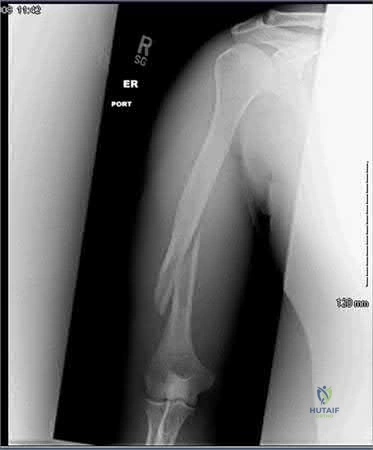
A 68-year-old male sustains the humeral shaft fracture shown in Figures A and B. Upon presentation, he is unable to extend his thumb, fingers, and wrist. After 4 months of non-operative management, the fracture has healed, but his physical exam is unchanged. What is the next most appropriate step in management?


Explanation
The clinical presentation is consistent for a residual radial nerve palsy 4 months after a humeral shaft fracture. An EMG is indicated at this time to evaluate the status of the nerve recovery.
A radial nerve injury which occurs during a humeral shaft fracture or after bracing is not an indication for immediate exploration. Most often, the nerve function returns without surgical intervention. An EMG should be performed at 3-5 months to evaluate the status of the nerve recovery. If fasciculations are present, then this represents recovery, and observation should be continued. If fibrillations are present, this represents denervation, and surgical exploration should be considered.
Pollock et al followed 24 humeral-shaft fractures with associated radial-nerve injuries, 2 of which required open exploration and all recovered. They recommend careful observation for return of nerve function and exploration at 3.5-4 months after injury if there is still no clinical or EMG evidence of recovery.
Bostman et al reviewed 59 immediate and 16 secondary radial nerve palsies and no support emerged for routine early exploration in either group.
Figures A and B show an oblique fracture at the junction of the middle and distal 1/3 of the humeral shaft.
Illustration A shows the relative close position of the radial nerve to the humerus at the midlevel of humerus, and why it is at risk with a humerus shaft fracture.
A radial nerve injury which occurs during a humeral shaft fracture or after bracing is not an indication for immediate exploration. Most often, the nerve function returns without surgical intervention. An EMG should be performed at 3-5 months to evaluate the status of the nerve recovery. If fasciculations are present, then this represents recovery, and observation should be continued. If fibrillations are present, this represents denervation, and surgical exploration should be considered.
Pollock et al followed 24 humeral-shaft fractures with associated radial-nerve injuries, 2 of which required open exploration and all recovered. They recommend careful observation for return of nerve function and exploration at 3.5-4 months after injury if there is still no clinical or EMG evidence of recovery.
Bostman et al reviewed 59 immediate and 16 secondary radial nerve palsies and no support emerged for routine early exploration in either group.
Figures A and B show an oblique fracture at the junction of the middle and distal 1/3 of the humeral shaft.
Illustration A shows the relative close position of the radial nerve to the humerus at the midlevel of humerus, and why it is at risk with a humerus shaft fracture.
Question 15High Yield
A 10-year-old boy sustained an injury to the left knee. The radiographic findings shown in Figure 19 are most commonly associated with injury to which of the following structures?
Explanation
The radiograph shows a bony avulsion of the ACL attachment site on the tibial spine in this skeletally immature patient. In this age group, injury often results in failure of the bony attachment site rather than the substance of the ligament. Avulsion of the patellar tendon insertion site can occur, but this structure is located at the apophysis of the tibial tubercle. The attachment site of the PCL is much more posterior. In adults, bony avulsion is more commonly associated with PCL injuries than with ACL injuries. When a small bony avulsion of the lateral capsule from the lateral tibial plateau is seen on the AP view, this finding is considered pathognomonic of an ACL injury (Segond sign) in adults. The area of the pes anserinus is anterior and distal; avulsion would be unusual.
REFERENCES: Baxter MP, Wiley JJ: Fractures of the tibial spine in children: An evaluation of knee stability. J Bone Joint Surg Br 1988;70:228-230.
Meyers MH, McKeever FM: Fracture of the intercondylar eminence of the tibia. J Bone Joint Surg Am 1970;52:1677-1684.
DeLee JC: Ligamentous injury of the knee, in Stanitski CL, DeLee JC, Drez D Jr (eds): Pediatric and Adolescent Sports Medicine. Philadelphia, PA, WB Saunders, 1994, pp 406-432.
REFERENCES: Baxter MP, Wiley JJ: Fractures of the tibial spine in children: An evaluation of knee stability. J Bone Joint Surg Br 1988;70:228-230.
Meyers MH, McKeever FM: Fracture of the intercondylar eminence of the tibia. J Bone Joint Surg Am 1970;52:1677-1684.
DeLee JC: Ligamentous injury of the knee, in Stanitski CL, DeLee JC, Drez D Jr (eds): Pediatric and Adolescent Sports Medicine. Philadelphia, PA, WB Saunders, 1994, pp 406-432.
Question 16High Yield
Which of the following properties is false concerning articular cartilage:
Explanation
Important properties of articular cartilage include: Avascular (no blood vessels)
Aneural (no nerve fibers) Alymphatic (no lymphatic vessels)
Very low friction on cartilage on cartilage motion
Self-renewing (maintenance and restoration of extracellular matrix) With aging, loss of ability to maintain the extracellular matrix
C orrect Answer: Moderate friction on cartilage-on-cartilage motion
.v4b{border:2px solid #0984e3;background:#fff;color:#0984e3;padding:8px 20px;border-radius:25px;cursor:pointer;margin-right:10px;font-weight:bold;transition:0.3s;}
.v4b.active{background:#0984e3;color:#fff;}
.v4b:hover:not(.active){background:#e3f2fd;}
.mcq-v4-card{background:#fff;border-radius:15px;padding:35px;margin-bottom:40px;border:1px solid #e1e8ed;box-shadow:0 5px 15px rgba(0,0,0,0.04);}
.card-meta{color:#0984e3;font-weight:800;margin-bottom:20px;letter-spacing:1.5px;font-size:0.95rem;}
.q-stem{font-size:1.25rem;margin-bottom:30px;font-weight:500;line-height:1.7;color:#2d3436;}
.q-opt{display:flex;align-items:center;padding:15px;border:2px solid #f1f2f6;border-radius:12px;margin-bottom:15px;cursor:pointer;transition:all 0.2s ease-in-out;background:#fff;}
.q-opt:hover{border-color:#0984e3;background:#f0f7ff;transform:translateX(5px);}
.q-opt-circle{width:35px;height:35px;border:2px solid #ddd;border-radius:50%;display:flex;align-items:center;justify-content:center;margin-right:20px;font-weight:bold;background:#fafafa;flex-shrink:0;color:#636e72;}
.q-opt.correct{background:#e3fcef;border-color:#00b894;}
.q-opt.correct .q-opt-circle{background:#00b894;color:#fff;border-color:#00b894;}
.q-opt.wrong{background:#fff5f5;border-color:#ff7675;}
.q-opt.wrong .q-opt-circle{background:#ff7675;color:#fff;border-color:#ff7675;}
.q-opt.selected{border-color:#0984e3;background:#e3f2fd;}
.q-opt.selected .q-opt-circle{background:#0984e3;color:#fff;border-color:#0984e3;}
.q-feedback{margin-top:30px;padding:25px;background:#f8f9fa;border-left:6px solid #0984e3;border-radius:8px;}
.feedback-label{font-weight:bold;margin-bottom:15px;font-size:1.2rem;}
.explanation-text{line-height:1.7;color:#444;font-size:1.05rem;}
var v4E={
m:'study',r:new Map(),
setMode:function(m){this.m=m;document.getElementById('v4s').classList.toggle('active',m=='study');document.getElementById('v4e').classList.toggle('active',m=='exam');document.getElementById('v4xa').style.display=m=='exam'?'block':'none';this.reset();},
reset:function(){document.querySelectorAll('.q-opt').forEach(e=>{e.className='q-opt';e.style.pointerEvents='auto';});document.querySelectorAll('.q-feedback').forEach(e=>e.style.display='none');this.r.clear();this.up();},
up:function(){let s=0;this.r.forEach(v=>{if(v===true||v.s==v.c)s++;});const t=document.querySelectorAll('.mcq-v4-card').length;document.getElementById('v4sc').innerText=Math.round((s/t)*100)||0;},
reveal:function(c,s,k){const o=c.querySelectorAll('.q-opt');if(o[k-1])o[k-1].classList.add('correct');if(s!=k && o[s-1])o[s-1].classList.add('wrong');c.querySelector('.q-feedback').style.display='block';const fl=c.querySelector('.feedback-label');fl.innerHTML=s==k?' Correct Answer':' Incorrect';},
finish:function(){this.r.forEach((v,k)=>{this.reveal(document.getElementById('card-'+k),v.s,v.c);});document.querySelectorAll('.q-opt').forEach(e=>e.style.pointerEvents='none');window.scrollTo({top:0,behavior:'smooth'});}
};
document.querySelectorAll('.q-opt').forEach(el=>{
el.onclick=function(){
const q=this.dataset.q,k=this.dataset.correct,s=this.dataset.idx,p=this.closest('.mcq-v4-card');
if(v4E.m=='study') { if(v4E.r.has(q))return; v4E.r.set(q,s==k); p.querySelectorAll('.q-opt').forEach(o=>o.style.pointerEvents='none'); v4E.reveal(p,s,k); }
else { p.querySelectorAll('.q-opt').forEach(o=>o.classList.remove('selected')); this.classList.add('selected'); v4E.r.set(q,{s:s,c:k}); }
v4E.up();
};
});
Aneural (no nerve fibers) Alymphatic (no lymphatic vessels)
Very low friction on cartilage on cartilage motion
Self-renewing (maintenance and restoration of extracellular matrix) With aging, loss of ability to maintain the extracellular matrix
C orrect Answer: Moderate friction on cartilage-on-cartilage motion
.v4b{border:2px solid #0984e3;background:#fff;color:#0984e3;padding:8px 20px;border-radius:25px;cursor:pointer;margin-right:10px;font-weight:bold;transition:0.3s;}
.v4b.active{background:#0984e3;color:#fff;}
.v4b:hover:not(.active){background:#e3f2fd;}
.mcq-v4-card{background:#fff;border-radius:15px;padding:35px;margin-bottom:40px;border:1px solid #e1e8ed;box-shadow:0 5px 15px rgba(0,0,0,0.04);}
.card-meta{color:#0984e3;font-weight:800;margin-bottom:20px;letter-spacing:1.5px;font-size:0.95rem;}
.q-stem{font-size:1.25rem;margin-bottom:30px;font-weight:500;line-height:1.7;color:#2d3436;}
.q-opt{display:flex;align-items:center;padding:15px;border:2px solid #f1f2f6;border-radius:12px;margin-bottom:15px;cursor:pointer;transition:all 0.2s ease-in-out;background:#fff;}
.q-opt:hover{border-color:#0984e3;background:#f0f7ff;transform:translateX(5px);}
.q-opt-circle{width:35px;height:35px;border:2px solid #ddd;border-radius:50%;display:flex;align-items:center;justify-content:center;margin-right:20px;font-weight:bold;background:#fafafa;flex-shrink:0;color:#636e72;}
.q-opt.correct{background:#e3fcef;border-color:#00b894;}
.q-opt.correct .q-opt-circle{background:#00b894;color:#fff;border-color:#00b894;}
.q-opt.wrong{background:#fff5f5;border-color:#ff7675;}
.q-opt.wrong .q-opt-circle{background:#ff7675;color:#fff;border-color:#ff7675;}
.q-opt.selected{border-color:#0984e3;background:#e3f2fd;}
.q-opt.selected .q-opt-circle{background:#0984e3;color:#fff;border-color:#0984e3;}
.q-feedback{margin-top:30px;padding:25px;background:#f8f9fa;border-left:6px solid #0984e3;border-radius:8px;}
.feedback-label{font-weight:bold;margin-bottom:15px;font-size:1.2rem;}
.explanation-text{line-height:1.7;color:#444;font-size:1.05rem;}
var v4E={
m:'study',r:new Map(),
setMode:function(m){this.m=m;document.getElementById('v4s').classList.toggle('active',m=='study');document.getElementById('v4e').classList.toggle('active',m=='exam');document.getElementById('v4xa').style.display=m=='exam'?'block':'none';this.reset();},
reset:function(){document.querySelectorAll('.q-opt').forEach(e=>{e.className='q-opt';e.style.pointerEvents='auto';});document.querySelectorAll('.q-feedback').forEach(e=>e.style.display='none');this.r.clear();this.up();},
up:function(){let s=0;this.r.forEach(v=>{if(v===true||v.s==v.c)s++;});const t=document.querySelectorAll('.mcq-v4-card').length;document.getElementById('v4sc').innerText=Math.round((s/t)*100)||0;},
reveal:function(c,s,k){const o=c.querySelectorAll('.q-opt');if(o[k-1])o[k-1].classList.add('correct');if(s!=k && o[s-1])o[s-1].classList.add('wrong');c.querySelector('.q-feedback').style.display='block';const fl=c.querySelector('.feedback-label');fl.innerHTML=s==k?' Correct Answer':' Incorrect';},
finish:function(){this.r.forEach((v,k)=>{this.reveal(document.getElementById('card-'+k),v.s,v.c);});document.querySelectorAll('.q-opt').forEach(e=>e.style.pointerEvents='none');window.scrollTo({top:0,behavior:'smooth'});}
};
document.querySelectorAll('.q-opt').forEach(el=>{
el.onclick=function(){
const q=this.dataset.q,k=this.dataset.correct,s=this.dataset.idx,p=this.closest('.mcq-v4-card');
if(v4E.m=='study') { if(v4E.r.has(q))return; v4E.r.set(q,s==k); p.querySelectorAll('.q-opt').forEach(o=>o.style.pointerEvents='none'); v4E.reveal(p,s,k); }
else { p.querySelectorAll('.q-opt').forEach(o=>o.classList.remove('selected')); this.classList.add('selected'); v4E.r.set(q,{s:s,c:k}); }
v4E.up();
};
});
Question 17High Yield
Which of the following variables has not been shown to be increased in patients who sustain bilateral femoral shaft fractures as compared to patients with unilateral femoral shaft fractures?
Explanation
Bilateral femur fractures have not been shown to have increased rates of thoracic/chest wall injury. They have been shown to have increased rates of initial hypotension, mortality, open skull fractures, and pelvic fractures.
Due to their high-energy nature, bilateral femur fractures have increased rates of initial hypotension or hemodynamic instability, mortality, head injuries, abdominal injuries, pulmonary injuries, and other orthopaedic injuries.
Copeland et al. performed a retrospective analysis using their trauma registry data on consecutive blunt trauma patients with unilateral (800 patients) or bilateral (85 patients) femoral shaft fractures. Patients with bilateral femoral fractures had a significantly higher Injury Severity Score (30.2 versus 24.5, p
< 0.05) and higher mortality rate (25.9 vs 11.7%, p < 0.014) than patients with unilateral femoral fractures. Bilateral fracture patients also had significantly more closed head injuries, open skull fractures, intra-abdominal injuries requiring surgical intervention, and pelvic fractures. Regression analysis of variables evident on admission revealed a significant correlation between bilateral femoral fractures and death; however, other factors (shock, closed head injury, and thoracic injury) had much stronger correlations with mortality. No increase in risk of thoracic injury was seen with bilateral injuries as compared to unilateral injuries.
Kobbe et al. also reviewed their trauma registry data on 776 patients with unilateral and 118 patients with bilateral femoral shaft fractures. They found that bilateral femur fracture patients has a higher ISS score, higher incidence of delayed pulmonary failure and multiple organ failure, and higher mortality. They also noted that patients with bilateral femoral shaft fractures have
significantly more often severe abdominal injuries as well as severe blood loss which may account for the increased mortality rate.
Incorrect Answers:
Answer 1: Increased rates of hypotension upon admission are seen in the bilateral group.
Answer 2: Increased mortality rates have been reported in bilateral femur patients.
Answer 4: Increased rates of open and closed head injuries are noted in bilateral femur patients.
Answer 5: Increased rates of pelvic and other orthopaedic injuries are reported in the bilateral group.
Due to their high-energy nature, bilateral femur fractures have increased rates of initial hypotension or hemodynamic instability, mortality, head injuries, abdominal injuries, pulmonary injuries, and other orthopaedic injuries.
Copeland et al. performed a retrospective analysis using their trauma registry data on consecutive blunt trauma patients with unilateral (800 patients) or bilateral (85 patients) femoral shaft fractures. Patients with bilateral femoral fractures had a significantly higher Injury Severity Score (30.2 versus 24.5, p
< 0.05) and higher mortality rate (25.9 vs 11.7%, p < 0.014) than patients with unilateral femoral fractures. Bilateral fracture patients also had significantly more closed head injuries, open skull fractures, intra-abdominal injuries requiring surgical intervention, and pelvic fractures. Regression analysis of variables evident on admission revealed a significant correlation between bilateral femoral fractures and death; however, other factors (shock, closed head injury, and thoracic injury) had much stronger correlations with mortality. No increase in risk of thoracic injury was seen with bilateral injuries as compared to unilateral injuries.
Kobbe et al. also reviewed their trauma registry data on 776 patients with unilateral and 118 patients with bilateral femoral shaft fractures. They found that bilateral femur fracture patients has a higher ISS score, higher incidence of delayed pulmonary failure and multiple organ failure, and higher mortality. They also noted that patients with bilateral femoral shaft fractures have
significantly more often severe abdominal injuries as well as severe blood loss which may account for the increased mortality rate.
Incorrect Answers:
Answer 1: Increased rates of hypotension upon admission are seen in the bilateral group.
Answer 2: Increased mortality rates have been reported in bilateral femur patients.
Answer 4: Increased rates of open and closed head injuries are noted in bilateral femur patients.
Answer 5: Increased rates of pelvic and other orthopaedic injuries are reported in the bilateral group.
Question 18High Yield
A 12-year-old girl with foot pain who has been diagnosed with hereditary motor sensory neuropathy is seen for the foot deformity shown in Figure 59a. A “block test” is performed and shown in Figure 59b. What is the most appropriate management for this patient?


Explanation
The hindfoot varus in this individual with a cavovarus deformity is nonstructural as shown by the “block test”. Therefore, surgical procedures directed at correcting the hindfoot deformity are not necessary. Observation is not in order and shoe modifications have not been shown to be effective in managing this problem. The patient is symptomatic; therefore, the treatment of choice is plantar release with first metatarsal osteotomy and possible tendon transfers.
REFERENCES: Paulos L, Coleman SS, Samuelson KM: Pes cavovarus: Review of a surgical approach
using selective soft-tissue procedures. J Bone Joint Surg Am 1980;62:942-953.
McCluskey WP, Lovell WW, Cummings RJ: The cavovarus foot deformity: Etiology and management. Clin Orthop Relat Res 1989;247:27-37.
Ward CM, Dolan LA, Bennett DL, et al: Long-term results of reconstruction for treatment of a flexible
cavovarus foot in Charcot-Marie-Tooth disease. J Bone Joint Surg Am 2008;90:2631-2642.
Figure 60a Figure 60b Figure 60c
REFERENCES: Paulos L, Coleman SS, Samuelson KM: Pes cavovarus: Review of a surgical approach
using selective soft-tissue procedures. J Bone Joint Surg Am 1980;62:942-953.
McCluskey WP, Lovell WW, Cummings RJ: The cavovarus foot deformity: Etiology and management. Clin Orthop Relat Res 1989;247:27-37.
Ward CM, Dolan LA, Bennett DL, et al: Long-term results of reconstruction for treatment of a flexible
cavovarus foot in Charcot-Marie-Tooth disease. J Bone Joint Surg Am 2008;90:2631-2642.
Figure 60a Figure 60b Figure 60c
Question 19High Yield
Figures 60a and 60b show the radiographs of the ankle and distal leg of an 1-
2. year-old girl after she twisted her ankle while playing soccer. She has no
3. history of ankle or leg pain. Examination reveals localized swelling and
4. tenderness over the lateral ankle, and the tibia is not tender. The bone lesion
5. identified in the tibia most likely is
6. 1- osteoblastoma.
7. 2- osteoid osteoma.
8. 3- ossifying fibroma.
9. 4- fibrous dysplasia.
10. 5- nonossifying fibroma.
2. year-old girl after she twisted her ankle while playing soccer. She has no
3. history of ankle or leg pain. Examination reveals localized swelling and
4. tenderness over the lateral ankle, and the tibia is not tender. The bone lesion
5. identified in the tibia most likely is
6. 1- osteoblastoma.
7. 2- osteoid osteoma.
8. 3- ossifying fibroma.
9. 4- fibrous dysplasia.
10. 5- nonossifying fibroma.
Explanation
1.
1. [next question](content://com.estrongs.files/storage/emulated/0/Download/OITE%201997.html#-1,-1,NEXT)
1. Reference(s)
2. Bertoni F, Calderoni P, Bacchim P, et al: Benign fibrous histiocytoma of bone. J Bone Joint Surg 1986;68A:1225-1230. Unni KK: Dahlin's Bone Tumors: General Aspects and Data on 11,087 Cases, ed 4. Philadelphia, PA, JB Lippincott, 1996, pp 360-365.
#
1. [next question](content://com.estrongs.files/storage/emulated/0/Download/OITE%201997.html#-1,-1,NEXT)
1. Reference(s)
2. Bertoni F, Calderoni P, Bacchim P, et al: Benign fibrous histiocytoma of bone. J Bone Joint Surg 1986;68A:1225-1230. Unni KK: Dahlin's Bone Tumors: General Aspects and Data on 11,087 Cases, ed 4. Philadelphia, PA, JB Lippincott, 1996, pp 360-365.
#
Question 20High Yield
A 14-year-old boy is lifting weights and feels a sudden pain in his back, associated with sciatica bilaterally. The sciatica persists for several weeks. The radiograph shown in Figure 7a is negative, and the CT scan shown in Figure 7b is available for evaluation. An MRI scan is read as a disk bulge. Management should consist of
Explanation
DISCUSSION: A limbus or apophyseal fracture caused by heavy lifting or twisting is commonly seen in older children and adolescents. Patients describe feeling a popping sensation and report radicular symptoms. Radiographs usually are not sufficient to diagnose the injury. MRI or CT should be used to determine the exact location of the fracture. Nonsurgical management is rarely successful. A wide laminectomy with surgical excision of the limbus fragment is recommended if neurologic symptoms are present.
REFERENCE: Fischgrund JS (ed): Orthopedic Knowledge Update 9. Rosemont, IL, American Academy of Orthopaedic Surgeons, 2008, p 694.
**2010 Pediatric Orthopaedic Examination Answer Book • 13**
Figure 8
DISCUSSION: A limbus or apophyseal fracture caused by heavy lifting or twisting is commonly seen in older children and adolescents. Patients describe feeling a popping sensation and report radicular symptoms. Radiographs usually are not sufficient to diagnose the injury. MRI or CT should be used to determine the exact location of the fracture. Nonsurgical management is rarely successful. A wide laminectomy with surgical excision of the limbus fragment is recommended if neurologic symptoms are present.
REFERENCE: Fischgrund JS (ed): Orthopedic Knowledge Update 9. Rosemont, IL, American Academy of Orthopaedic Surgeons, 2008, p 694.
**2010 Pediatric Orthopaedic Examination Answer Book • 13**
Figure 8
Question 21High Yield
An adult with a distal humeral fracture underwent open reduction and internal fixation. What is the most common postoperative complication?
Explanation
Most patients lose elbow range of motion after open reduction and internal fixation of a distal humeral fracture. Ulnar nerve dysfunction, nonunion, and infection all occur less commonly.
REFERENCES: Webb LX: Distal humerus fractures in adults. J Am Acad Orthop Surg 1996;4:336-344.
McKee MD, Wilson TL, Winston L, et al: Functional outcome following surgical treatment of intra-articular distal humeral fractures through a posterior approach. J Bone Joint Surg Am 2000;82:1701-1707.
REFERENCES: Webb LX: Distal humerus fractures in adults. J Am Acad Orthop Surg 1996;4:336-344.
McKee MD, Wilson TL, Winston L, et al: Functional outcome following surgical treatment of intra-articular distal humeral fractures through a posterior approach. J Bone Joint Surg Am 2000;82:1701-1707.
Question 22High Yield
Malignant transformation of osteochondroma commonly occurs to:
Explanation
Osteochondroma is a cartilaginous tumor and malignant transformation is to a low-grade chondrosarcoma.
Question 23High Yield
During open reduction and internal fixation of a both bone forearm fracture, restoration of the radial bow has been most associated with which of the following?
Explanation
Restoration of the anatomy of the radial bow directly correlates with the range of motion postoperatively (pronation-supination).
The referenced study by Schemitsch et al found that restoration of the normal radial bow was related to the functional outcome. A good functional result
(more than 80 percent of normal rotation of the forearm) was associated with restoration of the normal amount and location of the radial bow. Similarly, the recovery of grip strength was associated with restoration of the location of the radial bow toward normal.
The referenced study by Schemitsch et al found that restoration of the normal radial bow was related to the functional outcome. A good functional result
(more than 80 percent of normal rotation of the forearm) was associated with restoration of the normal amount and location of the radial bow. Similarly, the recovery of grip strength was associated with restoration of the location of the radial bow toward normal.
Question 24High Yield
A 36-year-old male is brought to the trauma center following a motor vehicle accident. Physical exam shows a deformed left lower extremity with a 1-cm open wound over the anterolateral aspect of his leg. Radiographs are provided in Figures A and B. Which of the following interventions has been shown in the literature to decrease the occurrence of infection at the fracture site?


Explanation
The clinical scenario and radiographs are consistent with a Gustilo and Anderson type 3A open tibia fracture.
Melvin et al review the evidenced-based literature and make recommendations for the initial evaluation and management of open tibial shaft fractures. The time elapsed before antibiotic administration and adequate surgical debridement of all contamination are the only factors definitively shown to reduce infection and improve outcome. Traditional recommendations have suggested surgical debridement of open fractures occur within 6 hours of injury. However, there is no literature to support this time window. Certainly, open fractures should be addressed with urgency, but there is no evidence reporting a definitive time window. There is insufficient data to recommend gram negative coverage with gentamicin for all open fractures although this is a common practice. The addition of antibiotics to the irrigation solution has been shown to decrease bacterial load, but it has also demonstrated host tissue necrosis and delayed wound healing. There is not sufficient data to support its use over a castile soap solution or normal saline. Similarly, high pressure pulsatile lavage decreases bacterial load, but also seeds bacteria deeper within the soft tissues and harms host tissues. There is no evidence to support pulsatile lavage over gravity flow.
Question 25High Yield
Aneurysmal bone cyst of the spine is most likely in this age group:
Explanation
The most common age is the second decade; the mean age is 13 years old.
Question 26High Yield
Which of the following is an advantage of unreamed nailing of the tibia compared to reamed nailing?
Explanation
The debate between reamed versus unreamed intramedullary nailing of the tibia continues. Although unreamed nailing was proposed for open fractures to minimize infection, its simplicity made it appealing for closed fractures. However, most studies to date show that the only advantage of unreamed nailing is less surgical time. All studies show higher nonunion rates with increased hardware failure and increased time to union for unreamed nailing. Even in open fractures graded up to Gustilo Grade IIIA, the reamed tibial nail performs better.
REFERENCES: Larsen LB, Madsen JE, Hoiness PR, et al: Should insertion of intramedullary nails for tibial fractures be with or without reaming? A prospective, randomized study with 3.8 years’ follow-up. J Orthop Trauma 2004;18:144-149.
Blachut PA, O’Brien PJ, Meek RN, et al: Interlocking intramedullary nailing with or without reaming for the treatment of closed fractures of the tibial shaft: A prospective randomized study. J Bone Joint Surg Am 1997;79:640-646.
REFERENCES: Larsen LB, Madsen JE, Hoiness PR, et al: Should insertion of intramedullary nails for tibial fractures be with or without reaming? A prospective, randomized study with 3.8 years’ follow-up. J Orthop Trauma 2004;18:144-149.
Blachut PA, O’Brien PJ, Meek RN, et al: Interlocking intramedullary nailing with or without reaming for the treatment of closed fractures of the tibial shaft: A prospective randomized study. J Bone Joint Surg Am 1997;79:640-646.
Question 27High Yield
Which of the flowing trajectories is preferred for placement of C1 lateral mass screws?
Explanation
The C1 lateral mass can safely accommodate screw fixation. Trajectory of 10 degrees medial and 22 degrees cephalad was safely applied in a series of 50 patients.
Postoperative CT scans confirmed the safe trajectory. The benefit of lateral mass screws is that they can be safely placed despite the existence of an anomalous vertebral artery that could preclude the safe placement of transarticular screws.
Question 28High Yield
Which ancillary test is not helpful in the diagnosis of C harcot-Marie-Tooth disease (C MT):
Explanation
C harcot-Marie-Tooth disease (C MT) is a neuropathic process resulting in muscle atrophy, therefore, muscle enzyme studies will not be helpful.
Electromyography (EMG) will confirm the diagnosis by displaying increased amplitude and duration of signals, both of which are indicative of a neuropathic process.
Nerve conduction velocity (NC V) will also confirm the diagnosis by displaying decreased motor and sensory conduction velocities.
Nerve biopsy can be helpful by showing loss of myelinated fibers and fibrosis. Muscle biopsy will show diffuse atrophy, fibrosis, and adipose tissue within muscle.
Electromyography (EMG) will confirm the diagnosis by displaying increased amplitude and duration of signals, both of which are indicative of a neuropathic process.
Nerve conduction velocity (NC V) will also confirm the diagnosis by displaying decreased motor and sensory conduction velocities.
Nerve biopsy can be helpful by showing loss of myelinated fibers and fibrosis. Muscle biopsy will show diffuse atrophy, fibrosis, and adipose tissue within muscle.
Question 29High Yield
1244) A polytrauma patient sustains a right bicondylar tibial plateau fracture and a right humeral shaft fracture both treated with open reduction and internal fixation. He also underwent statically locked intramedullary nailing of a left femoral shaft fracture. What is the appropriate weightbearing status?
Explanation
The standard treatment for a bicondylar tibial plateau fractures is a period of post-operative non-weight bearing.
Tingstad et al found favorable results of immediate weightbearing on humeral shaft fractures treated with plating and full weightbearing did not have any effect on the union or malunion rates.
Brumback et al evaluated the feasibility, safety and efficacy of immediate
weightbearing after treatment of femoral shaft fractures with statically locked IM nail. All the patients went on to union and no loss of fixation occurred.
Tingstad et al found favorable results of immediate weightbearing on humeral shaft fractures treated with plating and full weightbearing did not have any effect on the union or malunion rates.
Brumback et al evaluated the feasibility, safety and efficacy of immediate
weightbearing after treatment of femoral shaft fractures with statically locked IM nail. All the patients went on to union and no loss of fixation occurred.
Question 30High Yield
A patient sustained the injuries shown in the radiographs and clinical photograph seen in Figures 10a through 10c. The neurovascular examination is normal. The first step in emergent management of the extremity injuries should consist of
Explanation
The figures show an open tibial fracture, a femoral shaft fracture, and femoral head dislocation. The most urgent treatment is reduction of the femoral head, as timing to reduction has been correlated with preventing osteonecrosis. After reduction of the femoral head, the next priority is wound management, followed by stabilization of the femoral and tibial fractures with either splinting, traction, or external fixation.
REFERENCES: Sahin V, Karakas ES, Aksu S, et al: Traumatic dislocation and fracture-dislocation of the hip: A long-term follow-up study. J Trauma 2003;54:520-529.
Moed BR, WillsonCarr SE, Watson JT: Results of operative treatment of fractures of the posterior wall of the acetabulum. J Bone Joint Surg Am 2002;84:752-758.
REFERENCES: Sahin V, Karakas ES, Aksu S, et al: Traumatic dislocation and fracture-dislocation of the hip: A long-term follow-up study. J Trauma 2003;54:520-529.
Moed BR, WillsonCarr SE, Watson JT: Results of operative treatment of fractures of the posterior wall of the acetabulum. J Bone Joint Surg Am 2002;84:752-758.
Question 31High Yield
Which of the following cohorts of patients is at highest risk of a future anterior cruciate ligament (ACL) tear?
Explanation
DISCUSSION: Hewett and associates reported in a study of 205 female athletes that female athletes, with increased dynamic valgus and high abduction loads, were at increased risk of ACL injury. The same investigators in an earlier study of 81 high school basketball players reported that female athletes landed with greater total valgus knee motion and a greater maximum valgus knee angle than male athletes. Female athletes were also found to have significant differences between their dominant and nondominant side in maximum valgus knee angle. Lephart and associates reported that in single-leg landing and forward hop tasks that female athletes had significantly less knee flexion and lower leg internal rotation maximum angular displacement, and less knee flexion time to maximum angular displacement than males. Females with an adduction moment during landing should have a lower incidence of ACL tears. Males in general have a lower incidence of ACL tears.
REFERENCES: Hewett TE, Myer GD, Ford KR, et al: Biomechanical measures of neuromuscular control and valgus loading of the knee predict anterior cruciate ligament injury risk in female athletes: A prospective study. Am J Sports Med 2005;33:492-501.
Ford KR, Meyer GD, Hewett TE: Valgus knee motion during landing in high school female and male basketball players. Med Sci Sports Exerc 2003;35:1745-1750.
Lephart S, Ferris CM, Riemann BL, et al: Gender differences in strength and lower extremity kinematics during landing. Clin Orthop Relat Res 2002;401:162-169.
Fig ure 35
REFERENCES: Hewett TE, Myer GD, Ford KR, et al: Biomechanical measures of neuromuscular control and valgus loading of the knee predict anterior cruciate ligament injury risk in female athletes: A prospective study. Am J Sports Med 2005;33:492-501.
Ford KR, Meyer GD, Hewett TE: Valgus knee motion during landing in high school female and male basketball players. Med Sci Sports Exerc 2003;35:1745-1750.
Lephart S, Ferris CM, Riemann BL, et al: Gender differences in strength and lower extremity kinematics during landing. Clin Orthop Relat Res 2002;401:162-169.
Fig ure 35
Question 32High Yield
Which of the following cells has receptors for parathyroid hormone:
Explanation
Osteoblasts have receptors for parathyroid hormone. Once stimulated, the cells release interleukin-6 (IL-6). IL-6 signals osteoclasts to resorb bone. The osteoblasts secrete neutral proteases that degrade the osteoid surface. Osteoclasts then attach to the bone surface and secrete acid proteases that degrade the bone matrix. Parathyroid hormone related protein increases osteoblast expression of receptor activator of nuclear factor âkB ligand (RANKL). RANKL binds to osteoclast precursor cells for the formation of active osteoclasts
Question 33High Yield
A 64-year-old man with a history of diabetes mellitus underwent open reduction and internal fixation of a displaced ankle fracture 8 weeks ago. Examination now reveals recent onset erythema, warmth, and swelling of the midfoot. Radiographs are shown in Figures 23a through 23d. What is the most likely reason for the swelling of the foot?
Explanation
A Charcot flare in adjacent joints is not uncommon in patients with neuropathy who undergo surgery or other trauma. Venous thrombosis would present with swelling of the entire leg, while infection would present earlier in the postoperative period. The radiographs are pathognomonic of Charcot arthropathy, not an unrecognized fracture or gout. A compartment syndrome this late after injury is extremely rare, and there would be no bony distraction associated with compartment syndrome.
REFERENCE: Connolly JF, Csencsitz TA: Limb threatening neuropathic complications from ankle fractures in patients with diabetes. Clin Orthop 1998;348:212-219.
Question 34High Yield
Figure 1 is a representative MRI scan of a 45-year-old man who was lifting a couch 2 days ago when he felt a pop in the elbow and had immediate pain in this area. He had no problems with the elbow prior to this injury. Examination reveals full range of motion; however, he has significant bruising and swelling in the antecubital fossa. A hook test is positive. If choosing to perform single-incision surgical repair for this injury, what is the most common complication associated with this procedure?
Explanation
This patient has a complete distal biceps rupture, as evidenced by history, examination and imaging. Surgical repair is typically recommended in otherwise healthy patients to restore supination strength of the forearm. Surgical repair can be undertaken using either a single- or dual-incision approach. The single-incision approach is associated with injury to the lateral
antebrachial cutaneous nerve, whereas the dual-incision approach carries an increased risk of radioulnar synostosis. Tendon retear and radial nerve injury, while possible, are less common.
71
antebrachial cutaneous nerve, whereas the dual-incision approach carries an increased risk of radioulnar synostosis. Tendon retear and radial nerve injury, while possible, are less common.
71
Question 35High Yield
Figure 62


Explanation
- Chondrosarcoma_
Question 36High Yield
One year ago, a patient underwent a triple arthrodesis for management of a severe foot deformity. Although the deformity of her foot is notably improved since the surgery, she has not walked comfortably and the pain is worse than it had been prior to surgery. Upon clinical examination, she is noted to have a fixed supination deformity of the forefoot and callosity under the base of the fifth metatarsal. The recommended management of this problem is:
Explanation
This patient underwent a triple arthrodesis that resulted in malunion as demonstrated by the location of the callosity and the fixed forefoot deformity.
A calcaneus osteotomy will not correct the midfoot deformity. Nonoperative treatment will not be sufficient in long-term management.
Question 37High Yield
Closed chain kinetic exercises are differentiated from open chain exercises by which of the following?
Explanation
DISCUSSION: Closed chain kinetic exercises confer a margin of safety and are protective of healing or repaired tissues by the compressive nature of the applied forces. Closed chain kinetic exercise is associated with decreased shear, translation, and distraction of the joints within the chain. Because of patterns of motion with closed chain kinetic exercises, individual muscles may not be maximally strengthened or all joint motion returned to normal. Closed chain kinetic exercises may be used earlier in the rehabilitation process.
REFERENCES: Kibler WB, Livingston B: Closed-chain rehabilitation for upper and lower extremities. J Am Acad Orthop Surg 2001;9:412-421.
Garrick JG (ed): Orthopaedic Knowledge Update: Sports Medicine 3. Rosemont, IL, American Academy of
Orthopaedic Surgeons, 2004, pp 131-132.
REFERENCES: Kibler WB, Livingston B: Closed-chain rehabilitation for upper and lower extremities. J Am Acad Orthop Surg 2001;9:412-421.
Garrick JG (ed): Orthopaedic Knowledge Update: Sports Medicine 3. Rosemont, IL, American Academy of
Orthopaedic Surgeons, 2004, pp 131-132.
Question 38High Yield
A 37-year-old laborer falls 12 feet and sustains a comminuted tibial plafond
fracture. Three years after treatment using standard techniques, what will be
the most likely outcome?
fracture. Three years after treatment using standard techniques, what will be
the most likely outcome?
Explanation
Two recent studies by Pollak and associates and Marsh and associates have focused on function after high-energy tibial plafond fractures. Findings are unfavorable even when anatomic reduction is performed in the best centers and patients are provided excellent rehabilitation. Function improves up to 2 years after injury, but even basic walking skills remain adversely affected. Virtually all patients have long-term adverse general health effects compared to their gender and age-matched peers. Posttraumatic degenerative arthritis is present in most ankles. Patients should be told early about the long-term prognosis, and early vocational/psychological counseling should be given. Despite these adverse outcomes, only a minority of patients require fusion or arthroplasty.
REFERENCES: Pollak AN, McCarthy ML, Bess RS, et al: Outcomes after treatment of high-energy tibial plafond fractures. J Bone Joint Surg Am 2003;85:1893-1900.
Marsh JL, Weigel DP, Dirschl DR: Tibial plafond fractures: How do these ankles function over time? J Bone Joint Surg Am 2003;85:287-295.
REFERENCES: Pollak AN, McCarthy ML, Bess RS, et al: Outcomes after treatment of high-energy tibial plafond fractures. J Bone Joint Surg Am 2003;85:1893-1900.
Marsh JL, Weigel DP, Dirschl DR: Tibial plafond fractures: How do these ankles function over time? J Bone Joint Surg Am 2003;85:287-295.
Question 39High Yield
A surgeon recommends an interscalene regional block to a patient undergoing shoulder arthroscopy. When asked about potential complications, which of the following is most likely to occur?
Explanation
**
Sensory neuropathy is the most common complication seen with interscalene regional block.
Question 40High Yield
Figure 1 is the MR image of a 14-year-old football player who injured his right knee during a game. He describes feeling a "pop" and then needing help walking off the field. His knee is visibly swollen. The patient undergoes surgery to repair/reconstruct the damaged structure and has no postsurgical complications and begins physical therapy rehabilitation. The boy and his parents stress they want to “get the therapy over with as fast as possible" to expedite his return to sports, and the surgeon and rehabilitation team consider their request. Compared with nonaccelerated rehabilitation, patients who follow an early accelerated rehabilitation protocol experience
---
---

Explanation
The MR image shows bone bruises (“kissing contusions”) consistent with an ACL tear. During the ACL subluxation event, the posterolateral tibial plateau subluxes anteriorly, making contact with the mid portion of the lateral femoral condyle and resulting in this characteristic bone bruise pattern on MRI. Randomized clinical trials comparing early accelerated versus nonaccelerated rehabilitation programs have demonstrated no significant differences in long-term results with regard to function, reinjury, and successful return to play. These studies did not address timing of return to play with an early accelerated rehabilitation program. At 2 and 3 years postsurgically, there are no differences in laxity, number of graft _failures, or KOOS scores._
Question 41High Yield
A regimen of ankle bracing and supervised physical therapy:
Explanation
In a study performed by Alvarez and colleagues, 47 patients with stage I or II posterior tibial tendon dysfunction were treated nonoperatively with either a hinged ankle-foot orthosis or foot orthosis and a supervised physical therapy program. After 10 therapy visits, 83% of patients had successful subjective and functional outcomes. Eighty-nine percent of patients were satisfied with the outcome of nonoperative treatment. This included significant improvement in visual analog scale scores and increased strength, concentrically and eccentrically. In this study, 11% of patients failed conservative treatment and required surgery.
Question 42High Yield
Genetic mutations that may result in the cervical abnormalities noted in the figures generally affect the


Explanation
The figures are characteristic of a child with Klippel-Feil syndrome (congenital cervical spine abnormalities) in association with congenital scoliosis in the upper thoracic spine and a right-sided Sprengel deformity (congenital elevation of the scapula). Sprengel deformity occurs in as many as 30% of children with Klippel-Feil syndrome. Other congenital conditions that are commonly associated with Klippel-Feil, and that should be screened for, include deafness in 30%, genitourinary abnormalities in 25% to 35%, and cardiovascular abnormalities in 4% to 29% of children with Klippel-Feil syndrome.
In Sprengel deformity, there is usually a tether called the omovertebral connection between the abnormally elevated scapula and the spinous processes in the upper thoracic region. This tether is most commonly bony but also may be cartilaginous or fibrous. Although there also may be abnormalities in the ribs, clavicle, or humerus, they are morphologic abnormalities only, not tethers.
Patients with Klippel-Feil syndrome should be discouraged from participating in contact or collision sports if they have a massive fusion of the cervical spine, any involvement of C2, or limited cervical motion. Fusions at 1 or 2 interspaces below C3 and normal cervical motion do not preclude participation in activities. A Sprengel deformity may limit abduction of the shoulder and normal racquet or throwing mechanics, but, in the absence of pain, is not a contraindication to attempted participation.
Klippel-Feil syndrome affects a heterogenous cohort of patients and different inheritance patterns have been seen, including autosomal-dominant and autosomal-recessive types, with varying levels of penetrance. The first human Klippel-Feil syndrome locus was identified on chromosome 8 and is called SGM1. Other candidates for mutations in Klippel-Feil include PAX genes and Notch pathway genes. In general, the involved genes help regulate the formation and segmentation of the vertebrae.
Between days 20 and 30 following conception, the paraxial mesoderm subdivides into segments called somites. As they mature, somites develop into 3 layers called the sclerotome, myotome, and dermatome. The sclerotome undergoes a process of resegmentation during which the caudal section from 1 somite joins with the rostral section of the immediately caudal somite to form the vertebral bodies. It is during the processes of segmentation and resegmentation that the abnormalities leading to Klippel-Feil syndrome occur. Gastrulation refers to the phase early in embryonic development when the single-layered blastula is reorganized into a trilaminar structure with 3 germ layers: the ectoderm, mesoderm, and endoderm. Neurulation refers to the process by which the notochord induces formation of the neural tube from the neural plate, forming the brain and spinal cord.
Figure 55a
Figure 55b
Figure 55c
In Sprengel deformity, there is usually a tether called the omovertebral connection between the abnormally elevated scapula and the spinous processes in the upper thoracic region. This tether is most commonly bony but also may be cartilaginous or fibrous. Although there also may be abnormalities in the ribs, clavicle, or humerus, they are morphologic abnormalities only, not tethers.
Patients with Klippel-Feil syndrome should be discouraged from participating in contact or collision sports if they have a massive fusion of the cervical spine, any involvement of C2, or limited cervical motion. Fusions at 1 or 2 interspaces below C3 and normal cervical motion do not preclude participation in activities. A Sprengel deformity may limit abduction of the shoulder and normal racquet or throwing mechanics, but, in the absence of pain, is not a contraindication to attempted participation.
Klippel-Feil syndrome affects a heterogenous cohort of patients and different inheritance patterns have been seen, including autosomal-dominant and autosomal-recessive types, with varying levels of penetrance. The first human Klippel-Feil syndrome locus was identified on chromosome 8 and is called SGM1. Other candidates for mutations in Klippel-Feil include PAX genes and Notch pathway genes. In general, the involved genes help regulate the formation and segmentation of the vertebrae.
Between days 20 and 30 following conception, the paraxial mesoderm subdivides into segments called somites. As they mature, somites develop into 3 layers called the sclerotome, myotome, and dermatome. The sclerotome undergoes a process of resegmentation during which the caudal section from 1 somite joins with the rostral section of the immediately caudal somite to form the vertebral bodies. It is during the processes of segmentation and resegmentation that the abnormalities leading to Klippel-Feil syndrome occur. Gastrulation refers to the phase early in embryonic development when the single-layered blastula is reorganized into a trilaminar structure with 3 germ layers: the ectoderm, mesoderm, and endoderm. Neurulation refers to the process by which the notochord induces formation of the neural tube from the neural plate, forming the brain and spinal cord.
Figure 55a
Figure 55b
Figure 55c
Question 43High Yield
A 16-year-old high school football player who sustained an acute forceful dorsiflexion ankle injury reported that he felt a pop and then noted immediate swelling over the lateral malleolus. Examination 24 hours later reveals moderate swelling and tenderness along the lateral malleolus. The external rotation, squeeze, anterior drawer, and talar tilt tests are negative. Subluxation of the peroneal tendons is palpable over the peroneal groove of the fibula. Radiographs reveal a small cortical avulsion off the distal rim of the fibula. The stress views show no instability. Initial management for this injury should include
Explanation
The patient has an acute peroneal tendon dislocation. The evaluation for syndesmotic injury and lateral ankle instability is negative. The cortical avulsion off the distal tip of the lateral malleolus, a rim fracture, is characteristic of peroneal tendon dislocations. The sensation of apprehension or frank subluxation of the peroneal tendons with active dorsiflexion of the foot while the foot is held in plantar flexion confirms the diagnosis. Based on these findings, initial management should consist of cast immobilization and protected weight bearing. If a recurrent or chronic condition develops, surgery is the most reliable treatment option.
REFERENCES: Arrowsmith SR, Fleming LL, Allman FL: Traumatic dislocations of the peroneal tendons. Am J Sports Med 1983;11:142-146.
Marti R: Dislocation of the peroneal tendons. Am J Sports Med 1977;5:19-22.
REFERENCES: Arrowsmith SR, Fleming LL, Allman FL: Traumatic dislocations of the peroneal tendons. Am J Sports Med 1983;11:142-146.
Marti R: Dislocation of the peroneal tendons. Am J Sports Med 1977;5:19-22.
Question 44High Yield
A 52-year-old woman reports the sudden onset of intense pain in the right shoulder. She denies any history of injury or previous shoulder problems. At a 2-week follow-up examination, she notes that the pain has decreased, but she now has severe weakness of the external rotators and abductors. Her cervical spine and remaining shoulder examination are otherwise unremarkable. Radiographs of the shoulder and neck are normal. What is the most likely diagnosis?
Explanation
Patients with brachial neuritis or Parsonage-Turner syndrome usually report the sudden onset of intense pain that subsides in 1 to 2 weeks, followed by weakness for a period of up to 1 year in the muscle that is supplied by the involved nerve. Calcific tendinitis usually can be diagnosed radiographically, with calcium deposits seen in the rotator cuff. Bursitis and rotator cuff tendinosis usually are seen after an increase in activity, and both decrease with rest and medication. Glenohumeral arthritis is a slow, progressive problem that results in a loss of range of motion.
REFERENCES: Misamore GW, Lehman DE: Parsonage-Turner syndrome (acute brachial neuritis). J Bone Joint Surg Am 1996;78:1405-1408.
Dillin L, Hoaglund FT, Scheck M: Brachial neuritis. J Bone Joint Surg Am 1985;67:878-880.
REFERENCES: Misamore GW, Lehman DE: Parsonage-Turner syndrome (acute brachial neuritis). J Bone Joint Surg Am 1996;78:1405-1408.
Dillin L, Hoaglund FT, Scheck M: Brachial neuritis. J Bone Joint Surg Am 1985;67:878-880.
Question 45High Yield
What most accurately describes treatment of displaced proximal humerus fractures involving the humeral neck for elderly patients?
Explanation
A Cochrane Review of the literature demonstrated no differences regarding inclusion of physical therapy and complication rates between surgical and nonsurgical treatment and outcomes. Surgery as initial treatment is associated with an increased risk for later surgery than nonsurgical initial treatment.
RECOMMENDED READINGS
78. [Handoll HH, Brorson S. Interventions for treating proximal humeral fractures in adults. Cochrane Database Syst Rev. 2015 Nov 11;11:CD000434. doi: 10.1002/14651858.CD000434.pub4. Review. PubMed PMID: 26560014.](http://www.ncbi.nlm.nih.gov/pubmed/26560014)[View Abstract at PubMed](http://www.ncbi.nlm.nih.gov/pubmed/26560014)
79. [Cuff DJ, Pupello DR. Comparison of hemiarthroplasty and reverse shoulder arthroplasty for the treatment of proximal humeral fractures in elderly patients. J Bone Joint Surg Am. 2013 Nov 20;95(22):2050-5. doi: 10.2106/JBJS.L.01637. PubMed PMID: 24257664. ](http://www.ncbi.nlm.nih.gov/pubmed/24257664)[View Abstract at PubMed](http://www.ncbi.nlm.nih.gov/pubmed/24257664)
RECOMMENDED READINGS
78. [Handoll HH, Brorson S. Interventions for treating proximal humeral fractures in adults. Cochrane Database Syst Rev. 2015 Nov 11;11:CD000434. doi: 10.1002/14651858.CD000434.pub4. Review. PubMed PMID: 26560014.](http://www.ncbi.nlm.nih.gov/pubmed/26560014)[View Abstract at PubMed](http://www.ncbi.nlm.nih.gov/pubmed/26560014)
79. [Cuff DJ, Pupello DR. Comparison of hemiarthroplasty and reverse shoulder arthroplasty for the treatment of proximal humeral fractures in elderly patients. J Bone Joint Surg Am. 2013 Nov 20;95(22):2050-5. doi: 10.2106/JBJS.L.01637. PubMed PMID: 24257664. ](http://www.ncbi.nlm.nih.gov/pubmed/24257664)[View Abstract at PubMed](http://www.ncbi.nlm.nih.gov/pubmed/24257664)
Question 46High Yield
A 75-year-old woman who sustained a fall now reports neck pain and upper extremity weakness.Examination reveals 4 of 5 strength in the upper extremities and 5 of 5 strength in the lower extremities.Radiographs show multilevel degenerative disk disease. An MRI scan is shown in Figure 96. Her clinical presentation is most compatible with which of the following?
Explanation
The MRI scan shows advanced multilevel degenerative changes and moderate to severe stenosis at C3-C4 and C4-C5 with associated cord signal change. The patient has greater weakness in the upper extremities than in the lower extremities. This pattern is most compatible with central cord syndrome. Patients with brachial plexus injury will have unilateral weakness. Patients with anterior cord syndrome will have greater weakness in the legs than in the arms, and those with Brown-Séquard syndrome will have ipsilateral motor deficits and contralateral pain and temperature deficits.
Question 47High Yield
Delayed unions and nonunions of base of fifth metatarsal fractures have been demonstrated to heal by:
Explanation
Nine delayed unions and nonunions of the proximal fifth metatarsal were treated with pulsed electromagnetic fields. All fractures healed in a mean of 4 months (follow-up 39 months, no refractures).
Question 48High Yield
The dominant arterial blood supply to the patella enters at which anatomical location?


Explanation
The largest arterial contribution to the patella will enter at the distal (inferior) pole of the patella, with the dominant artery entering inferomedially.
The arterial blood supply to the patella is made up of branches of six main arteries: the descending genicular, the superior medial and lateral genicular, the inferior medial and lateral genicular, and the anterior genicular. Several of these branches contribute to the anastomotic network that surround the patella. From the ring, there are two main interosseous blood supply systems to enter the patella, known as the midpatellar and polar vessel systems. The distal pole of the patella is considered to be the largest arterial contribution to the peripatellar ring and the polar vessel system.
Lazaro et al. used twenty matched pairs of fresh-frozen cadaveric knees to isolate the dominant blood supply to the patella. After cannulating the superficial femoral artery, anterior tibialis artery, and posterior tibialis artery and performing magnetic resonance imaging, they found that the largest arterial contribution to the patella entered at the inferior pole in 100% of the specimens. In sixteen specimens (80%), the dominant artery entered the medial aspect of the distal pole. In three specimens (15%), it entered the lateral aspect of the distal pole.
Illustation A shows the arterial supply system to the patella. The dominant arterial supply enters at the distal (inferior) pole of the patella, with the dominant geniculate arteries entering inferomedially (labelled with a green star). Illustration B shows an anatomical illustration of the patellar blood supply. Note the dominant distal pole blood supply (arrow).
Incorrect Answers:
Answers 1-4: Two main arterial systems (midpatellar and polar vessel systems) form the intraosseous blood supply of the patella, which are supplied by the medial/lateral and superior/inferior genicular branches, respectively.
The dominant arterial supply comes from the inferior branches.
The arterial blood supply to the patella is made up of branches of six main arteries: the descending genicular, the superior medial and lateral genicular, the inferior medial and lateral genicular, and the anterior genicular. Several of these branches contribute to the anastomotic network that surround the patella. From the ring, there are two main interosseous blood supply systems to enter the patella, known as the midpatellar and polar vessel systems. The distal pole of the patella is considered to be the largest arterial contribution to the peripatellar ring and the polar vessel system.
Lazaro et al. used twenty matched pairs of fresh-frozen cadaveric knees to isolate the dominant blood supply to the patella. After cannulating the superficial femoral artery, anterior tibialis artery, and posterior tibialis artery and performing magnetic resonance imaging, they found that the largest arterial contribution to the patella entered at the inferior pole in 100% of the specimens. In sixteen specimens (80%), the dominant artery entered the medial aspect of the distal pole. In three specimens (15%), it entered the lateral aspect of the distal pole.
Illustation A shows the arterial supply system to the patella. The dominant arterial supply enters at the distal (inferior) pole of the patella, with the dominant geniculate arteries entering inferomedially (labelled with a green star). Illustration B shows an anatomical illustration of the patellar blood supply. Note the dominant distal pole blood supply (arrow).
Incorrect Answers:
Answers 1-4: Two main arterial systems (midpatellar and polar vessel systems) form the intraosseous blood supply of the patella, which are supplied by the medial/lateral and superior/inferior genicular branches, respectively.
The dominant arterial supply comes from the inferior branches.
Question 49High Yield
Parathyroid hormone stimulates which of the following cells to secrete neutral protease that degrades the osteoid bone surface:
Explanation
Osteoblasts have receptors for parathyroid hormone. Osteoblasts have neutral proteases that begin the degradation of the osteoid matrix. Once stimulated, the cells release interleukin-6 (IL-6). IL-6 signals osteoclasts to resorb bone. The osteoblasts secrete neutral proteases that degrade the osteoid surface. Osteoclasts then attach to the bone surface and secrete acid proteases that degrade the bone matrix. Parathyroid hormone related protein increases osteoblast expression of receptor activator of nuclear factor âkB ligand (RANKL). RANKL binds to osteoclast precursor cells for the formation of active osteoclasts
Question 50High Yield
Figure 77

Explanation
- Anterior cruciate ligament
You Might Also Like
Medically Verified Content by
Prof. Dr. Mohammed Hutaif
Consultant Orthopedic & Spine Surgeon
