Structured Hip Oral Examination: Master This Complex Case
Key Takeaway
We review everything you need to understand about Structured Hip Oral Examination: Master This Complex Case. During a structured hip oral examination, pseudotumours are discussed as severe inflammatory reactions often linked to metal particulate debris (ALVAL), excessive wear, or hypersensitivity following hip resurfacing. Factors like implant size, design, and positioning influence the risk of impingement and edge loading. The "divot sign," a neck depression from bone-to-component abutment, is also considered.
A 52-year-old woman presents with non-specific right hip pain 3 years following a metal-on-metal (MoM) hip resurfacing. Examine this radiograph.
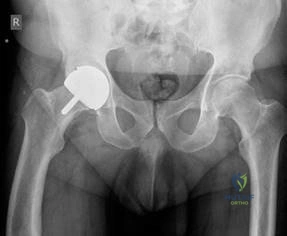
Candidate: I see an AP radiograph of a right-sided MoM hip resurfacing. The acetabular component appears to have a high abduction (lateral opening) angle, which exceeds the recommended 40 degrees. This is a known risk factor for edge loading, increased wear, and elevated metal ion levels. There is no evidence of loosening, neck narrowing, or the 'divot sign'. I am concerned about potential Adverse Reaction to Metal Debris (ARMD) and would proceed with blood tests and MARS-MRI.
Failing to mention the abduction angle, not identifying the "divot sign" risk, or treating it as a generic THA case without acknowledging the unique biology of MoM bearings (metal hypersensitivity vs. wear-related inflammation).
A systematic analysis: 1. **Positioning:** Comment on abduction/inclination (risk of edge loading). 2. **Component analysis:** Check for neck narrowing or the 'divot sign' (impingement/stress shielding). 3. **Risk Stratification:** Acknowledge the patient's demographics (female, small head size < 46mm) which are independent risk factors for ALVAL/pseudotumour.
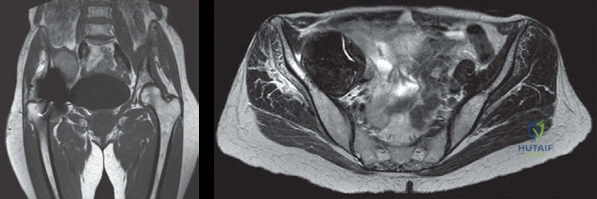
The patient undergoes an MRI due to your clinical suspicion. Interpret these findings.
Candidate: The coronal T2-weighted MARS-MRI demonstrates a large intra-pelvic soft-tissue mass consistent with a pseudotumour or ALVAL reaction. Given the symptomatic nature of the patient and the extent of the lesion, this necessitates urgent revision surgery.
Suggesting biopsy or conservative management. The correct management for a symptomatic, space-occupying pseudotumour is surgical revision.
Define the pathology as an ARMD (Adverse Reaction to Metal Debris). Explain that the management involves complete surgical excision (debridement of the mass) and conversion to a large-head Metal-on-Polyethylene or Ceramic-on-Polyethylene THA, avoiding another MoM surface.
What are the contraindications for hip resurfacing you would cite in a viva discussion?
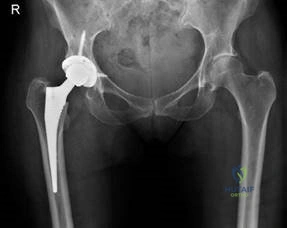
Candidate: Absolute contraindications include established osteonecrosis with large head cysts, severe osteoporosis, severe metal hypersensitivity, and patients with significant renal impairment. Relative contraindications include smaller femoral anatomy (risking neck fracture), BMI > 35, and female patients of childbearing age.
Listing only general arthroplasty contraindications (like age) without mentioning the specific resurfacing risks: femoral head cysts, neck anatomy, and the specific concern regarding female sex/metal sensitivity.
Categorize the response into: 1. **Bone Quality/Anatomy** (Osteoporosis, Cysts, Narrow Neck/Notching). 2. **Patient Factors** (Renal failure, Allergy, BMI). 3. **The "Exam Buzz":** Acknowledge that the procedure is now largely historical due to the failure rates associated with the ASR and other MoM systems, demonstrating current knowledge of literature.
