Ace Your Ewing's Sarcoma Examination Questions
Key Takeaway
Discover the latest medical recommendations for Ace Your Ewing's Sarcoma Examination Questions. For an examination question ewings, Ewing's sarcoma is characterized by small, round, blue cells on histology and typically presents with pain and swelling in adolescents. X-rays show a lytic, moth-eaten bone appearance with a classic "onion peel" laminated periosteal reaction. Management involves neo-adjuvant chemotherapy followed by surgical excision, due to its responsiveness to both chemotherapy and radiotherapy.
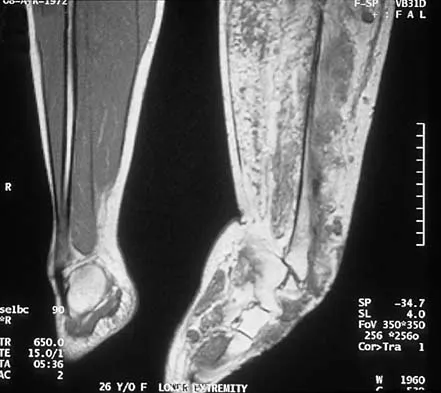
A 12-year-old boy presents with a 3-month history of progressive pain and swelling in the left mid-thigh. He is systemically well. You review the provided imaging.
What is your differential diagnosis, and how would you structure your further investigations?
Candidate: "Based on the age and the diaphyseal location with an onion-skin periosteal reaction, my top differential is Ewing's Sarcoma. Other possibilities include osteomyelitis, osteosarcoma, or eosinophilic granuloma. I would perform a systemic workup including bloods (ESR, CRP, LDH, FBC), an MRI of the entire femur, a CT chest, and a bone marrow biopsy, followed by a core needle biopsy of the lesion."
Candidates often fail to mention the need for systemic staging (Bone marrow/CT chest) or jump straight to biopsy without confirming the lesion's total intramedullary extent via MRI. Importantly, failing to mention the multidisciplinary team (MDT) or the necessity of a biopsy done in a specialized center is a major "red flag" for examiners.
The candidate must exhibit a structured approach:
1. Clinical Context: Acknowledge the "Small Round Blue Cell" differential (Ewing’s, Lymphoma, PNET, Osteomyelitis).
2. Imaging/Staging: Request MRI (whole bone) for local staging, CT Chest/Bone scan/PET for systemic staging.
3. Biopsy: Emphasize that the biopsy MUST be performed at the regional sarcoma unit where the patient will receive definitive treatment, using a core needle, not open excision.
4. MDT: State clearly that the plan will be directed by the Sarcoma MDT, likely involving neoadjuvant chemotherapy first ("chemoprimary" approach).
The biopsy confirms Ewing's Sarcoma with a t(11;22) translocation. How would you explain the management of this patient to the parents, specifically addressing the role of surgery vs. radiotherapy?
Candidate: "I would explain that this is a systemic disease requiring a multimodal approach. Chemotherapy is the backbone. For local control, we aim for surgical resection if wide margins are achievable without excessive morbidity. If surgery cannot achieve clear margins, or if the tumor is unresectable, we use radiotherapy. Often, both are used if the response to chemotherapy is incomplete."
Assuming that radiation is "worse" than surgery or implying that all Ewing's tumors require amputation. Failing to mention that in children, radiotherapy to an open physis causes permanent growth arrest and limb length discrepancy.
A sophisticated answer covers:
1. Multimodal Philosophy: Emphasize that local control is subordinate to systemic control.
2. Surgery vs. RT: Surgery (R0 resection) is preferred for local control, but radiotherapy is a highly effective alternative.
3. Pediatric Considerations: Specifically highlight that radiotherapy in a skeletally immature patient carries the high risk of growth plate destruction and secondary sarcoma development, which influences the surgical decision-making process.
