Orthopedic Trauma 2026 MCQs: Board Review Questions & Answers (Part 3)
Key Takeaway
Discover the latest medical recommendations for Orthopedic Trauma 2026 MCQs: Board Review Questions & Answers (Part 3). Top-rated Orthopedic Trauma 2026 MCQs bank. Practice with clinical case questions, orthopedic surgery board review, and evidence-based answers updated for 2026.
Orthopedic Trauma 2026 MCQs: Board Review Questions & Answers (Part 3)
Comprehensive 100-Question Exam
00:00
Start Quiz
Question 1
A left-handed 23-year-old man who fell 5 feet from a ladder onto his left elbow sustained the closed injury shown in Figure 26. Management should consist of
Explanation
Question 2
Which of the following is a long-term complication of ankle arthrodesis for posttraumatic arthritis?
Explanation
Question 3
A 19-year-old female long-distance runner has an incomplete tension-side femoral neck stress fracture. Management should consist of
Explanation
Question 4
A 7-year-old girl who sustained a type III posteromedial extension supracondylar fracture underwent a closed reduction at the time of injury. Figure 27a shows the position of the fracture fragments prior to percutaneous medial and lateral pin fixation. Following surgery, healing was uneventful and the patient regained a full painless range of motion. Fifteen months after the injury, she now reports loss of elbow motion and moderate pain with activity. A current AP radiograph is shown in Figure 27b. What is the most likely cause of her symptoms?
Explanation
Question 5
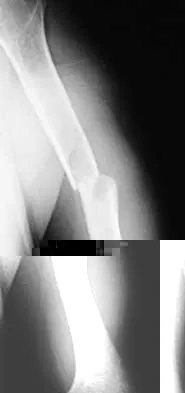
A 55-year-old man sustained an isolated closed fracture of the humerus. Initial neurologic examination reveals no active wrist or finger extension. Radiographs are shown in Figures 28a and 28b. Management should consist of
Explanation
Question 6
Examination of a 41-year-old man who was thrown from a motorcycle reveals that both legs appear externally rotated and there is bruising in the perineal area. He has a blood pressure of 80/40 mm Hg, a pulse rate of 140/min, a respiratory rate of 25/min, and he appears confused. Following administration of 4 L of saline solution and 2 units of packed red blood cells, he has a blood pressure of 80/40 mm Hg, a pulse rate of 160/min, and a respiratory rate of 25/min. The abdominal assessment for intraperitoneal blood is negative. An AP radiograph shows an anteroposterior compression injury with 7 cm of symphysis diastasis but no posterior displacement in the sacroiliac joints. What is the next most appropriate step in management?
Explanation
Question 7
A 32-year-old man sustained a closed injury after falling 25 feet from a roof. His ankle and foot are severely swollen. Radiographs and CT scans are shown in Figures 29a through 29d. Initial management should consist of
Explanation
Question 8
Which of the following parameters is considered most important when assessing an acetabular fracture for surgical indications?
Explanation
Question 9
A 57-year-old man has had right ankle pain for the past 10 months following an injury that went untreated. Radiographs are shown in Figures 30a through 30c. Management should consist of
Explanation
Question 10
A 32-year-old man sustains a forceful inversion injury while playing soccer. Examination reveals tenderness in the lateral hindfoot and midfoot region with associated ecchymosis and swelling. Radiographs show proximal migration of the os peroneum. Active eversion is still present. These findings indicate disruption of the
Explanation
Question 11
A 24-year-old man sustained a grade IIIb open tibial fracture and an ipsilateral grade IIIa femoral fracture in a motorcycle accident. He is unresponsive, intubated, and has a Glasgow Coma Scale score of 8. He is resuscitated and taken to the operating room for definitive orthopaedic care. Which of the following intraoperative problems will most likely adversely affect his long-term outcome?
Explanation
Question 12
Figure 31 shows the radiograph of an 8-year-old boy who has a swollen forearm after falling out of a tree. Examination reveals that all three nerves are functionally intact, and there is no evidence of circulatory embarrassment. Management should consist of
Explanation
Question 13
Figure 32 shows the radiograph of a laborer who jammed his thumb in a fall. Examination reveals pain at the base of the thumb and proximal thenar eminence region. Management should consist of
Explanation
Question 14
In displaced calcaneal fractures, what fragment is the only one that remains in its anatomic position?
Explanation
Question 15
A 46-year-old man sustains a calcaneal fracture in a fall off a scaffold. During surgical reconstruction using an extended lateral incision, the fracture is reduced and fixed with a plate and screws. One of the posterior facet screws is found to be 5 mm out of the bone on the Harris view. What structure is most likely at risk because of this finding?
Explanation
Question 16
A 23-year-old man sustained an injury to his left foot when a forklift rolled over it at work. Examination reveals marked swelling of the midfoot and forefoot, with tenderness to palpation over the medial hindfoot and dorsomedial forefoot. The distal dorsalis pedis pulse is audible on Doppler examination, and his sensation is intact to touch. Radiographs are shown in Figures 33a and 33b. Management should consist of
Explanation
Question 17
A 24-year-old woman who has hypotension, a head injury, and who experienced a poor response to resuscitation has been taken to the operating room for a splenectomy. Following abdominal surgery she remains unstable with increasing pulmonary respiratory pressures and decreasing oxygen saturation. She has a transverse mid-diaphyseal fracture of the tibia with a 4-cm laceration and soil-contaminated muscle in the wound. Based on these findings, management should consist of
Explanation
Question 18
A 53-year-old woman has severe neck and left shoulder pain after a rollover motor vehicle accident. Radiographs and a CT scan of the cervical spine are shown in Figures 34a through 34c. Management should consist of
Explanation
Question 19
What is the most common clinically significant preventable complication secondary to the treatment of a displaced talar neck fracture?
Explanation
Question 20
Examination of a carpenter who hit his thumb with a hammer reveals that the nail plate is broken but in place, and there is a 100% subungual hematoma that covers 100% of the area under the nail plate. Radiographs reveal a comminuted distal phalangeal tuft fracture. Management should consist of
Explanation
Question 21
An olecranon fracture-dislocation of the elbow in which the fracture line exits distal to the coronoid process is best managed by open reduction and
Explanation
Question 22
A 15-year-old baseball pitcher who reports increasing pain in his right shoulder over the past 3 weeks states that the pain increases the more he pitches. Radiographs of both shoulders are shown in Figures 35a and 35b. What is the next most appropriate step in management?
Explanation
Question 23
A 36-year-old man sustains a traumatic spondylolisthesis of L5 on S1. Surgical stabilization requires pedicular fixation into the sacrum. If the screw is placed in a medial to lateral direction and penetrates the sacral ala, what nerve root is at risk?
Explanation
Question 24
A 25-year-old woman who fell on her outstretched hand reports chronic pain over the hypothenar eminence region and some dorsal ulnar wrist pain. She also notes difficulty playing golf and tennis. Plain radiographs of the hand and wrist are unremarkable. A CT scan is shown in Figure 36. What is the next most appropriate step in management?
Explanation
Question 25
An active 72-year-old woman sustained a mid-diaphyseal right humerus fracture 16 months ago. History reveals that she was first treated with a brace for 7 months. Additional treatment consisted of intramedullary nailing 9 months ago. Recently the rod was removed, and the patient now reports pain and gross motion at the fracture site. Current radiographs are shown in Figures 37a and 37b. What is the next most appropriate step in management?
Explanation
Question 26
A 78-year-old female presents with a highly comminuted, intra-articular distal humerus fracture after a fall. Her bone quality is osteoporotic. Which of the following surgical options is associated with the most reliable return to independent activities of daily living in this specific patient demographic?
Explanation
Question 27
A 30-year-old male with a closed midshaft tibia fracture is treated with intramedullary nailing. Six hours postoperatively, he complains of pain out of proportion to the injury. His blood pressure is 110/70 mmHg. Direct measurement of the anterior compartment pressure reveals a value of 45 mmHg. What is the most appropriate next step in management?
Explanation
Question 28
A 25-year-old male arrives at the trauma bay hemodynamically unstable after a high-speed motorcycle collision. An AP pelvic radiograph demonstrates a symphysis pubis diastasis of 4 cm and widening of the sacroiliac joints consistent with an APC III injury. During initial resuscitation, a pelvic binder is applied. To maximize reduction of the pelvic volume, over which anatomical landmark should the binder be centered?
Explanation
Question 29
A 40-year-old construction worker falls from a height of 15 feet and sustains bilateral joint-depression calcaneus fractures. Which of the following injuries is most commonly associated with this mechanism of trauma and must be actively ruled out?
Explanation
Question 30
A 28-year-old female sustains a high-energy basicervical femoral neck fracture (Pauwels III) following a motor vehicle collision. Which of the following fixation constructs is biomechanically optimal to resist the high shear forces inherent in this fracture pattern?
Explanation
Question 31
A 35-year-old male sustains a purely ligamentous Lisfranc injury. There are no associated fractures, but weight-bearing radiographs show 3 mm of widening between the medial and middle cuneiforms. What is the recommended definitive treatment to optimize long-term functional outcomes?
Explanation
Question 32
A 50-year-old female sustains an open tibia fracture (Gustilo-Anderson IIIB) and undergoes initial surgical debridement and intramedullary nailing. A rotational muscle flap is planned. To minimize the risk of deep infection, what is the optimal timeframe for soft-tissue coverage?
Explanation
Question 33
A 22-year-old male presents with a closed, distal-third humeral shaft fracture. He is neurologically intact on initial evaluation in the emergency department. Following closed reduction and placement of a coaptation splint, he exhibits a complete wrist drop and inability to extend his metacarpophalangeal joints. What is the most appropriate next step in management?
Explanation
Question 34
A 45-year-old male presents with a high-energy pilon fracture. The limb exhibits marked soft-tissue swelling and extensive fracture blisters circumferentially. Definitive open reduction and internal fixation is planned. What is the most appropriate initial management?
Explanation
Question 35
A 60-year-old female taking alendronate for 10 years presents with 3 months of lateral thigh pain. Radiographs reveal diffuse cortical thickening of the lateral subtrochanteric femur with a transverse radiolucent 'beak' on the lateral cortex extending halfway through the bone. What is the most appropriate management?
Explanation
Question 36
A 32-year-old male is evaluated 8 weeks after open reduction and internal fixation of a displaced talar neck fracture. The AP radiograph of the ankle reveals a subchondral radiolucent band in the talar dome. What does this radiographic finding indicate?
Explanation
Question 37
A 48-year-old male sustains a posterior hip dislocation in a motor vehicle collision. The dislocation is successfully reduced closed in the emergency department within 2 hours of the injury. What is the most significant long-term complication associated with this injury?
Explanation
Question 38
A 29-year-old male sustains a terrible triad injury of the elbow (elbow dislocation, radial head fracture, and coronoid fracture). Operative management is planned. According to standard treatment algorithms, what is the typical sequence of surgical repair?
Explanation
Question 39
A 38-year-old male sustains an isolated, displaced, midshaft clavicle fracture with 2.5 cm of shortening. What is the primary established benefit of operative fixation over non-operative management for this specific injury pattern?
Explanation
Question 40
A 24-year-old male is brought to the trauma bay with scapulothoracic dissociation following a motorcycle accident. What is the most critical immediate life-threatening concern associated with this injury?
Explanation
Question 41
A 55-year-old male undergoes an extensile lateral approach for open reduction and internal fixation of a joint-depression calcaneus fracture. During the development of the full-thickness subperiosteal flap, which neurological structure is at highest risk of iatrogenic injury?
Explanation
Question 42
A 26-year-old male professional soccer player sustains an acute Zone 2 (Jones) fracture of the proximal fifth metatarsal. He wishes to return to play as safely and rapidly as possible. What is the most appropriate management?
Explanation
Question 43
A 33-year-old male sustains an anteroposterior compression (APC) pelvic ring injury. Which of the following anatomic disruptions defines an APC III injury and differentiates it from an APC II injury?
Explanation
Question 44
A 65-year-old male with a native hip sustains a low-energy anterior hip dislocation after a fall. Upon initial inspection in the emergency department, what is the typical clinical posture of the affected lower extremity?
Explanation
Question 45
A 40-year-old male sustains a low-velocity gunshot wound to the right thigh, resulting in a non-displaced midshaft femur fracture. Clinical examination reveals normal distal pulses and no neurologic deficits. What is the most appropriate initial management?
Explanation
Question 46
A 25-year-old male sustains a high-energy motor vehicle collision, resulting in a displaced talar neck fracture with dislocation of both the subtalar and tibiotalar joints. According to the Hawkins classification, what is the approximate expected rate of avascular necrosis (AVN) of the talar body for this injury pattern?
Explanation
Question 47
A 35-year-old male undergoes open reduction and internal fixation of a transverse posterior wall acetabular fracture via a Kocher-Langenbeck approach. Postoperatively, the patient demonstrates weak ankle dorsiflexion and eversion, but normal plantarflexion. Which nerve was most likely injured during the procedure?
Explanation
Question 48
A 40-year-old presents to the emergency department with a closed middle-third humeral shaft fracture and an immediate, complete radial nerve palsy upon initial presentation. What is the most appropriate initial management?
Explanation
Question 49
A 28-year-old male sustains a highly vertical, displaced femoral neck fracture (Pauwels III). Which fixation construct offers the most optimal biomechanical stability for this specific, high-shear fracture pattern?
Explanation
Question 50
A 45-year-old farmer is struck by a tractor, sustaining a Gustilo-Anderson Type IIIA open tibial shaft fracture heavily contaminated with soil and organic debris. Which initial intravenous antibiotic regimen is most appropriate?
Explanation
Question 51
A 50-year-old man sustains a high-energy bicondylar tibial plateau fracture. Axial and coronal CT imaging reveals a large, separate, and distally displaced posteromedial fragment. What is the optimal surgical approach to adequately address this specific fragment?
Explanation
Question 52
A 25-year-old male is brought to the trauma bay after a motorcycle crash with an Antero-Posterior Compression type III (APC-III) pelvic ring injury. He remains hypotensive despite 2 liters of crystalloid and application of a pelvic binder. A FAST exam is negative. What is the next best step in management?
Explanation
Question 53
A 40-year-old patient presents with a highly comminuted, displaced tibial pilon fracture resulting from a fall from height. The soft tissues are severely swollen with extensive fracture blisters spanning the ankle. What is the preferred initial management strategy?
Explanation
Question 54
A 60-year-old woman falls on an outstretched hand, sustaining a volar Barton's fracture of the distal radius. Which of the following best describes this fracture pattern and its optimal management?
Explanation
Question 55
A 22-year-old athlete sustains a midfoot sprain. Weight-bearing radiographs demonstrate a 3 mm diastasis between the base of the first and second metatarsals. What is the recommended treatment approach?
Explanation
Question 56
A 30-year-old male sustains a closed comminuted tibial shaft fracture. Which of the following clinical findings is the most sensitive early indicator of acute compartment syndrome?
Explanation
Question 57
A 45-year-old sustains a distal femur fracture. Coronal CT imaging demonstrates an isolated coronal shear fracture of the lateral femoral condyle (Hoffa fracture). Which surgical approach and fixation strategy is generally considered most appropriate?
Explanation
Question 58
In evaluating a patient with a displaced intra-articular calcaneus fracture, which of the following demographic or socioeconomic factors is most strongly associated with a poor clinical outcome and lower return-to-work rates following operative intervention?
Explanation
Question 59
A 24-year-old male falls on an outstretched hand and sustains a displaced fracture of the proximal pole of the scaphoid. He is at high risk for avascular necrosis (AVN) primarily due to which unique anatomical feature of the scaphoid's blood supply?
Explanation
Question 60
A 45-year-old man feels a 'pop' in his anterior elbow while lifting a heavy object. The Hook test is positive. If surgical repair of the distal biceps is performed utilizing a single-incision anterior approach, which nerve is at greatest risk of iatrogenic injury?
Explanation
Question 61
During open reduction and internal fixation of a bimalleolar equivalent ankle fracture, the intraoperative Cotton test reveals syndesmotic instability. Which of the following is an accepted biomechanical principle regarding syndesmotic screw fixation?
Explanation
Question 62
An 80-year-old woman with a well-fixed cementless total hip arthroplasty sustains a fall. Radiographs demonstrate a periprosthetic femur fracture extending around the stem, but the stem remains completely stable (Vancouver B1). What is the standard operative management?
Explanation
Question 63
A 35-year-old male involved in a high-speed MVC sustains an ipsilateral displaced midshaft clavicle fracture and a displaced scapular neck fracture ('floating shoulder'). What is the primary rationale for performing operative fixation of the clavicle in this specific scenario?
Explanation
Question 64
A 40-year-old male presents after a high-speed motorcycle crash. His blood pressure is 70/40 mmHg. Pelvic radiographs show an APC-III injury. A pelvic binder is applied, and 2 units of PRBCs are given. Repeat blood pressure is 75/40 mmHg. FAST exam is negative. What is the most appropriate next step in management?
Explanation
Question 65
A 45-year-old male is involved in a high-speed motorcycle crash. Pelvic radiographs demonstrate a widened symphysis pubis of 3.5 cm and widened anterior sacroiliac joints bilaterally, but the posterior sacroiliac ligaments remain intact. What is the most appropriate definitive management for this specific injury pattern?
Explanation
Question 66
A 30-year-old female falls from a significant height and sustains a Hawkins Type III talar neck fracture. Based on this classification, what is the approximate risk of developing avascular necrosis (AVN) of the talar body?
Explanation
Question 67
A 28-year-old male sustains a closed tibial shaft fracture and presents with out-of-proportion leg pain and tense compartments. Which of the following pressure measurements is the most reliable objective indicator for performing an emergent fasciotomy?
Explanation
Question 68
A 55-year-old male sustains a high-energy closed tibial pilon fracture. Clinical examination reveals massive soft tissue swelling, fracture blisters over the medial ankle, and threatened skin. What is the standard of care for the initial management of this injury?
Explanation
Question 69
During the operative management of a supracondylar distal femur fracture, a coronal plane fracture of the lateral femoral condyle (Hoffa fragment) is identified. Which surgical approach and fixation strategy is most appropriate for this specific fragment?
Explanation
Question 70
A 40-year-old man presents to the emergency department with a posterior hip dislocation and an associated posterior wall acetabular fracture following a dashboard injury. Which nerve is most commonly injured in this specific clinical scenario?
Explanation
Question 71
A 35-year-old female sustains a "terrible triad" injury of the elbow after a fall onto an outstretched hand. Which of the following correctly describes the anatomic components of this injury pattern?
Explanation
Question 72
A 22-year-old farmer sustains a Gustilo-Anderson Type IIIb open tibial shaft fracture heavily contaminated with soil and organic debris. According to current guidelines, what is the most appropriate initial empiric intravenous antibiotic regimen?
Explanation
Question 73
A 29-year-old motorcyclist presents with massive swelling over the shoulder girdle, a pulseless upper extremity, and a completely flail arm. Radiographs show extreme lateral displacement of the scapula. After the primary ATLS survey, what is the most critical initial diagnostic step?
Explanation
Question 74
A 45-year-old construction worker falls from scaffolding, sustaining a joint-depressed intra-articular calcaneus fracture. Bohler's angle is measured at 5 degrees. What is the primary anatomic goal of open reduction and internal fixation (ORIF) in this patient?
Explanation
Question 75
A 60-year-old female presents with a Schatzker Type II tibial plateau fracture. Which concomitant soft tissue injury is most commonly associated with this specific fracture pattern?
Explanation
Question 76
A 25-year-old male sustains a vertically oriented, displaced femoral neck fracture (Pauwels Type III) during a motor vehicle collision. What biomechanical complication is most likely to occur if this is fixed with standard multiple parallel cancellous screws alone?
Explanation
Question 77
A 32-year-old polytrauma patient presents with bilateral femoral shaft fractures, a grade IV liver laceration, and a severe pulmonary contusion. His lactate is 4.5 mmol/L, and pH is 7.21. What is the most appropriate initial orthopedic management for his femur fractures?
Explanation
Question 78
A 24-year-old football player sustains a hyperplantarflexion injury to his midfoot. Weight-bearing radiographs reveal a 3 mm diastasis between the base of the 1st and 2nd metatarsals. Injury to which of the following anatomic structures is the primary cause of this finding?
Explanation
Question 79
A 72-year-old female sustains a 4-part proximal humerus fracture. According to Hertel's radiographic criteria, which of the following findings is the strongest independent predictor of subsequent humeral head ischemia?
Explanation
Question 80
A 35-year-old male presents with a hemodynamically unstable pelvic ring injury after a motorcycle collision. To be most effective at reducing pelvic volume, at what anatomic level should a pelvic circumferential compression device (binder) be placed?
Explanation
Question 81
According to classic Godina principles, what is the optimal timeframe for definitive soft tissue coverage (flap) in a Gustilo-Anderson type IIIB open tibia fracture to minimize flap failure and infection rates?
Explanation
Question 82
A 24-year-old male with bilateral femoral shaft fractures undergoes intramedullary nailing. Postoperatively, he develops a petechial rash, confusion, and hypoxia. Which of the following is the most significant risk factor for this syndrome?
Explanation
Question 83
A 65-year-old female sustains a 3-part proximal humerus fracture with anteroinferior dislocation of the humeral head. Which muscle's function must be carefully assessed during the primary evaluation due to its high risk of denervation?
Explanation
Question 84
A 22-year-old football player presents with midfoot pain after his foot was axially loaded in plantar flexion. Radiographs show a "fleck sign" at the base of the second metatarsal. Which ligament is avulsed in this injury?
Explanation
Question 85
A 25-year-old male sustains a proximal pole scaphoid fracture. Which of the following best describes the primary vascular supply to the scaphoid that makes this fracture prone to nonunion and avascular necrosis?
Explanation
Question 86
A 30-year-old male with a comminuted tibial plateau fracture complains of pain out of proportion. Intracompartmental pressure monitoring is performed. Which value is the universally accepted threshold indicating four-compartment fasciotomy?
Explanation
Question 87
A 40-year-old female falls on an outstretched hand and sustains a "terrible triad" injury of the elbow. What are the three classic components of this injury pattern?
Explanation
Question 88
A 28-year-old man sustains a closed, high-energy vertically oriented femoral neck fracture (Pauwels Type III). Open reduction is performed via a Smith-Petersen approach to achieve an anatomic reduction. To maximize biomechanical stability and minimize shear forces across the fracture site, which of the following fixation constructs is most appropriate?
Explanation
None
