Anterior Approach to the Pubic Symphysis
The anterior approach to the pubic symphysis is an approach that is used almost exclusively for the open reduction and internal fixation of a ruptured symphysis or internal fixation of displaced fractures of the superior pubic ramus. Other uses include biopsy of tumors and treatment of chronic osteomyelitis.
Because widely displaced symphysis injuries often are associated with urologic damage, obtaining a urologic assessment is advisable before undertaking open surgery, which often includes a retrograde urethrogram. A urethral catheter must be inserted before surgery. A full bladder will seriously interfere with the surgical approach.
Position of the Patient
Place the patient supine on the operating table.
Landmarks and Incision
Landmarks
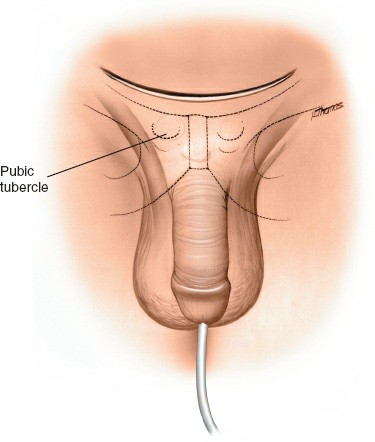
The superior pubic ramus and pubic tubercles are easily palpable in all but the most obese patients. The pubic symphysis will be palpable (as a gap) only in cases of rupture.
Incision
Make a 15-cm curved incision in the line of the skin crease, centering it about 1 cm above the pubic symphysis (Fig. 7-7).
Internervous Plane
An internervous plane is not available for use in this approach. Because the rectus abdominis muscles receive a segmental nerve supply, they are not denervated, even though they are divided by this approach.

Figure 7-7 Palpate the pubic tubercles. Make a curved incision in the line of the skin crease, centering it 1 cm above the pubic symphysis.
Superficial Surgical Dissection
Incise the subcutaneous fat in the line of the skin incision, deepening the incision down to the anterior portion of the rectus sheath (Fig. 7-8). Identify, ligate, and divide the superficial epigastric arteries and veins that run up from below across the operative field. Then, divide the rectus sheath transversely, about 1 cm above the symphysis pubis. The two rectus abdominal muscles now are visible (Fig. 7-9). In most cases of rupture of
the symphysis pubis, one of these muscles will have been detached from its insertion into the pubic symphysis. Divide the remaining muscle a few millimeters above its insertion into the bone.
Deep Surgical Dissection
Retract the cut edges of the rectus abdominal muscles superiorly to reveal the symphysis and pubic crest (Fig. 7-10). If access to the back of the symphysis is required, use the fingers or a swab to push the bladder gently off the back of the bone. Palpation of the posterior surface of the body of the pubis is useful to identify the correct direction for the insertion of screws. This dissection is very easy to perform unless adhesions have formed due to damage to the bladder. Such adhesions make it difficult to open up this potential space (the preperitoneal space of Retzius) (Fig. 7-11). The pubic symphysis and superior pubic rami now are exposed adequately for internal fixation.
Dang
Bladder
The bladder may have been damaged during the trauma. If so, adhesions will have developed between the damaged bladder and the back of the pubis. Mobilization of the space of Retzius, therefore, may lead to inadvertent bladder rupture. If fixation is considered in the presence of urologic damage, it is best to operate in conjunction with an experienced urologic surgeon.

Figure 7-8 Incise the fat in the line of the skin incision and retract the skin edges to reveal the anterior portion of the rectus sheath.


Figure 7-9 Divide the rectus sheath transversely 1 cm above the symphysis pubis to reveal the rectus abdominis muscles and pyramidalis.
How to Enlarge the Approach
Local Measures
Because of the considerable amount of subcutaneous fat in this area, it may be necessary to extend the skin incision and superficial dissection in both directions to allow better visualization of the deep structures in obese patients.
Extensile Measures
The approach can be extended laterally to expose the entire anterior column of the acetabulum and the inner wall of the ilium. (See ilioinguinal approach to acetabulum, page 378.)


Figure 7-10 Divide the rectus muscles 1 cm above their insertion and retract their cut edges superiorly to reveal the superior ramus of the pubis.


Figure 7-11 A: Open the plane behind the symphysis pubis, using your finger as a blunt dissector. B: The pubic symphysis and superior pubic rami now are exposed.
