ULNAR STYLOID FRACTURES
■ Following anatomic reduction of the distal radius fracture, insert the arthroscope in the dorsal 3/4 portal and the probe in the 6R portal. Palpate the tension of the articular disc.
■ Good tension indicates that the majority of the pe-
ripheral TFCC fibers are intact or still attached to the proximal ulna.
■ A peripheral tear of the articular disc is repaired
arthroscopically when detected.21
■ Stabilization of a large ulnar styloid fragment is considered when the articular disc is lax by palpation and no peripheral TFCC is identified (TECH FIG 5).
■ In this instance, the majority of the fibers of the TFCC
are attached to the displaced ulnar styloid fragment.
■ Make a small incision between the extensor carpi ulnaris and the flexor carpi ulnaris tendons and identify the fracture site.
■ Retrieve the distal fragment, which often displaces in a
distal and radial direction.
■ Mobilize the styloid fragment using a no. 15 blade, taking care to protect the TFCC insertion.
■ Reduce the fragment anatomically, under direct visual-
ization, and insert a guidewire in a retrograde manner for provisional stability.
■ Stabilize the ulnar styloid fragment using either a ten-
sion band technique (with wire and two K-wires) or, preferably, using a micro headless cannulated screw.
■ Place the cannulated headless screw over the guidewire and verify fracture reduction with fluoroscopy.
■ Insert the arthroscope into the 3/4 portal and the probe
into the 6R portal to document restoration of TFCC
tension.

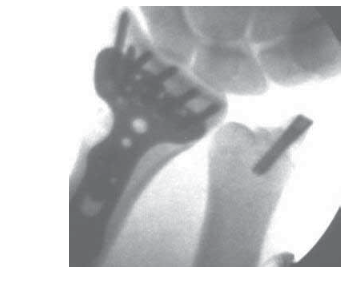
TECH FIG 5 • In this case, following reduction to the distal radius fracture, the articular disc was palpated and found to be lax but with no peripheral tear. The large ulnar styloid fragment was reduced with a micro Acutrak screw (Acumed, Hillsboro, OR).
PEARLS AND PITFALLS

POSTOPERATIVE CARE
■ The degree of postoperative immobilization depends on numerous factors, including the mode of fracture stabilization, the quality of the bone for internal fixation, the stability of the fixation, and the management of any associated soft tissue injuries that were addressed during the arthroscopic evaluation.
■ Immediate range of motion of the digits and wrist is initiated in patients with volar plate fixation with good bone stock and solid fixation.
■ In patients with soft osteopenic bone with volar plate fixation, digital range of motion exercises are initiated immediately, but wrist range of motion is delayed approximately 3 to
4 weeks to permit some fracture healing.
■ Soft bone may collapse around the rigid plate.
■ In patients without metaphyseal comminution treated by arthroscopically assisted stabilization with cannulated screws, range of motion is initiated as the patient tolerates.
■ In patients treated with percutaneous K-wires, the wrist is immobilized until the wires are removed, usually 4 to 6 weeks after surgery.
■ A patient with an unstable DRUJ treated by TFCC repair or ulnar styloid reduction and fixation is restricted from pronation and supination for 2 to 4 weeks.
OUTCOMES
■ The literature is relatively sparse regarding the results of arthroscopically assisted fixation of displaced intra-articular distal radius fractures.
■ A comparison study of 12 open and 12 arthroscopic reductions of comminuted AO type VII and VIII fractures of the distal radius found that the arthroscopic group had increased range of motion as compared to the open stabilization group.23
■ A second comparison study of 38 patients who underwent arthroscopically assisted fixation compared to open reduction found the arthroscopically assisted group had better results and improved range of motion.2
■ One study compared 15 patients with arthroscopically assisted fixation to 15 patients who underwent closed reduction and external fixation.21 In this study, there were 10 tears of the triangular fibrocartilage complex in the group that underwent arthroscopic reduction, of which seven were peripheral and repaired. There were no signs of distal radioulnar joint instability at final follow-up visit. In the 15 patients who underwent stabilization by external fixation alone, four patients had continued complaints of instability of the distal radial joint, very possibly the result of undiagnosed and untreated TFCC tears.
COMPLICATIONS
■ Failure of fixation
■ Late settling of the fracture despite fixation
■ Flexor and extensor tendon irritation
■ Painful metal requiring removal
■ Neuromas of the dorsal sensory branch of the radial and ulnar nerves
■ Carpal tunnel syndrome
■ Reflex sympathetic dystrophy
■ Wrist and hand stiffness
Scientific References
-
1\. Bradway JK, Amadio PC, Cooney WP. Open reduction and internal fixation of displaced comminuted intraarticular fractures of the distal end of the radius. J Bone Joint Surg Am 1989;71A:839–847.
2\. Doi K, Hatturi T, Otsuka K, et al. Intraarticular fractures of the distal aspect of the radius arthroscopically assisted reduction compared with open reduction and internal fixation. J Bone Joint Surg Am
1999;81A:1093–1110.
3\. Edwards CC III, Harasztic J, McGillivary GR, et al. Intraarticular distal radius fractures: arthroscopic assessment of radiographically assisted reduction. J Hand Surg Am 2001;26A:1036–1041.
4\. Fernandez DL, Geissler WB. Treatment of displaced articular fractures of the radius. J Hand Surg Am 1991;16:375–384.
5\. Geissler WB. Arthroscopically assisted reduction of intra-articular fractures of the distal radius. Hand Clin 1995;11:19–29.
6\. Geissler WB. Intra-articular distal radius fractures: the role of arthroscopy? Hand Clin 2005;21:407–416.
7\. Geissler WB, Freeland AE. Arthroscopically assisted reduction of intra-articular distal radial fractures. Clin Orthop Relat Res 1996;
327:125–134.
8\. Geissler WB, Freeland AE, Savoie FH, et al. Intracarpal soft-tissue lesions associated with an intra-articular fracture of the distal end of the radius. J Bone Joint Surg Am 1996;78A:357–365.
9\. Geissler WB, Savoie FH. Arthroscopic techniques of the wrist.
Mediguide to Orthopedics 1992;11:1–8.
10\. Hanker GJ. Wrist arthroscopy in distal radius fractures. Proceedings of the Arthroscopy Association North America Annual Meeting, Albuquerque, NM, October 7–9, 1993.
11\. Hixon ML, Fitzrandolph R, McAndrew M, et al. Acute ligamentous tears of the wrist associated with Colles fractures. Proceedings of the Annual Meeting of the American Society for Surgery of the Hand, Baltimore, 1989.
12\. Hollingworth R, Morris J. The importance of the ulnar side of the wrist in fractures of the distal end of the radius. Injury 1976;7:263.
13\. Knirk JL, Jupiter JB. Intra-articular fractures of the distal end of the radius in young adults. J Bone Joint Surg Am 1986;68A:647–658.
14\. Lafontaine M, Hardy D, Delince P. Stability assessment of distal radius fractures. Injury 1989;20:208–210.
15\. Levy HJ, Glickel SZ. Arthroscopic assisted internal fixation of intraarticular wrist fractures. Arthroscopy 1993;9:122–123.
16\. Lindau T. Treatment of injuries to the ulnar side of the wrist occurring with distal radial fractures. Hand Clin 2005;21:417–425.
2182
17\. Melone CP. Articular fractures of the distal radius. Orthop Clin
North Am 1984;15:217–235.
18\. Mohanti RC, Kar N. Study of triangular fibrocartilage of the wrist joint in Colles fracture. Injury 1979;11:311–324.
19\. Mudgal CS, Jones WA. Scapholunate diastasis: a component of fractures of the distal radius. J Hand Surg Br 1990;15:503–505.
20\. Ruch DS, Vallee J, Poehling GG, et al. Arthroscopic reduction versus fluoroscopic reduction in the management of intra-articular distal radius fractures. Arthroscopy 2004;20:225–230.
21\. Short WH, Palmer AK, Werner FW, et al. A biomechanical study of distal radial fractures. J Hand Surg Am 1987;12:529–534.
22\. Stewart NJ, Berger RA. Comparison study of arthroscopic as open reduction of comminuted distal radius fractures. Abstract. Presented at the 53rd Annual Meeting of the American Society for Surgery of the Hand. January 11, 1998, Scottsdale, AZ.
23\. Trumble TE, Schmitt SR, Vedder NB. Factors affecting functional outcome of displaced intra-articular distal radius fractures. J Hand Surg Am 1994;19:325–340.
