Patient Presentation and History
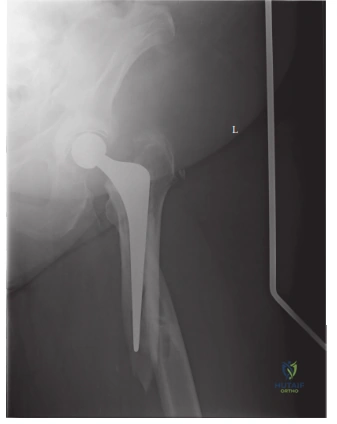
We present the case of a 78-year-old female who sustained a periprosthetic femoral fracture following a low-energy fall from standing height at her home. She presented to the emergency department with acute onset of severe left hip pain and an inability to bear weight on the affected limb. This case represents a complex reconstructive challenge frequently encountered in geriatric orthopedic trauma, necessitating a thorough understanding of arthroplasty principles, fracture biomechanics, and bone biology.
Her medical history includes a primary total hip arthroplasty on the left side approximately ten years prior for severe primary osteoarthritis. The index procedure involved a cementless, proximally porous-coated titanium femoral stem and a cementless hemispherical acetabular component with highly cross-linked polyethylene.
She has a long-standing diagnosis of osteoporosis, for which she has been on weekly oral alendronate for the past seven years. This prolonged bisphosphonate therapy raises clinical considerations regarding bone turnover rates, the potential for atypical fracture morphology, and the biological capacity for osseointegration of revision implants. Her medical comorbidities include essential hypertension, which is well-controlled on an ACE inhibitor, and Type 2 Diabetes Mellitus, managed with oral hypoglycemics. Her most recent Hemoglobin A1c was 6.8 percent, indicating adequate glycemic control, which is a critical factor for mitigating postoperative infection risk and ensuring optimal wound healing.
Her prior surgical history is non-contributory to the current presentation, including an appendectomy, cholecystectomy, and right knee arthroscopy. She has no known drug allergies.
Regarding her social history, she is a non-smoker and reports occasional alcohol use. Prior to this traumatic event, she lived independently with minimal assistance and was functionally active. She ambulated with a single-point cane for long distances, primarily for balance rather than structural support, indicating a relatively high baseline functional demand for her age cohort.
On initial assessment, the patient was hemodynamically stable, with vital signs within normal limits, effectively ruling out immediate life-threatening hemorrhagic shock, which, although rare in isolated closed proximal femur fractures, must always be considered in the geriatric trauma population. She reported immediate, excruciating pain in her left hip and thigh, exacerbated by any attempt at movement. A detailed history revealed no prodromal pain, mechanical symptoms such as catching or popping, or recent fevers, chills, or night sweats that might suggest an indolent periprosthetic joint infection or symptomatic aseptic loosening prior to the fall. The absence of antecedent thigh pain is particularly notable, as aseptic loosening often presents with start-up pain or activity-related discomfort in the thigh, corresponding to micromotion of the distal stem tip against the endosteal cortex.
Clinical Examination Findings
A comprehensive musculoskeletal and neurovascular examination was performed in the emergency department, revealing classical signs of a displaced proximal femoral fracture complicated by the presence of an intramedullary implant.
Inspection and Palpation
The left lower extremity was visibly shortened by approximately three centimeters, abducted, and externally rotated compared to the contralateral limb. This classic deformity is dictated by the unopposed pull of the iliopsoas on the lesser trochanter (if attached to the proximal fragment) and the short external rotators, combined with the loss of the structural fulcrum of the intact femur. Significant swelling and ecchymosis were observed around the left greater trochanter, extending distally along the lateral and anterior aspects of the proximal thigh.
Careful inspection of the integument revealed no open wounds, abrasions, or signs of impending skin compromise. The surgical incision from the index total hip arthroplasty, a standard posterolateral approach scar, appeared well-healed with mature cicatrization, demonstrating no erythema, fluctuance, or sinus tract formation that would raise suspicion for chronic periprosthetic infection.
Palpation elicited marked, exquisitely localized tenderness over the lateral aspect of the left proximal femur and greater trochanter. Palpable crepitus was readily noted with gentle, minimal manipulation of the limb, confirming the loss of structural continuity of the osseous cylinder. The pelvis was stable to anteroposterior and lateral compression stress, and there was no tenderness over the pubic symphysis or sacroiliac joints, decreasing the likelihood of a concomitant pelvic ring injury.
Range of Motion Assessment
Active and passive range of motion of the left hip was severely limited and effectively precluded by pain and mechanical instability. Any attempt at internal rotation or flexion caused significant patient distress and palpable motion at the fracture site rather than the articulation. Knee and ankle range of motion were grossly intact, but the patient was unable to actively perform a straight leg raise or heel slide due to the loss of the proximal femoral lever arm and severe pain inhibition.
Neurological and Vascular Evaluation
A meticulous neurovascular assessment is paramount in displaced periprosthetic fractures due to the proximity of the sciatic nerve posteriorly and the femoral neurovascular bundle anteriorly.
Distal neurovascular status was confirmed to be intact. Sensation to light touch and pinprick was normal in the dermatomal distributions of the femoral (L4), obturator (L3-L4), sciatic, superficial peroneal (L5), deep peroneal (L5), and tibial (S1) nerves. Motor function was assessed distal to the injury. Ankle dorsiflexion (tibialis anterior, deep peroneal nerve), plantarflexion (gastrocnemius-soleus complex, tibial nerve), and great toe extension (extensor hallucis longus, deep peroneal nerve) were preserved at full strength (Grade 5/5). The preservation of sciatic nerve function is a critical negative finding, given the significant displacement and external rotation of the distal fragment, which can occasionally tether or contuse the sciatic nerve against the posterior border of the greater trochanter or the implant itself.
Vascular examination revealed brisk capillary refill in the toes (less than two seconds). The dorsalis pedis and posterior tibial pulses were strong, symmetric, and easily palpable bilaterally. There were no clinical signs of distal ischemia, compartment syndrome of the thigh (a rare but limb-threatening complication), or venous congestion.
Imaging and Diagnostics
The diagnostic workup for a suspected periprosthetic fracture requires a systematic approach to define the fracture geometry, assess the stability of the existing implants, evaluate the remaining host bone stock, and rule out occult infection.
Radiographic Evaluation
Initial radiographic evaluation included an anteroposterior (AP) view of the pelvis, and dedicated AP and cross-table lateral views of the left hip and the entire length of the left femur. It is a fundamental principle of orthopedic trauma that imaging must visualize the joint above and the joint below the injury, and in the context of periprosthetic fractures, the entire length of the implanted hardware must be clearly delineated.

The radiographs revealed a spiral fracture of the proximal femur. The primary fracture line originated just distal to the lesser trochanter and extended distally for approximately eight centimeters, spiraling around the previously implanted cementless femoral stem. The fracture involved a complete cortical breach with significant medial and proximal translation of the distal femoral shaft relative to the proximal fragment and the implant.
Crucially, critical analysis of the bone-implant interface revealed definitive radiographic signs suggestive of aseptic femoral stem loosening that likely predated the traumatic event. Specifically, complete radiolucent lines measuring greater than two millimeters were observed at the bone-implant interface traversing multiple Gruen zones (specifically zones 1, 2, 6, and 7). Furthermore, there was clear evidence of subsidence of the femoral component. Comparison with historical radiographs obtained one year prior demonstrated a distal migration of the stem collar relative to the calcar of approximately eight millimeters. There was also evidence of a pedestal formation at the distal tip of the stem in Gruen zone 4, indicating micromotion and abnormal load transfer at the distal aspect of the implant. When comparing the AP and lateral views, there was evidence of gross change in the alignment of the stem within the medullary canal, transitioning from a neutral position to a varus alignment, confirming the loss of proximal osseous support.
The acetabular component, a cementless hemispherical shell, appeared well-fixed with no evidence of progressive radiolucent lines in DeLee and Charnley zones I, II, or III. The femoral head was concentrically reduced within the polyethylene liner, and there was no obvious radiographic evidence of catastrophic polyethylene wear or eccentric positioning of the femoral head.
Advanced Imaging Modalities
While plain radiographs are the cornerstone of diagnosis, advanced imaging is frequently mandated for preoperative planning in complex periprosthetic fractures. A high-resolution Computed Tomography (CT) scan of the left femur with metal artifact reduction sequence (MARS) was obtained.
The CT scan provided invaluable three-dimensional information regarding the fracture morphology and the remaining bone stock. It confirmed the spiral nature of the fracture and identified additional longitudinal split fractures extending distally along the linea aspera, which were not readily apparent on plain radiographs. These occult longitudinal splits are critical to identify, as they dictate the required length of the revision stem to achieve adequate diaphyseal bypass and prevent catastrophic intraoperative propagation during canal preparation.
Furthermore, the CT scan allowed for a precise volumetric assessment of the proximal femoral bone stock. It revealed significant endosteal osteolysis and cortical thinning in the proximal metaphysis, confirming that the proximal femur was structurally incompetent to support either the existing implant or a standard primary revision stem. The diaphyseal bone distal to the fracture, however, demonstrated adequate cortical thickness (isthmic cortices measured greater than four millimeters), suggesting it would be a suitable target for diaphyseal fixation of a revision stem.
Laboratory Analysis and Infection Rule Out
In any patient presenting with a loose arthroplasty component, whether complicated by a fracture or not, periprosthetic joint infection (PJI) must be considered the primary differential until proven otherwise. The acute trauma setting complicates this assessment, as systemic inflammatory markers can be elevated secondary to the fracture itself.
Serum erythrocyte sedimentation rate (ESR) and C-reactive protein (CRP) were drawn upon admission. The ESR was 28 mm/hr, and the CRP was elevated at 45 mg/L. While elevated, these values are consistent with the acute inflammatory response to a major long bone fracture. Given the lack of clinical signs of infection, the absence of prodromal symptoms, and the clear mechanical mechanism of failure (subsidence and subsequent fracture), an immediate preoperative joint aspiration was not deemed strictly necessary, though intraoperative tissue cultures and synovial fluid analysis (including alpha-defensin and leukocyte esterase if fluid was present) were planned as mandatory steps during the surgical intervention.
Preoperative Templating
Rigorous preoperative digital templating is mandatory. The goal of templating in this scenario is to determine the appropriate length and diameter of the revision stem required to bypass the most distal aspect of the fracture by a minimum of two cortical diameters.
Using the contralateral, intact femur as a reference for leg length and offset, and the fractured femur for canal dimension assessment, templating was performed for a modular, fluted, tapered titanium diaphyseal-engaging stem. The templating indicated that a stem length of at least 200 millimeters would be required to achieve adequate isthmic engagement distal to the lowest extent of the fracture lines identified on the CT scan. The anticipated distal diameter was templated at 15 to 16 millimeters to achieve a rigid interference fit within the intact diaphysis.
Differential Diagnosis
The presentation of a periprosthetic fracture requires a precise classification to guide surgical management. The differential diagnosis primarily revolves around distinguishing the exact nature of the fracture relative to the implant stability and the quality of the surrounding bone stock.
| Diagnostic Consideration | Clinical Presentation | Radiographic Findings | Management Implications |
|---|---|---|---|
| Vancouver B2 Periprosthetic Fracture | Acute pain following trauma. Implant was previously functioning but may have had occult loosening. | Fracture around or just distal to the stem. Clear evidence of stem loosening (subsidence, radiolucencies). Adequate remaining bone stock for diaphyseal fixation. | Requires revision arthroplasty. Internal fixation alone will fail due to the loose implant. Long diaphyseal-engaging stem is the gold standard. |
| Vancouver B3 Periprosthetic Fracture | Acute pain following trauma. Often a history of progressive thigh pain prior to the fracture. | Fracture around the stem with a loose implant. Severe proximal bone loss or comminution precluding standard diaphyseal fixation without augmentation. | Requires complex revision. Options include tumor megaprosthesis (proximal femoral replacement), impaction bone grafting, or massive structural allografts. |
| Vancouver B1 Periprosthetic Fracture | Acute pain following trauma. No prior symptoms of loosening. | Fracture around or just distal to the stem. The stem remains rigidly fixed to the proximal bone fragment. No subsidence or radiolucencies. | Managed with Open Reduction and Internal Fixation (ORIF) using locking plates, cerclage cables, and potentially cortical strut allografts. Implant retention is key. |
| Pathologic Fracture (Malignancy) | Trivial trauma. History of primary malignancy (breast, prostate, lung, renal, thyroid). | Destructive, lytic, or blastic lesions at the fracture site. Permeative cortical destruction not typical of simple mechanical failure. | Requires oncologic workup. Management may involve resection and tumor prosthesis, often combined with postoperative radiation therapy. |
| Septic Loosening with Secondary Fracture | History of fevers, chills, wound drainage, or progressive pain. Elevated inflammatory markers prior to trauma. | Periosteal reaction, rapid osteolysis, potentially gas in the soft tissues. Loose implant with fracture. | Two-stage revision is typically mandated. Immediate explantation, thorough debridement, antibiotic spacer placement, and delayed reconstruction. |
In this specific case, the definitive presence of stem subsidence and radiolucencies spanning multiple Gruen zones confirms that the implant is loose. The critical distinction then lies between a Vancouver B2 and a Vancouver B3 fracture. While there is significant proximal osteolysis, the CT scan confirmed adequate diaphyseal bone stock distal to the fracture to achieve rigid fixation with a fluted tapered stem. Therefore, the most accurate diagnosis is a Vancouver Type B2 Periprosthetic Femoral Fracture.
Surgical Decision Making and Classification
The management of periprosthetic femoral fractures is fundamentally dictated by the Vancouver Classification System, which assesses three critical variables: the location of the fracture, the stability of the implant, and the quality of the surrounding bone stock.
Application of the Vancouver Classification System
- Type A: Fractures in the trochanteric region (AG for greater trochanter, AL for lesser trochanter).
- Type B: Fractures around or just distal to the stem.
- B1: Well-fixed stem.
- B2: Loose stem, adequate bone stock.
- B3: Loose stem, inadequate bone stock.
- Type C: Fractures well below the stem, managed similarly to isolated femoral shaft fractures.
Our patient presents with a fracture surrounding the stem. The radiographic evidence of subsidence and complete radiolucent lines confirms the stem is loose. The presence of adequate isthmic cortical bone distal to the fracture, as confirmed by CT templating, classifies this definitively as a Vancouver B2 fracture.
Rationale for Operative Intervention
Non-operative management of displaced Vancouver B2 fractures is universally associated with catastrophic outcomes, including nonunion, persistent pain, severe limb shortening, and a high mortality rate due to the complications of prolonged immobility in the geriatric population (deep vein thrombosis, pulmonary embolism, pneumonia, decubitus ulcers). Therefore, operative intervention is absolutely indicated.
The Fallacy of Isolated Internal Fixation
A common pitfall in the management of periprosthetic fractures by inexperienced surgeons is the attempt to treat a Vancouver B2 fracture with isolated Open Reduction and Internal Fixation (ORIF) using plates and cables.
Because the implant is loose, it acts as a massive intramedullary toggle. If ORIF is performed without revising the stem, the mechanical loads of weight-bearing are transferred entirely through the fixation construct rather than being shared with the bone-implant interface. This inevitably leads to rapid fatigue failure of the plates and screws, catastrophic hardware pullout, and nonunion. The fundamental principle of treating a Vancouver B2 fracture is that the loose implant must be removed, and the fracture must be bypassed with a new, longer implant that achieves rigid fixation in the intact bone distal to the fracture.
Selection of Revision Construct
The surgical plan involves a revision total hip arthroplasty utilizing a long, cementless, fluted, tapered titanium stem.
The rationale for this specific implant design is rooted in the Wagner philosophy of diaphyseal fixation. The longitudinal flutes provide immediate rotational stability by biting into the endosteal cortex of the intact diaphysis. The two-degree or three-degree taper provides axial stability, resisting subsidence through a rigid interference fit. Titanium is chosen for its modulus of elasticity, which is closer to that of cortical bone compared to cobalt-chrome, thereby reducing stress shielding and promoting osseointegration. A modular stem design is preferred in this scenario, as it allows the surgeon to independently establish rigid distal fixation and then subsequently adjust the proximal body to optimize leg length, offset, and version, independent of the distal stem position.
Surgical Technique and Intervention
The surgical execution of a Vancouver B2 revision requires meticulous planning, an extensive surgical approach, and precise handling of compromised bone and soft tissues.
Patient Positioning and Anesthesia
The patient was cleared for surgery following a rapid but thorough preoperative medical optimization, including a cardiology consultation due to her age and hypertensive history. She was brought to the operating room and placed under general endotracheal anesthesia. A Foley catheter was inserted for precise intraoperative fluid management.
The patient was positioned in the lateral decubitus position on a radiolucent Jackson table, utilizing a peg board system for rigid pelvic stabilization. Careful padding of all bony prominences, particularly the contralateral peroneal nerve at the fibular head and the axilla, was ensured. The surgical field was prepped and draped in a standard sterile fashion, ensuring wide exposure from the iliac crest to the knee joint line to allow for distal extension of the surgical approach and intraoperative fluoroscopy.
Surgical Approach and Exposure
A standard posterolateral approach to the hip was utilized, incorporating the previous surgical incision. The deep fascia was incised in line with the skin incision. The gluteus maximus was split bluntly in line with its fibers.
Upon identifying the short external rotators, it was noted that the piriformis, obturator internus, and gemelli were attenuated and partially avulsed secondary to the fracture displacement. The remaining capsular structures were incised, exposing the proximal femur.
Given the distal extent of the fracture and the need for diaphyseal fixation, the exposure was extended distally. The fascia lata was split longitudinally. The vastus lateralis was elevated off the linea aspera from posterior to anterior, carefully coagulating the perforating branches of the profunda femoris artery. This subvastus/vastus-elevating approach provides excellent visualization of the lateral femur while preserving the anterior blood supply to the bone.
Extended Trochanteric Osteotomy (ETO)
In the setting of a Vancouver B2 fracture with a proximally loose stem, an Extended Trochanteric Osteotomy (ETO) is frequently utilized, and in this case, the fracture pattern itself essentially created a traumatic ETO. The proximal lateral fragment, containing the greater trochanter and the abductor insertion, was carefully mobilized.
If the fracture had not completely separated this fragment, a formal ETO would have been performed. The ETO serves multiple critical functions:
1. It provides unparalleled, straight-line access to the medullary canal, facilitating safe removal of the existing implant and any distal cement or pedestal.
2. It allows for direct visualization of the diaphyseal bone for precise reaming and stem insertion, significantly reducing the risk of i इंट्राoperative cortical perforation.
3. It preserves the vital abductor musculature attachment to the greater trochanter fragment, which can then be securely repaired to the new implant or the diaphyseal bone, optimizing postoperative abductor function and joint stability.
Implant Removal and Canal Preparation
The hip was dislocated, and the loose proximal fragment was retracted superiorly. As anticipated from the preoperative radiographs, the cementless femoral stem was grossly loose within the proximal metaphysis.

The stem was extracted with minimal force using a standard threaded slap-hammer extractor. There was no need for specialized extraction tools such as high-speed burrs or trephines, as the bone-implant interface had completely failed.
Following extraction, the acetabular component was meticulously evaluated. The liner was removed to inspect the locking mechanism. The titanium shell was tested for stability using a curved gouge and mallet; it was found to be rigidly fixed with no evidence of motion or retroacetabular osteolysis. Therefore, the decision was made to retain the well-fixed acetabular shell and simply exchange the highly cross-linked polyethylene liner for a new one of the appropriate inner diameter to match the planned revision femoral head.
Attention was then turned to the femoral canal. The canal was thoroughly debrided of all reactive fibrous tissue and neocapsule using a combination of long curettes and pituitary rongeurs. Multiple tissue samples were sent for aerobic, anaerobic, and fungal cultures, as well as permanent histologic sectioning to definitively rule out occult infection, adhering to strict oncologic-style sterile technique during the sampling process.
Femoral Reconstruction and Fixation Construct
The critical step of the procedure is achieving rigid distal fixation in the intact diaphysis. Continuous intraoperative fluoroscopy was utilized.
A ball-tipped guide wire was passed down the medullary canal, ensuring it remained centralized within the intact diaphysis and did not exit through the distal fracture lines. Flexible reamers were passed sequentially over the guide wire to clear the canal and determine the true isthmic diameter.
Following this, rigid, straight, fluted reamers corresponding to the chosen modular revision system were utilized. Reaming commenced at a diameter two millimeters smaller than the templated size and progressed in one-millimeter increments. The reaming was advanced until circumferential cortical chatter was felt, indicating engagement of the endosteal cortex in the diaphysis. The depth of reaming was carefully monitored to ensure the fluted portion of the stem would bypass the most distal aspect of the fracture by a minimum of five centimeters (approximately two cortical diameters).
Once the appropriate distal diameter was established (in this case, 16 millimeters), the trial distal stem was impacted into the canal. Rotational stability was assessed by applying a torsional force to the trial stem; rigid, unyielding fixation is mandatory. If any micromotion is detected, a larger diameter stem or a longer stem must be utilized.
With the distal stem rigidly fixed, the proximal trial body was assembled. The modularity allows for independent adjustment of version (typically setting it at 15 to 20 degrees of anteversion relative to the condylar axis) and height to restore leg length and offset. The hip was reduced with a trial femoral head, and stability was assessed through a full range of motion. Soft tissue tension was evaluated by the shuck test and the drop test; the construct was found to be highly stable with equal leg lengths compared to the contralateral side.
The trial components were removed, and the definitive implants were opened. The real distal stem was impacted into the diaphysis with vigorous mallet strikes until the distinct change in pitch indicated complete seating and a rigid interference fit. The proximal body was then impacted onto the distal stem via the Morse taper junction, ensuring clean and dry surfaces to maximize the cold-weld lock. A 36-millimeter ceramic femoral head was impacted onto the trunnion.
Fracture Reduction and Cable Fixation
With the intramedullary load-sharing device securely in place, attention was turned to the fracture fragments and the ETO. The proximal lateral fragment (the greater trochanter) was reduced anatomically to the proximal body of the revision stem and the medial calcar fragment.
Fixation was achieved using multiple heavy-duty titanium cerclage cables. A cable passer was used to carefully route the cables around the femur, ensuring they remained subperiosteal to preserve the blood supply and strictly avoiding the neurovascular bundle medially. Two cables were placed proximal to the lesser trochanter to secure the trochanteric fragment, and two additional cables were placed distally around the diaphyseal fracture lines to provide supplementary compression and rotational control of the spiral fragments around the rigid intramedullary stem.
The construct was evaluated under fluoroscopy, confirming anatomic reduction of the fracture fragments around the stem, appropriate seating of the implant, and complete bypass of the fracture zones. The wound was copiously irrigated with sterile saline. The vastus lateralis was repaired to its fascial origin. The short external rotators and capsule, where viable, were repaired through drill holes in the greater trochanter to enhance posterior stability. The deep fascia, subcutaneous tissues, and skin were closed in a layered fashion. A sterile occlusive dressing was applied.
Post Operative Protocol and Rehabilitation
The postoperative management of a complex periprosthetic fracture revision is as critical as the surgical execution. The protocol must balance the need for early mobilization to prevent medical complications with the necessity of protecting the fragile bone-implant interface and the fracture fixation construct.
Immediate Postoperative Care
The patient was transferred to the Post-Anesthesia Care Unit (PACU) and subsequently to the orthopedic ward. Hemoglobin and hematocrit were monitored closely, given the extensive surgical exposure and the intramedullary reaming, which can lead to significant hidden blood loss.
Intravenous antibiotics (Cefazolin) were continued for 24 hours postoperatively as standard prophylaxis. Given the high risk of venous thromboembolism (VTE) in this patient population, chemical prophylaxis was initiated. Based on current guidelines and the patient's bleeding risk profile, a low-molecular-weight heparin (Enoxaparin 40 mg subcutaneously daily) was commenced 12 hours postoperatively and planned for a duration of 35 days.
Weight Bearing Status and Physical Therapy
The weight-bearing protocol following a Vancouver B2 revision with a diaphyseal engaging stem is a subject of ongoing debate in the literature. However, modern fluted tapered stems designed for rigid diaphyseal interference fit are biomechanically capable of withstanding significant axial loads immediately.
In this case, given the rigid intraoperative fixation achieved and the supplementary cerclage cabling, the patient was allowed toe-touch weight bearing (TTWB), defined as less than 2