Pathology and healing of fractures
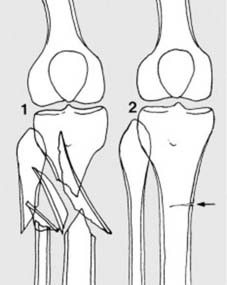
1
Initial definitions: Fracture:
A fracture is present when there is loss of continuity in the substance of a bone. The term covers all bony disruptions, ranging from one end of the scale when (1) a bone is broken into many fragments (multifragmentary or comminuted fracture) to (2) hair-line and even microscopic fractures at the other. To the layman the word ‘fracture’ implies a more severe injury than a simple break in the bone, but in the strict medical sense there is no difference between these terms.
2
Open fractures:
All fractures are either
closed or open
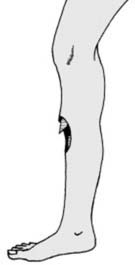
. In an open fracture there is a wound in continuity with the fracture, and the potential exists for organisms to enter the fracture site from outside. All open fractures therefore carry the risk of becoming infected. In addition, blood loss from external haemorrhage may be significant. (Note: the term ‘compound’ is still frequently used to describe a fracture which is open; the term ‘simple’, to describe a closed fracture, may lead to confusion, and is now largely abandoned.)
3
Closed fracture:
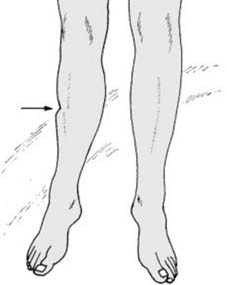
In a closed fracture the skin is either intact, or if there are any wounds these are superficial or unrelated to the fracture. So long as the skin is intact, there is no risk of infection from outside. (Blood-borne infection of closed fractures is extremely rare.) Any haemorrhage is internal.
4
Dislocation:
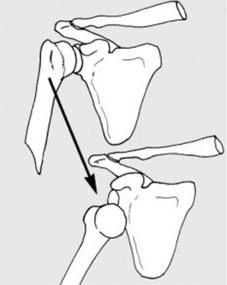
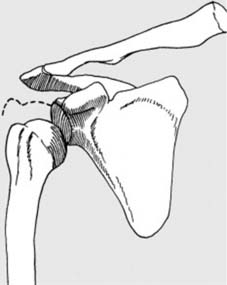
In a dislocation there is complete loss of congruity between the articulating surfaces of a joint. The bones taking part in the articulation are displaced relative to one another; e.g. in a dislocated shoulder the head of the humerus loses all contact with the glenoid. In the common anterior dislocation the head of the humerus is displaced anteriorly.
5
Subluxation:
In a subluxation, the articulating surfaces of a joint are no longer congruous, but loss of contact is incomplete. The term is often used to describe the early stages in a condition which may proceed to complete dislocation (e.g. in a joint infection or in rheumatoid arthritis).
6
Sprain:
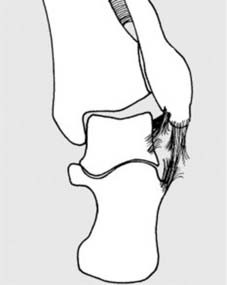
A sprain is an incomplete tear of a ligament or complex of ligaments responsible for the stability of a joint; e.g. a sprain of the ankle is a partial tear of the lateral ligament and is not associated with instability (as distinct from a complete tear). The term sprain is also applied to incomplete tears of muscles and tendons.
7
Causes of fracture: Direct violence (a):
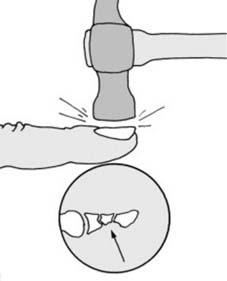
Fractures are caused by the application of stresses which exceed the limits of strength of a bone. Violence is the commonest cause. In the case of
direct violence
, a bone may be fractured by being struck by a moving or falling object, e.g. a fracture of the terminal phalanx of a finger by a hammer blow.
8
Direct violence (b):
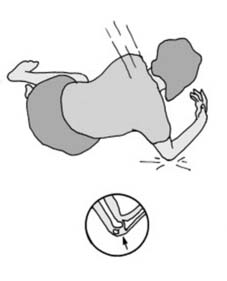
A bone may also be fractured if
it
forcibly strikes a resistant object. For example, a fall on the point of the elbow may fracture the olecranon.
9
Indirect violence:
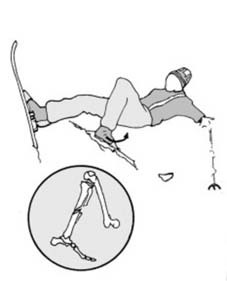
Very frequently fractures result from indirect violence.
A twisting or bending stress is applied to a bone, and this results in its fracture at some distance from the application of the causal force. For example, a rotational stress applied to the foot may cause a spiral fracture of the tibia. Indirect violence is also the commonest cause of dislocation.
10
Fatigue fractures:
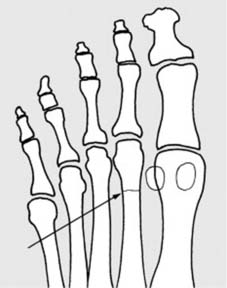
Stresses, repeated with excessive frequency to a bone, may result in fracture. This mechanism is often compared with fatigue in metals which break after repeated bending beyond their elastic limit. The commonest of these fractures involves the second metatarsal – the march fracture (so called because of its frequency in army recruits).
11
Pathological fractures (a):
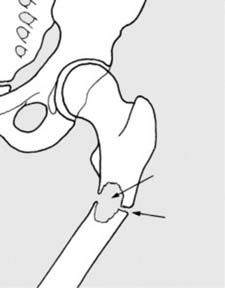
A pathological fracture is one which occurs in an abnormal or diseased bone. If the osseous abnormality reduces the strength of the bone then the force required to produce fracture is reduced, and may even become trivial. For example a secondary tumour deposit may lead to a pathological fracture of the subtrochanteric region of the femur – a common site.
12
Pathological fractures (b):
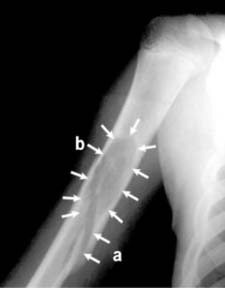
Pathological fractures may also occur at the site of simple tumours, e.g. a fracture of the humerus (a) in a child with a simple bone cyst (b).
The commonest causes of pathological fracture are osteoporosis and osteomalacia.
NEXT
Fracture patterns and their significance: Hair-line fractures
