Score: 0%
ORTHOPEDIC MCQS ONLINE 013 BASIC
A 70-year-old man is experiencing neck pain, progressive weakness, and numbness in his arms and legs without bowel or bladder dysfunction or dysphagia. Upon examination, he has atrophy of his upper extremities but normal muscle bulk in his legs. Strength is diffusely 4/5 throughout. Cervical spine radiographs show spondylosis. Electromyography (EMG) reveals fibrillations with increased amplitude in the extensor carpi radialis and pronator teres. Nerve conduction studies demonstrate slowing conduction diffusely in the sural, peroneal, and ulnar nerves, and severe slowing in the median nerve. Testing of the tongue and thoracic paraspinal muscles does not show fibrillations or positive short waves. What is the most likely diagnosis?
.Sclerostin and dickkopf-1 (Dkk-1) are direct inhibitors of what pathway related to bone and/or cartilage regulation?
A 62-year-old woman has advanced osteoarthritis of the knee that has been refractory to nonsurgical treatment. She wishes to discuss total knee arthroplasty. She reports a lifelong history of intolerance to most jewelry and is concerned about having an allergic reaction to the metallic knee implant.Hypersensitivity to metal implants is usually classified as what type of Gell-Coombs reaction?
A surgeon decides to report outcomes for a new surgical procedure that he has performed on 10 patients who have a rare type of arthritis. He provides data on the functional and subjective patient outcomes.This type of study design is best described as a
A study is proposed in which 2 groups of patients are randomized to treatment with bisphosphonates or placebo. This is an example of what study type?
-A 5-year-old boy has a history of delayed walking and difficulty climbing stairs. Physical examination shows a positive Gower sign and scoliosis. Laboratory tests show elevated serum creatine phosphokinase.A mutation of what protein results in this disorder?
After sustaining a muscle contusion injury, prolonged immobilization leads to
Delayed-onset muscle soreness (DOMS) is initially evident at the muscle tendon junction and can spread throughout the entire muscle. It is primarily associated with what type of exercise?
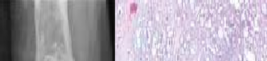
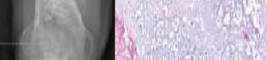
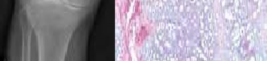
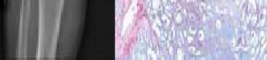
-Figures 13a and 13b are the radiograph and biopsy specimen of a 72-year-old woman who had increasing thigh pain for several months. She fell at home and was suddenly unable to bear weight on her right side.What is the most appropriate diagnostic test?
Implants composed of polylactic acid are excreted by what system after they are absorbed?
What role does quorum sensing play in the development of a bacterial biofilm?
A 14-year-old boy sustained a right forearm fracture after a moderate-speed fall while skateboarding. He was previously treated for fractures of his left femur and right tibia, all from low-energy mechanisms.He has had some mild vertigo since school age, but otherwise has had an unremarkable birth and growth history. His family history is significant for frequent fractures (his mother). On examination,he has slightly blue sclerae, grossly normal hearing, and normal dentition. Chest, abdomen, and pelvis radiographs reveal a mild curvature of the spine (Cobb angle 10 degrees) and suggestion of a slightly large aortic knob. Findings from a nonaccidental trauma workup were normal. This boy’s bones are fragile because of a gene mutation affecting what protein?
-A 5-year-old boy sustains a Salter-Harris type II fracture of the distal femur. One year later, he is noted to have radiographic evidence of injury. Injury to the physis occurred through which cellular layer?
-A patient sustains a grade III medial collateral ligament injury. One year later, when compared to collagen in an uninjured ligament, an increase is likely in the
-During endochondral ossification of the growth plate, the process that most contributes to the longitudinal growth of long bones is
-A 32-year-old man who is a smoker sustained an open tibial fracture and underwent a staged treatment with placement of an intramedullary nail. Four weeks after surgery, he developed a pseudomonas deepwound infection. What is the strongest predictor of persistent infection if implants are retained until fracture union?
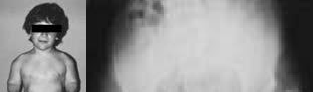
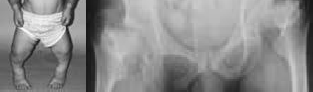
The patient shown in Figures 22a and 22b has what defect or deficiency?
-Premature arrest following growth plate injury is attributed to what mechanism?
-Bacterial resistance to tetracycline is confirmed by ribosome protection, tetracycline modification, and
Patients with Friedreich ataxia are most likely to have what condition?
-What protein promotes tumor cell attachment to bone during metastasis?
-A 14-year-old boy has failed physical therapy management for Scheuermann kyphosis, and an extension thoracolumbosacral orthosis brace is recommended. The boy and his parents are told that the brace will force his thoracic spine into normal sagittal alignment and put the anterior vertebral bodies of the thoracic segment into tension, which will induce bone growth and normalization of wedge-shaped vertebrae. What name is associated with this process?
-A tendon repair is thought to be weakest during which phase of tendon healing?
-A 4-year-old boy has bilateral genu varum and is in the fifth percentile for height for his age. A younger sister has less severe genu varum. Radiographs reveal physeal cupping and widening on both the distal femur and proximal tibia. Laboratory studies show sodium 145 mEq/L (reference range, 136-142 mEq/L),potassium 4.0 mEq/L (reference range, 3.5-5.0 mEq/L), calcium 9.0 mg/dL (reference range, 8.2-10.2 mg/dL), phosphorous 2 mg/dL (reference range, 4-6.5 mg/dL), vitamin D 50 ng/mL (reference range, 30-100ng/mL), and urine phosphorus 2 g/24-hour collection (reference range, 0.4-1.3 g). What effect would treatment with only Calcitriol (1,25 dihydroxy vitamin D3) have?
A 35-year-old woman began to train for a half marathon. After 8 weeks of increasing her mileage, what changes can you expect in her Achilles tendon?
-Tendon fibroblasts detect applied strain through what mechanism?
-What mechanism is most likely responsible for the initiation of mechanical failure seen at the midstem modular junction of modular revision hip stems?
-A 45-year-old man develops a nonunion after undergoing external fixation of an open femoral shaft fracture. The procedure is revised with an open reduction and internal fixation, all intraoperative cultures are negative, and specimens from the fracture site are sent for biopsy. Histological analysis most likely will reveal
-In articular cartilage, Interleukin 1 (IL-1) increases
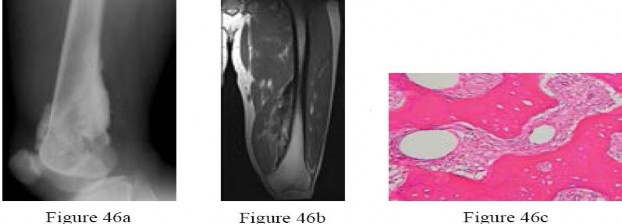
-Figures 46a through 46c are the radiograph, MRI scan, and biopsy specimen of a 42-year-old patient who has a slowly enlarging thigh mass. There is no significant past medical history or history of trauma.Examination reveals a firm mass with slight tenderness. The erythrocyte sedimentation rate and complete blood count findings are within defined limits. What is the most appropriate treatment?
-The initiating cellular event in development of posttraumatic osteoarthritis is attributed to which of the following?
-What polyethylene processing step results in increased polyethylene wear and subsequent osteolysis?
-The ability of compressed cortical bone to resist greater applied force in the longitudinal plane than in the transverse plane is an illustration of what material property?
-Decreased sun exposure leads to decreased bone health via what mechanism?
-What proteinaceous compound binds to hyaluronic acid to function as an effective boundary molecularlayer in articular cartilage?
-Reverse total shoulder arthroplasty improves kinematics in the rotator cuff deficient joint by what directional change to the center of rotation?
-What method of spinal fixation requires the largest force to disrupt the bone-implant interface?
-Amphotericin exerts antifungal activity by
-What factor induces myofibrillar muscle protein synthesis (MPS)?
-Etanercept modifies the natural history of inflammatory arthropathies through what mechanism?
-A 62-year-old man developed a pelvic mass 5 years after undergoing a metal-on-metal hip resurfacing arthroplasty (MOMHRA). A biopsy was performed and the histologic diagnosis of pseudotumor was made. What mechanism is associated with MOMHRA-related pseudotumors?
-Alveolar rhabdomyosarcoma (ARMS) was diagnosed in a 6-year-old boy after an incisional biopsy. What is the most common genetic abnormality in this tumor?
-An article in a leading orthopaedic journal describes a randomized controlled study comparing 2 popular and comparable surgical methods for fixation of hip fractures. Patients were randomized by a predetermined computer-generated list. There was approximately 20% crossover between treatment groups. Evaluation of study outcomes (clinical and radiographs) was performed by one of the surgeons participating in the study. Enrollment goals for appropriate power were achieved and final 1-year followup was obtained for 65% of patients. According to Oxford Group criteria, what is the appropriate level of
evidence for this study?
evidence for this study?
-What factor most significantly contributes to increased risk for pseudotumor formation in patients with metal-on-metal implants?
-Osteoclastic bone resorption is stimulated primarily by what molecular interaction?
--What human bone disease would result from loss of osteoprotegrin (OPG) protein?
--Degradation of the extracellular matrix in cancer metastasis is associated with
-How are free radicals removed from highly cross-linked polyethylene?
-Trabecular bone is remodeled through the formation of
-You have been waiting to enroll a patient into your recent institutional review board (IRB)-approved clinical research protocol. A patient is admitted who, upon initial screening, meets all inclusion criteria.However, he has late-stage dementia, and you are told by your research coordinator that this condition is an exclusionary criterion. This scenario demonstrates the need for which aspect of proper informed consent?
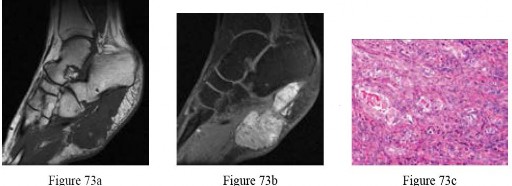
-Figures 73a through 73c are the MRI scans and biopsy specimen of a 37-year-old patient who has had a slowly enlarging right foot mass for 6 months. Medical and trauma histories are unremarkable.Examination reveals a firm mass with no substantial tenderness. What genetic defect most commonly is associated with this tumor?
--Figure 74a is the radiograph taken after of a 54-year-old man underwent an uncomplicated metal-on-metal left total hip replacement 2 years ago. He continued to have hip pain and discomfort after undergoing surgery. Figure 74b is the MRI scan taken 2 years later. Figure 74c shows the hematoxylin and eosin(H&E) stain of the subsequent biopsy. The patient is noted to have an erythrocyte sedimentation rate(ESR) of 100 mm/h (reference range, 0-20 mm/h) and a C-reactive protein (CRP) of 20 mg/dL (reference range, 0.0-.05 mg/dL). This patient should have surgery for debridement and receive administration of


-What molecules have been shown to promote fibrosis during muscle injury?
-Particulate wear debris is central to the mechanisms responsible for aseptic loosening. The severity of the biologic response to particulate polyethylene wear debris is directly proportional to particle
What dominant intracellular proteins become directly phosphorylated as a result of bone morphogenetic protein (BMP) binding to its receptors?
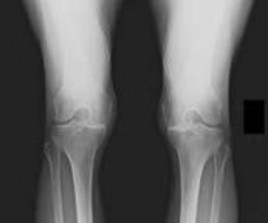
-Figure 81 is the radiograph of a healthy 72-year-old man who has a 3-month history of medial knee pain.He denies any specific trauma. Until 3 months ago when the pain began, he had been an avid runner for many years. Initial treatment should be oral anti-inflammatory medication
--Several techniques have been developed to improve the wear characteristics of polyethylene. What technique results in the largest reduction of free radicals?
--A 45-year-old previously healthy woman has experienced weakness and fatigability for 2 months. She states she feels best in the morning, but tires easily with exertion. If she sits and rests her strength improves, but she easily tires with each activity. When her fatigue is most severe, she has double vision.Physical examination is positive for ptosis with upward gaze after 20 seconds. When she holds her arms out straight she shows good initial strength, but rapidly decreasing strength with time.
What is the pathologic cause of her muscle weakness?
What is the pathologic cause of her muscle weakness?
--You are studying a single continuous variable after administration of a defined treatment intervention.Your statistician informs you the data are not normally distributed. What is the best test to analyze the data?
--An otherwise healthy 50-year-old man who is a smoker undergoes a posterior spine fusion with instrumentation for spondylolisthesis. What can the patient do to minimize his risk for pseudarthrosis?
-A researcher decides she wants to look at the current total number of patients who have methicillinresistant _Staphylococcus aureus_(MRSA) infections in a hospital on 1 particular day. What is the researcher measuring?
--A 48-year-old man who is scheduled to undergo total knee replacement has an X-linked clotting disorder that leads to abnormal bleeding and recurrent, spontaneous hemarthrosis. Before undergoing surgery, he should have replacement therapy of
-What is the recommended optimal timing of presurgical antibiotic administration to prevent infection in patients undergoing total joint replacement surgery?
-Bacterial resistance to antibiotics in biofilm is an example of
--A 19-year-old man sustains a thigh contusion over his quadriceps muscle while skateboarding. He is treated with several days of immobilization followed by gradually increasing range of motion and activity.Histologic analysis of a biopsy of the healing muscle in the mobilization state at 4 weeks from the date of injury would be characterized by
-A patient with Paget disease who is intolerant of bisphosphonates is given calcitonin. What is the mechanism of action of calcitonin?
-A cartilage water content increase is the hallmark of which osteoarthritis stage?
-Figures 99a through 99c are the hematoxylin and eosin (H&E) stain, S-100 stain, and MRI scan,respectively, of a tumor removed from a 42-year-old man. This type of tumor is most commonly associated with a condition that is transmitted in what type of pattern?
-A man who weighs 75 kg (165 pounds) is scheduled for elective total hip arthroplasty. He reports a history consistent with anaphylaxis from penicillin. Within 1 hour of the incision the patient should receive 1000 mg of
