1. The immune system is broadly categorized into two branches: the innate and the adaptive, with interaction and overlap between the two ( Fig. 1.48).
-
The innate system is primitive, nonspecific, the first line of defense using complement and leukocytes.
- Is antigen independent and involves NK cells , mast cells, basophils, eosinophils, macrophages, neutrophils, and dendritic cells
- Barriers—physical and chemical components (e.g., enzymes, pH)
- Skin—sebum, sweat (lysozyme, RNases and DNases, defensins, cathelicidins)
- Mucous membranes (IgA is most common immunoglobulin)
- Respiratory epithelium
- Urinary tract
- Recognition of pathogens by innate system
-
Pathogen-associated molecular patterns (PAMPs) on microbes are recognized by TLRs on innate immune system cells (e.g., macrophages and dendritic cells).
- Example of a PAMP is bacterial lipopolysaccharide (LPS), which is recognized by TLR-4.
- There is an upregulation of NF-κB transcription factor, resulting in release of immune mediators (e.g., IL-1, IL-6, TNF-α).
- IL-6 causes the liver to release inflammatory mediators such as CRP.
- Arachidonic acid released from cell membranes is acted on by COX and 5-lipoxygenase to make prostaglandins and leukotrienes that mediate exudation, chemotaxis, and bronchospasm.
-
Ibuprofen inhibits COX and reduces
prostaglandin production, preventing renal efferent arteriolar relaxation and increasing GFR.
- Factor (XII)—inflammatory protein made in the liver
- When exposed to collagen under damaged endothelium, activates coagulation
- Acute production of coagulation factors elevates ESR.
- Complement
- Activated by IgM or IgG antigen (Ag) complexes, microbial products, or mannose on microorganisms
- Mediates chemotaxis of PMNs, opsonization (tagging of evasive bacteria for elimination in the spleen), and membrane attack complex lysis of microbes, among other functions
- The adaptive system is more complex, is antigen dependent, and works through antigen presentation with B and T lymphocytes and antibodies.
- Response to a pathogen generates an immunologic memory in the adaptive system.
- Antigens are ligands recognized by the immune system. The smallest part of an antigen “seen” by a T- or B-cell receptor is an epitope.
- Cell mediated—T lymphocytes (helper, CD4+; cytotoxic, CD8+), macrophages
- Targets intracellular bacteria, virus, fungi, parasites, tumors, and transplanted organs/orthopaedic hardware
- Antigen-presenting cells (APCs— macrophages, dendritic cells, certain B cells, and Langerhans cells) process antigens.
- Humoral—B lymphocytes and their matured counterparts, plasma cells. Both produce antibodies.
- Targets exotoxin-mediated disease, encapsulated bacterial infection, other viral infections
- Each B cell makes antibodies specific to one single epitope (antigen). B cells use immunoglobulins (IgM and IgD) as cell membrane receptors.
- Terminally differentiated B cells are called plasma cells. The difference is that they secrete immunoglobulins into fluid.
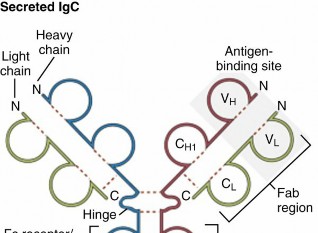
- Immunoglobulins ( Fig. 1.49) (mnemonic: MADGE)
- IgM: heaviest, first in the adaptive response
- IgA: in mucosal surfaces (e.g., MALT [mucosa-associated lymphoid tissue]) and secretions
- IgD: only on B-cell surfaces
- IgG: also on B-cell surface but also secreted.
- Mediates opsonization; later in the adaptive response
-
IgE: on the surface of mast cells (allergic reactions), basophils, and eosinophils (response to parasite).


FIG. 1.49 Basic subunit structure of the immunoglobulin molecule. C H and C L , Constant regions; Fab, antigen-binding fragment; Fc, crystallizable fragment; V H and V L , variable regions.
From Katz VL et al: Comprehensive gynecology,
ed 5, Philadelphia, 2007, Mosby. - Once secreted, antibodies can defend by a variety of mechanisms.
- Neutralization of viruses and toxins
- Opsonization
- Complement activation (IgG and IgM)
- Antibody cellular cytotoxicity
- Prevention of adherence and colonization (IgA)
- Cellular response in inflammation
- Neutrophil response—first cells recruited to sites of tissue injury
- Margination, rolling, adhesion, chemotaxis, and phagocytosis
