Tumors of the Hand and Wrist: Surgical Management
Key Takeaway
The management of hand and wrist tumors requires a meticulous understanding of complex anatomy, oncologic staging, and reconstructive principles. This guide details the evidence-based surgical approaches for benign lesions, malignant sarcomas, and tumorous conditions like ganglion cysts and Paget's disease. Emphasizing limb salvage and functional restoration, it provides orthopedic surgeons with critical insights into biopsy techniques, tumor resection margins, and advanced reconstructive protocols.
Comprehensive Introduction and Patho-Epidemiology
The evaluation and management of tumors and tumor-like conditions in the hand and wrist present a highly complex and unique challenge to the orthopedic surgeon. The dense concentration of critical neurovascular, tendinous, and articular structures within a severely confined anatomical space demands meticulous surgical planning. While the vast majority of hand masses are benign or represent pseudotumors (such as ganglion cysts or epidermoid inclusion cysts), the potential for primary or metastatic malignancy must never be overlooked. The diagnostic trap of assuming a painless, slow-growing mass is benign has historically led to catastrophic outcomes, including unwarranted marginal excisions of unrecognized sarcomas, thereby converting a potentially salvageable limb into an obligate amputation.
Epidemiologically, tumors of the hand and upper extremity are overwhelmingly benign, comprising over 95% of all presentations. Ganglion cysts account for approximately 50% to 70% of all soft-tissue masses in the hand and wrist, followed by giant cell tumors of the tendon sheath, epidermoid cysts, and lipomas. Primary osseous tumors are far less common, with enchondromas representing the most frequent benign primary bone tumor of the hand, typically localized to the proximal phalanges and metacarpals. Giant cell tumors of bone (GCT), osteoid osteomas, and aneurysmal bone cysts (ABC) occur with significantly less frequency but exhibit more locally aggressive behavior requiring complex reconstructive strategies.
Primary malignant tumors of the hand are exceedingly rare, representing less than 5% of all hand malignancies, which themselves are predominantly cutaneous in origin (squamous cell carcinoma, basal cell carcinoma, and melanoma). Chondrosarcoma is the most common primary malignant bone tumor of the hand, often arising secondary to a pre-existing enchondroma or osteochondroma, particularly in patients with multiple hereditary exostoses or Ollier disease. Soft tissue sarcomas, such as epithelioid sarcoma and synovial sarcoma, are the most frequently encountered non-cutaneous malignancies. Epithelioid sarcoma is particularly notorious for presenting as a benign-appearing, painless subcutaneous nodule or chronic ulceration, leading to frequent misdiagnosis, delayed treatment, and a high propensity for regional lymphatic spread.
The pathophysiology of these lesions spans a wide spectrum of genetic and molecular aberrations. For instance, solitary enchondromas frequently harbor somatic mutations in the IDH1 or IDH2 genes, leading to the accumulation of the oncometabolite D-2-hydroxyglutarate, which alters chondrocyte differentiation. Giant cell tumors of bone are driven by the RANK/RANKL pathway, where neoplastic stromal cells express RANKL, recruiting and activating multinucleated osteoclast-like giant cells that cause aggressive osteolysis. Understanding these molecular pathways is no longer purely academic; it directly influences modern surgical management, providing targets for neoadjuvant therapies such as denosumab (a monoclonal antibody against RANKL) to downstage aggressive GCTs prior to surgical resection.
Detailed Surgical Anatomy and Biomechanics
The surgical anatomy of the hand and wrist is defined by its compact, highly functional architecture, which severely limits the application of standard musculoskeletal oncology principles. In the lower extremity, thick fascial septa define distinct anatomical compartments that can contain tumor growth and allow for wide intra-compartmental or extra-compartmental resections. In stark contrast, the hand possesses a paucity of robust fascial barriers. The palmar fascia, while thick centrally, arborizes into delicate septa that poorly contain aggressive neoplasms. Furthermore, the extensive network of synovial sheaths, bursae, and potential spaces (such as the midpalmar, thenar, and Parona's spaces) serve as conduits for rapid tumor dissemination and hematoma tracking, complicating both staging and surgical extirpation.
The functional biomechanics of the hand rely on the precise interplay of the extrinsic and intrinsic musculotendinous units, stabilized by a complex retinacular and ligamentous system. Resection of tumors in the digits often threatens the integrity of the flexor tendon pulleys (specifically the critical A2 and A4 pulleys) or the extensor mechanism (central slip and lateral bands). An oncologic resection that sacrifices the A2 pulley without immediate or staged reconstruction will result in profound flexor tendon bowstringing, drastically reducing active range of motion and grip strength. Similarly, wide resection of metacarpal tumors alters the moment arms of the interosseous and lumbrical muscles, disrupting the delicate balance of the intrinsic-plus posture and potentially leading to a claw deformity if the intrinsic insertions are not functionally bypassed or reconstructed.
Vascular anatomy also dictates surgical limits. The superficial and deep palmar arches provide a robust collateral circulation to the digits, but the intimate association of soft tissue sarcomas or aggressive benign tumors (such as giant cell tumors of the tendon sheath) with the digital neurovascular bundles often requires meticulous microsurgical dissection. When a tumor encases a digital artery, the surgeon must assess the adequacy of collateral flow from the contralateral digital vessel. If both vessels are compromised, or if a wide resection of a malignancy demands sacrifice of the neurovascular bundle, the surgeon must be prepared to perform interpositional vein grafting or accept the necessity of a ray amputation to achieve negative oncologic margins while maintaining a functional, albeit modified, hand.
Furthermore, the wrist joint represents a biomechanical marvel where the proximal carpal row acts as an intercalated segment. Resection of distal radius or carpal tumors disrupts the radiocarpal and midcarpal ligamentous complexes (such as the scapholunate interosseous ligament). Tumors originating from the distal radius, such as GCTs, frequently expand into the subchondral bone, necessitating wide en bloc resection that sacrifices the articular surface. Reconstructing this defect requires complex solutions, such as vascularized fibular autografts or massive osteoarticular allografts, often culminating in a total wrist arthrodesis to provide a stable, painless fulcrum for the digital flexors and extensors, albeit at the complete sacrifice of wrist kinematics.
Exhaustive Indications and Contraindications
The decision-making process in hand tumor surgery is governed by the delicate balance between achieving absolute oncologic clearance and preserving maximal hand function. The Enneking surgical staging system remains the foundational framework for determining the appropriate surgical margin: intralesional, marginal, wide, or radical. The indications for surgical intervention are dictated not only by the histologic diagnosis but also by the lesion's biologic behavior, its anatomical location, and the patient's functional demands.
Surgical intervention is definitively indicated for any hand mass exhibiting rapid growth, rest pain, night pain, or progressive neurologic deficit (such as compression of the median nerve in the carpal tunnel by a lipofibromatous hamartoma or synovial sarcoma). For benign, asymptomatic lesions like small enchondromas or occult ganglion cysts, observation with serial clinical and radiographic examinations is a highly appropriate and often preferred strategy. However, prophylactic curettage and bone grafting of an enchondroma are indicated if the lesion occupies greater than 50% of the cortical diameter, due to the unacceptably high risk of pathologic fracture during normal hand use.
Contraindications to limb-sparing tumor resection in the hand are strict and must be respected to prevent oncologic disaster. Absolute contraindications to limb salvage include major neurovascular encasement by a high-grade sarcoma where functional reconstruction is impossible, extensive soft tissue contamination from a poorly executed prior biopsy, or an inability to achieve negative margins without rendering the hand completely functionless. In such scenarios, a radical resection, often taking the form of a ray amputation or below-elbow amputation, becomes the obligate, life-saving intervention. Medical comorbidities that preclude prolonged anesthesia or complex microvascular reconstruction also serve as relative contraindications to extensive limb salvage procedures.
| Condition / Tumor Type | Surgical Indication | Surgical Contraindication | Preferred Margin / Approach |
|---|---|---|---|
| Ganglion Cyst | Pain, mechanical restriction, cosmetic concern, nerve compression. | Asymptomatic, resolving spontaneously. | Marginal Excision (Open or Arthroscopic). |
| Enchondroma | Pathologic fracture, pain, >50% cortical thinning, diagnostic uncertainty. | Asymptomatic, incidental finding with thick cortices. | Intralesional Curettage + Adjuvant + Graft/PMMA. |
| Giant Cell Tumor (GCT) | Progressive osteolysis, impending fracture, joint destruction. | Medically unstable for prolonged reconstruction. | Extended Curettage or Wide Resection. |
| Glomus Tumor | Classic triad (pain, cold intolerance, point tenderness), nail deformity. | Ambiguous symptoms without MRI or clinical confirmation. | Marginal Excision (Transungual). |
| Schwannoma | Progressive pain, paresthesias, motor weakness, enlarging mass. | Asymptomatic, non-progressive incidentaloma. | Marginal Enucleation (Epineurotomy). |
| Lipofibromatous Hamartoma | Compression neuropathy (e.g., carpal tunnel syndrome). | Attempting complete tumor resection (causes paralysis). | Carpal Tunnel Release (Decompression only). |
| Chondrosarcoma | Biopsy-proven malignancy, cortical breakthrough, soft tissue mass. | Metastatic disease where local control does not improve quality of life. | Wide Resection or Ray Amputation. |
| Soft Tissue Sarcoma | High-grade lesion, local recurrence, progressive growth. | Inability to achieve negative margins with limb salvage. | Wide Local Excision or Amputation + Radiation. |
Pre-Operative Planning, Templating, and Patient Positioning
Pre-operative planning is the most critical phase in the management of hand and wrist tumors, beginning with a comprehensive imaging algorithm. Standard orthogonal radiographs are mandatory, evaluating the lesion's zone of transition, periosteal reaction, and matrix mineralization. A narrow zone of transition with a sclerotic margin suggests a slow-growing, benign process, whereas a wide, ill-defined zone with cortical destruction and "onion-skin" or "sunburst" periosteal reactions mandates a high suspicion for aggressive or malignant pathology. Magnetic Resonance Imaging (MRI) with and without gadolinium contrast is the gold standard for evaluating soft tissue masses, delineating the relationship of the tumor to the flexor/extensor tendons, and identifying the intraosseous and extraosseous extent of bone tumors. CT scans are invaluable for assessing remaining bone stock and planning osteotomies, while a PET-CT or CT of the chest, abdomen, and pelvis is required for systemic staging of malignant lesions.
The surgical biopsy is an operative step that can dictate the success or failure of subsequent limb salvage surgery. A poorly planned biopsy can contaminate adjacent compartments, converting a salvageable limb into an obligate amputation. The biopsy tract must always be placed in line with the planned definitive surgical incision so it can be excised en bloc during the final resection. Longitudinal incisions are strictly mandated in the extremities; transverse incisions contaminate multiple neurovascular planes and are anathema in orthopedic oncology. Furthermore, while exsanguination by gravity elevation is permitted, the use of an Esmarch bandage over a suspected tumor is absolutely contraindicated, as the mechanical compression can seed tumor cells into the systemic circulation. Meticulous hemostasis prior to closure is mandatory to prevent a post-biopsy hematoma, which acts as a vehicle for local tumor dissemination along fascial planes.
Patient positioning is typically supine with the operative arm extended on a radiolucent hand table. A pneumatic tourniquet is applied to the proximal arm, but as noted, exsanguination must be performed via elevation alone if malignancy is suspected. The use of loupe magnification (typically 2.5x to 4.5x) or an operating microscope is essential for the meticulous dissection required around the digital nerves and vessels. For complex reconstructions involving vascularized bone grafts (e.g., free fibula flap), the ipsilateral or contralateral lower extremity must be prepped and draped into the sterile field, requiring a two-team approach to minimize operative time and tourniquet ischemia.
Templating for bone tumor resection and reconstruction requires precise measurements of the anticipated defect. When planning a curettage and grafting for an enchondroma, the surgeon must calculate the volume of the void to ensure adequate availability of autograft (e.g., from the distal radius or iliac crest), allograft, or polymethylmethacrylate (PMMA) bone cement. For wide resections of the distal radius or metacarpals, 3D-printed patient-specific instrumentation (PSI) and custom cutting guides are increasingly utilized. These tools allow for exact translation of the pre-operative virtual surgical plan to the operating room, ensuring negative oncologic margins while perfectly matching the geometry of the planned allograft or autograft reconstruction.
Step-by-Step Surgical Approach and Fixation Technique
Intralesional Curettage for Enchondroma
Enchondromas are typically managed with intralesional curettage and grafting. The surgical approach involves a dorsal longitudinal incision over the affected phalanx or metacarpal. The extensor mechanism is either split longitudinally (for proximal phalanges) or retracted laterally to expose the periosteum. A high-speed burr or osteotome is utilized to create an oval cortical window, which must be large enough to access the entire medullary canal without creating a stress riser that could precipitate a postoperative fracture.
Meticulous intralesional curettage is performed using angled and reverse-angle curettes. The cavity must be aggressively scraped down to healthy, bleeding cortical bone, removing all gelatinous, avascular cartilaginous tissue. Following mechanical debridement, chemical adjuvants are employed to eliminate microscopic disease. The cavity is swabbed with 88% phenol for three cycles of one minute each, followed by copious neutralization with absolute alcohol, or treated with hydrogen peroxide and pulsatile lavage. The resulting void is then packed tightly with cancellous autograft, allograft, or PMMA. PMMA provides immediate structural stability, allowing for early mobilization, and the heat of polymerization provides an additional thermal adjuvant effect against residual tumor cells.
Management of Giant Cell Tumor of Bone (GCT)
GCTs in the hand exhibit a remarkably aggressive clinical course compared to those in long bones. Simple curettage is associated with unacceptably high recurrence rates. The surgical management requires extended curettage, utilizing a high-speed burr to expand the cavity beyond the reactive zone. Cryosurgery using liquid nitrogen is often employed as a physical adjuvant, rapidly freezing and thawing the cavity to induce cellular necrosis, though care must be taken to protect adjacent soft tissues and neurovascular structures from frostbite injury.
For lesions with extensive cortical destruction or joint involvement, wide en bloc resection is indicated. If a metacarpal is resected, reconstruction may involve a non-vascularized fibular autograft or a massive structural allograft, secured with a titanium locking plate. Arthrodesis of the adjacent metacarpophalangeal (MCP) or carpometacarpal (CMC) joint may be necessary to provide a stable construct, recognizing the permanent loss of motion in exchange for oncologic clearance and local control.
Transungual Excision of Glomus Tumors
Glomus tumors, benign hamartomas of the neuromyoarterial glomus body, classically present with a triad of severe pain, cold intolerance, and point tenderness, most commonly in the subungual region. The surgical technique begins with a digital block and a digital tourniquet. The nail plate is carefully elevated and removed using a Freer elevator, preserving it for use as a biological splint postoperatively.
A longitudinal incision is made directly through the sterile matrix over the bluish discoloration of the tumor. The tumor is typically a well-encapsulated, distinct, pearl-like mass that can be enucleated bluntly using tenotomy scissors or the tip of a scalpel. Meticulous care must be taken not to rupture the capsule. Following enucleation, the nail bed is meticulously repaired with 6-0 or 7-0 absorbable chromic gut or Vicryl sutures under loupe magnification to prevent postoperative nail dystrophy. The native nail plate is then replaced and secured with a figure-of-eight suture to act as a stent, maintaining the eponychial fold and protecting the repair.
Resection of Malignant Tumors (Ray Amputation)
For primary malignancies such as chondrosarcoma or epithelioid sarcoma confined to a single digit or metacarpal, a radical ray amputation provides definitive wide margins. The incision is designed as a racquet shape around the base of the involved digit, extending proximally over the metacarpal. The digital nerves are identified, placed under tension, sharply transected, and allowed to retract deep into the intrinsic musculature to prevent painful neuroma formation in the surgical scar.
The digital arteries are securely ligated. The extensor and flexor tendons are transected proximally. The metacarpal is then osteotomized at its base or disarticulated at the CMC joint, depending on the required oncologic margin. To prevent a cosmetically and functionally disruptive gap in the hand, a transposition of the adjacent digit (e.g., transposing the index finger to the third metacarpal base following a middle finger ray amputation) may be performed, meticulously repairing the deep transverse metacarpal ligament to restore the integrity of the transverse metacarpal arch.
Tumorous Conditions: Paget's Disease of Bone
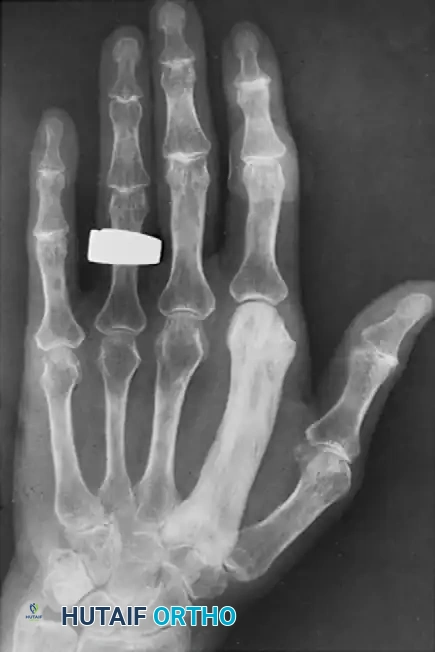
Paget's disease (osteitis deformans) is a disorder of abnormal bone remodeling characterized by excessive osteoclastic resorption followed by disorganized osteoblastic bone formation. While it commonly affects the pelvis, femur, and skull, involvement of the hand is exceptionally rare. When the hand is involved, it may present as a monostotic or polyostotic process, causing localized pain, bony enlargement, and severe deformity. Radiographically, the affected bones demonstrate cortical thickening, trabecular coarsening, and osseous expansion.
Surgical intervention for Paget's disease in the hand is rarely indicated unless there is a pathologic fracture or severe deformity causing functional impairment. Medical management with bisphosphonates is the primary treatment. If surgery is required (e.g., corrective osteotomy or fracture fixation), the surgeon must be prepared for highly vascular bone, which can lead to significant intraoperative hemorrhage. The disorganized woven bone also poses a high risk for hardware failure and delayed union. Furthermore, any sudden increase in pain or rapid swelling in a Pagetic bone must immediately raise the clinical suspicion for malignant transformation to secondary osteosarcoma, a devastating complication that carries a grave prognosis and mandates immediate biopsy and aggressive oncologic management.
Complications, Incidence Rates, and Salvage Management
The surgical management of hand and wrist tumors is fraught with potential complications, ranging from minor wound healing issues to catastrophic loss of limb function or oncologic recurrence. The confined anatomy of the hand means that even minor complications, such as postoperative edema or hematoma, can lead to severe joint stiffness and tendon adhesions, drastically compromising the final functional outcome.
Local recurrence is a primary concern, particularly for aggressive benign lesions and inadequately resected malignancies. Giant cell tumors of the hand have a recurrence rate approaching 30-50% when treated with simple curettage alone. The use of high-speed burring and chemical/thermal adjuvants reduces this rate significantly, but rigorous postoperative surveillance remains mandatory. Ganglion cysts also exhibit a notable recurrence rate (10-15% for dorsal cysts, higher for volar cysts) if the stalk and a window of the joint capsule are not adequately excised.
Nerve injury is a devastating complication, particularly during the resection of volar wrist ganglions (risk to the palmar cutaneous branch of the median nerve) or the enucleation of peripheral nerve tumors. While schwannomas can typically be enucleated while preserving the functional nerve fascicles, damage to these fascicles can result in permanent sensory or motor deficits. Attempted resection of a lipofibromatous hamartoma is a classic pitfall that will result in catastrophic, irreversible neurologic deficit; the salvage for this error is complex nerve grafting or tendon transfers, which yield universally inferior results compared to the native nerve.
| Complication | Estimated Incidence | Risk Factors | Salvage Management / Prevention |
|---|---|---|---|
| Local Tumor Recurrence | 10-50% (varies by tumor) | GCT histology, marginal excision of sarcoma, incomplete ganglion stalk removal. | Re-excision with wider margins, adjuvant radiation, or amputation. |
| Iatrogenic Nerve Injury | 2-5% | Volar ganglion excision, schwannoma enucleation, complex sarcoma resection. | Microsurgical primary repair, nerve autografting, or palliative tendon transfers. |
| Postoperative Stiffness | 15-30% | Prolonged immobilization, hematoma, extensive soft tissue dissection. | Aggressive hand therapy, tenolysis, or surgical capsulotomy if refractory. |
| Pathologic Fracture | 5-10% | Enchondroma >50% cortical width, inadequate PMMA/graft packing. | Internal fixation (mini-fragment plates) with concurrent tumor curettage/grafting. |
| Infection / Wound Breakdown | 3-8% | Prior radiation, extensive flap coverage, immunocompromise. | Aggressive surgical debridement, targeted IV antibiotics, flap revision. |
| Malignant Transformation | <1% (Paget's, Enchondroma) | Polyostotic Paget's disease, Ollier disease, Maffucci syndrome. | Radical resection / amputation, systemic chemotherapy based on histology. |
Phased Post-Operative Rehabilitation Protocols
The postoperative rehabilitation of hand tumors is highly variable and must be meticulously tailored to the extent of the resection, the stability of the reconstruction, and the biological nature of the tumor. The overarching goal is to protect the surgical repair while preventing the rapid onset of tendon adhesions and joint contractures that plague upper extremity surgery.
Phase I: Acute Protective Phase (0-2 Weeks)
Immediately postoperatively, the hand is immobilized in a bulky, non-compressive soft dressing or a custom-molded orthosis (typically a volar resting splint) to allow for primary wound healing and strict edema control. Elevation of the extremity above the level of the heart is mandatory to minimize swelling. For benign lesion excisions (e.g., ganglion cysts, simple enchondroma curettage), early active range of motion (AROM) of the uninvolved digits is initiated on postoperative day one. The surgical site is protected, but prolonged immobilization is strictly avoided to prevent stiffness.
Phase II: Early Mobilization and Tendon Gliding (2-6 Weeks)
Once the sutures are removed at 10-14 days, the rehabilitation protocol advances. If a large cortical window was created for an enchondroma and grafted, protective splinting is maintained during manual labor or heavy lifting, but AROM and active-assisted range of motion (AAROM) are aggressively pursued. Tendon gliding exercises are critical to prevent adhesions between the flexor/extensor mechanisms and the underlying bone graft or PMMA. Scar massage and silicone gel sheeting are introduced to optimize soft tissue pliability.
Phase III: Strengthening and Dynamic Splinting (6-12 Weeks)
As radiographic evidence of bone graft incorporation or osteotomy healing becomes apparent (typically around 6-8 weeks), progressive resistance exercises are initiated. Grip and pinch strengthening are gradually introduced using putty, hand dynamometers, and free weights. If joint contractures have developed despite early mobilization, dynamic or static-progressive splinting is fabricated by the hand therapist to provide a low-load, prolonged stretch to the affected tissues.
Phase IV: Return to Function and Oncologic Surveillance (>12 Weeks)
Return to unrestricted work or athletic activities is permitted once full functional range of motion and near-symmetric grip strength are achieved. For patients who have undergone limb salvage for malignant lesions, this phase involves adaptive functional training, potentially utilizing custom orthotics to compensate for lost motor function. Crucially, strict oncologic surveillance protocols must be established. This involves serial clinical examinations, local site MRIs, and chest CTs at regular intervals (e.g., every 3 months for the first 2 years, then every 6 months) based on the specific tumor histology and Enneking stage, ensuring rapid detection of any local recurrence or distant metastasis.
Summary of Landmark Literature and Clinical Guidelines
The surgical management of hand and wrist tumors is guided by a robust body of literature and established clinical guidelines that dictate the standard of care. The foundational principles of musculoskeletal oncology were established by William F. Enneking in the 1980s. His surgical staging system for benign and malignant bone and soft tissue tumors remains the universal language by which orthopedic oncologists communicate and plan surgical margins. Enneking's work definitively established that the biologic grade of the tumor and its anatomic setting (intracompartmental vs. extracompartmental) are the primary determinants of surgical outcome.
The National Comprehensive Cancer Network (NCCN) provides continuously updated, evidence-based guidelines for the management of Soft Tissue Sarcomas and Bone Sarcomas. For soft tissue sarcomas of the extremity, the NCCN guidelines emphasize the absolute necessity of a pre-treatment core needle or carefully planned incisional biopsy, followed by a multidisciplinary tumor board review. The guidelines strongly advocate for limb-sparing surgery combined with pre-operative or post-operative radiation therapy for high-grade lesions, though they acknowledge that in the hand, achieving negative margins often necessitates digital or ray amputation due to the lack of expendable soft tissue buffers.
In the realm of benign aggressive tumors, landmark studies by Mankin and the Musculoskeletal Tumor Society (MSTS) have defined the standard of care for Giant Cell Tumors of bone. Their multi-institutional reviews demonstrated the unacceptably high recurrence rates associated with simple curettage and validated the modern approach of extended curettage utilizing high-speed burrs and chemical/thermal adjuvants. More recently, literature regarding the use of denosumab (a RANKL inhibitor) has revolutionized the treatment of unresectable or highly destructive GCTs, allowing for the downstaging of tumors prior to surgical intervention, though long-term data regarding recurrence after cessation of denosumab therapy remains an area of active, critical investigation.
For enchondromas, the classic literature by Gaul and others has established that asymptomatic lesions can be safely observed, while those with impending fracture require curettage and grafting. The debate between using autograft, allograft, or PMMA has been extensively studied, with recent meta-analyses suggesting no significant difference in recurrence rates or final functional outcomes between the various void fillers, allowing the surgeon to choose based on defect size, patient age, and the need for immediate structural stability.
