Comprehensive Guide to Fifth Metacarpal Neck Fractures: Anatomy, Biomechanics & Management
Key Takeaway
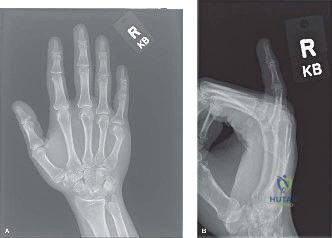
Fifth metacarpal neck fractures, or boxer's fractures, typically occur from axial loading on a clenched fist. They account for 10% of hand fractures, primarily affecting young adult males. The characteristic apex dorsal angulation results from extrinsic extensor tendon pull and intrinsic muscle forces on the distal fragment, alongside shortening from axial compression.
A 22-year-old male presents to the Emergency Department following a fight, having punched a brick wall. He has pain and swelling over the ulnar aspect of his dominant hand. On examination, there is a visible dorsal prominence over the 5th metacarpal head and a slight rotational deformity of the little finger when he attempts to make a fist.
How would you assess the rotational deformity, and what are the specific clinical implications of this finding?
Candidate: I would assess rotation by asking the patient to make a gentle fist. I am looking for scissoring or overlap of the little finger over the ring finger. If there is any rotational malalignment, this is a significant finding because the hand cannot compensate for rotational deformities, unlike angular deformities.
Failing to emphasize that rotational deformity is an absolute indication for surgery. Candidates often fixate on the "number of degrees" of angulation rather than acknowledging that even 5-10 degrees of rotational malunion causes functional scissoring that is poorly tolerated.
The candidate should state: "Clinical assessment of rotation is performed by observing the convergence of the fingertips toward the scaphoid tubercle during active flexion. Any rotational malalignment (scissoring or overlap) is functionally devastating. Unlike sagittal plane angulation, where the 5th MCP joint has significant compensatory hyperextension, rotational malunion has no compensatory mechanism. Therefore, any detectable rotational malalignment is an absolute indication for operative reduction to restore the normal digital cascade."
Regarding the management of this 5th metacarpal neck fracture, we discuss the "acceptable" degree of dorsal angulation. Historically, high degrees were tolerated. What is the current evidence-based threshold, and what factors influence your decision to operate?
Candidate: Historically, up to 70 degrees was acceptable, but now we aim for less. Generally, 30-40 degrees is the threshold. I would consider the patient's job, hand dominance, and whether they are a high-demand user.
Stating a rigid number without qualifying it. A "borderline" candidate will not explain *why* high angulation is problematic (e.g., extensor lag, grip strength loss, or palm prominence) or fail to mention the importance of the patient's functional demands.
The candidate must structure the response by addressing the shift in paradigm: "While older literature permitted 50-70 degrees of angulation, modern practice typically triggers operative intervention at >30-40 degrees. The decision is multifactorial: 1. Anatomic Factors: The 5th MCP joint has more inherent laxity, allowing for hyperextension, but excessive angulation leads to palm prominence and pain during grip. 2. Patient Factors: High-demand individuals (manual laborers, athletes) require more anatomical restoration of length and alignment to preserve grip strength. 3. Functional Goals: Preventing mechanical impingement and restoring the natural cascade is more important than achieving 'perfect' radiologic alignment in low-demand patients."
You decide to proceed with Closed Reduction and Percutaneous Pinning (CRPP). Describe your preferred technique for the reduction and the pin placement.
Candidate: I would use the Jahss maneuver, flexing the MCP and PIP joints to 90 degrees and pushing the head volarly. Then I would use retrograde K-wires inserted through the metacarpal head into the canal.
Failing to mention the risk to the articular surface or the specific need to avoid the extensor mechanism. Candidates often forget to mention fluoroscopic verification of the pins to ensure they have not penetrated the joint.
The candidate should state: "I perform the Jahss maneuver to leverage the metacarpal head into position. For fixation, I use retrograde intramedullary K-wires. 1. Entry Point: I insert two 0.035 or 0.045-inch wires through the dorsal-ulnar aspect of the metacarpal head, strictly avoiding the articular cartilage. 2. Fixation: The wires are driven across the fracture site and engaged into the metadiaphyseal bone of the proximal fragment. 3. Safety: I use C-arm fluoroscopy to confirm there is no intra-articular penetration. 4. Soft Tissue: Pins are bent and buried beneath the skin or kept short to prevent pin tract infection, and the patient is placed in an ulnar gutter splint with the MCP joint in 70-90 degrees of flexion."
