Surgical Correction of Calcaneal and Ankle Malunions
Key Takeaway
The surgical correction of extraarticular calcaneal malunions requires a meticulous approach to restore hindfoot biomechanics. This involves lateral wall exostectomy, peroneal tendon decompression, and often subtalar arthrodesis with corrective osteotomies. Addressing concurrent axial deformities, such as valgus or varus malalignment, is critical for optimal outcomes. Proper graft contouring and rigid cannulated screw fixation ensure stability, while tailored postoperative protocols dictate successful fusion and functional recovery.
Comprehensive Introduction and Patho-Epidemiology
The management of malunited extraarticular and intraarticular calcaneal fractures, as well as complex ankle mortise malunions, presents a formidable and technically demanding challenge to the orthopedic surgeon. When a calcaneal fracture heals in a non-anatomic position, the resulting pathoanatomy typically involves a catastrophic loss of calcaneal height, a dramatic increase in heel width, and severe axial malalignment—most commonly presenting as rigid varus or valgus deformities. This three-dimensional spatial distortion drastically alters hindfoot and midfoot kinematics, leading to subfibular impingement, chronic peroneal tendon pathology, and debilitating, progressive subtalar arthrosis.
Epidemiologically, calcaneal fractures represent approximately 60% of all tarsal fractures, with a significant proportion occurring in the working-age population due to high-energy axial load mechanisms, such as falls from a height or motor vehicle collisions. Despite advancements in operative fixation, a substantial subset of these fractures is managed non-operatively due to patient comorbidities, severe soft-tissue compromise, or delayed presentation. Furthermore, operative management is not immune to failure; loss of reduction, hardware failure, or inadequate initial restoration of the posterior facet can precipitate a symptomatic malunion. The true incidence of symptomatic calcaneal malunion is difficult to ascertain, but tertiary referral centers report that up to 30% of conservatively managed intraarticular fractures eventually require reconstructive salvage procedures.
In the context of malunited extraarticular fractures, Aly described a laterally based opening wedge osteotomy specifically designed for symptomatic valgus calcaneal deformity. In a highly scrutinized cohort of 34 patients, this technique yielded good or excellent results in 91% of cases, with only 9% reporting poor outcomes at a mean follow-up of 56.2 months. The mean American Orthopaedic Foot and Ankle Society (AOFAS) hindfoot and ankle score demonstrated dramatic improvement, rising from a preoperative baseline of 57 to a highly functional postoperative level. Such data underscore the efficacy of precise, anatomically driven surgical intervention.
Successful surgical reconstruction demands a comprehensive, almost intuitive understanding of hindfoot biomechanics, meticulous preoperative planning, and the flawless execution of corrective osteotomies, structural arthrodesis, and dynamic soft-tissue balancing. The overarching goal is not merely the cessation of pain, but the restoration of the mechanical axis, the salvage of the lever arm of the Achilles tendon, and the re-establishment of a plantigrade, functional foot.
Detailed Surgical Anatomy and Biomechanics
A profound mastery of the osseous and soft-tissue anatomy of the hindfoot is the absolute prerequisite for undertaking these complex reconstructions. The calcaneus is the largest tarsal bone, serving as the foundational block of the longitudinal arch and the primary lever arm for the gastrocsoleus complex. Osteologically, it is divided into the anterior process, the body, the sustentaculum tali medially, and the posterior tuberosity. The superior surface articulates with the talus via three distinct facets: the posterior, middle, and anterior. The posterior facet is the largest and is the primary weight-bearing surface of the subtalar joint.
In the setting of a malunion, the normal anatomy is grossly distorted. The lateral wall of the calcaneus, which is composed of thin cortical bone, typically blows out laterally during the initial axial impact. As the fracture consolidates, this blowout hypertrophies into a dense lateral exostosis. This exostosis encroaches upon the subfibular space, directly compressing the peroneal tendons against the distal fibula. The sural nerve, which courses posteroinferior to the lateral malleolus, is frequently tethered in scar tissue or directly compressed by this expanding osseous mass.
Biomechanically, the subtalar joint acts as a complex directional hinge, dictating the flexibility of the transverse tarsal joint (the talonavicular and calcaneocuboid joints). During normal gait, subtalar eversion (valgus) unlocks the transverse tarsal joint, allowing the midfoot to become flexible and accommodate uneven terrain. Conversely, subtalar inversion (varus) locks the transverse tarsal joint, converting the foot into a rigid lever for terminal stance push-off.
When a calcaneus malunites in varus, the transverse tarsal joint remains locked throughout the gait cycle. This forces the patient to vault over a rigid, lateralized foot, leading to severe lateral column overload, fifth metatarsal stress fractures, and rapid degeneration of the calcaneocuboid joint. A valgus malunion, conversely, leaves the foot chronically unlocked, resulting in a severe pes planovalgus deformity, medial column collapse, and profound strain on the posterior tibial tendon and spring ligament complex. Furthermore, the loss of calcaneal height decreases the calcaneal pitch, horizontally reorienting the talus and resulting in anterior tibiotalar impingement. The shortened lever arm of the Achilles tendon drastically reduces plantarflexion power, leading to a profound, fatiguing limp.
Exhaustive Indications and Contraindications
The decision to proceed with the surgical reconstruction of a calcaneal or ankle malunion must be carefully weighed against the patient's symptoms, functional demands, and physiologic capacity to heal a complex osseous and soft-tissue insult.
Calcaneal malunions are generally classified based on the presence of lateral wall exostosis, subtalar joint arthrosis, and axial malalignment, utilizing the universally recognized Stephens and Sanders classification. This classification dictates the surgical indications:
- Type I Malunion: Characterized by a lateral wall blowout (exostosis) causing subfibular impingement and peroneal tendon subluxation or stenosis, but without significant subtalar arthrosis or axial deformity. Indication: Lateral wall exostectomy and peroneal tenolysis/reconstruction.
- Type II Malunion: Involves lateral wall exostosis combined with symptomatic, post-traumatic subtalar arthritis, but with a relatively preserved mechanical axis. Indication: Exostectomy combined with an in situ subtalar arthrodesis.
- Type III Malunion: The most complex presentation, featuring lateral wall exostosis, subtalar arthritis, and significant axial malalignment (varus or valgus) with profound loss of height. Indication: Exostectomy, corrective calcaneal osteotomy, and distraction bone-block subtalar arthrodesis.
| Parameter | Surgical Indications | Absolute Contraindications | Relative Contraindications |
|---|---|---|---|
| Patient Factors | Intractable pain failing >6 months of conservative care (bracing, injections); severe gait dysfunction. | Active deep infection or osteomyelitis; non-ambulatory status. | Active tobacco use (requires cessation >6 weeks prior); poorly controlled diabetes mellitus (HbA1c > 8.0%). |
| Anatomic Factors | Stephens and Sanders Type I, II, or III malunion; symptomatic bimalleolar ankle malunion with talar shift. | Charcot neuroarthropathy with acute fragmentation; severe peripheral arterial disease (ABI < 0.4). | Severe osteopenia compromising hardware purchase; extensive prior soft-tissue compromise or skin grafting over the lateral hindfoot. |
| Neurologic Factors | Mechanically induced sural neuritis; tarsal tunnel syndrome secondary to severe valgus collapse. | Complete, irreversible paralysis of the lower extremity. | Chronic complex regional pain syndrome (CRPS) requiring aggressive perioperative pain management. |
Pre-Operative Planning, Templating, and Patient Positioning
Meticulous preoperative planning is the bedrock of successful malunion reconstruction. The clinical evaluation must begin with a thorough assessment of the patient's gait, noting the presence of an antalgic limp, varus thrust, or valgus collapse.
Clinical Examination
Always evaluate the peroneal tendons dynamically during the preoperative clinical examination. Subfibular impingement often masks underlying peroneal tendon tears, stenosis, or superior peroneal retinaculum (SPR) incompetence. Have the patient actively evert and dorsiflex the foot against resistance while palpating the posterior margin of the fibula. Examine the medial side of the ankle for signs of posterior tibial tendon dysfunction or tarsal tunnel syndrome, which frequently accompany severe valgus malunions. Assess the vascular status rigorously; non-invasive arterial studies (ABIs, toe pressures) are mandatory in patients with a history of smoking or diabetes.
Radiographic Imaging and Templating
A complete radiographic series is obligatory. This includes weight-bearing anteroposterior (AP), lateral, and mortise views of the ankle, as well as AP, lateral, and Harris axial views of the calcaneus.
* Lateral Radiograph: Evaluate the loss of calcaneal height, the collapse of Böhler’s angle, the widening of the crucial angle of Gissane, and the presence of anterior tibiotalar impingement.
* Harris Axial View: Essential for quantifying the degree of varus or valgus malalignment of the calcaneal tuberosity and assessing the lateral wall blowout.
* Computed Tomography (CT): A fine-cut CT scan with multi-planar (sagittal, coronal, axial) and 3D reconstructions is the gold standard for preoperative planning. The CT scan accurately maps the extent of subtalar arthrosis, the exact dimensions of the lateral exostosis, and the precise geometry of the axial deformity.
Templating should be performed on digital radiographs to calculate the required dimensions of the structural bone graft needed to restore calcaneal height. The angle of correction for a Dwyer closing wedge or a medial displacement osteotomy must be mathematically determined to restore the mechanical axis of the hindfoot.
Patient Positioning
The patient is placed in the lateral decubitus position on a radiolucent operative table. A beanbag is utilized to secure the patient, ensuring the operative leg is well-padded, particularly at the common peroneal nerve at the fibular neck of the contralateral down-leg. A high-thigh pneumatic tourniquet is applied. The fluoroscopy C-arm is positioned to enter from the anterior aspect of the table, allowing for unobstructed AP, lateral, and axial imaging of the hindfoot without compromising the sterile field.
Step-by-Step Surgical Approach and Fixation Technique
Surgical Approach and Flap Elevation
A standard extensile lateral approach to the calcaneus is utilized. The vertical limb is placed just anterior to the Achilles tendon, and the horizontal limb is placed in line with the base of the fifth metatarsal, ensuring the corner is gently curved rather than sharply angled to minimize the risk of apex necrosis. The incision is carried straight down to bone. A full-thickness subperiosteal flap is elevated using a "no-touch" technique. Retraction is achieved using K-wires placed into the talus, lateral malleolus, and cuboid, avoiding the use of self-retaining retractors that crush the delicate skin edges. This approach provides unparalleled access to the lateral wall, the subtalar joint, and the calcaneocuboid joint while minimizing the risk to the sural nerve and the lateral calcaneal artery, which are elevated within the superior flap.
Lateral Wall Exostectomy and Peroneal Tendon Management
Once the lateral wall is exposed, any retained hardware (such as Kirschner wires or broken plates) from previous surgeries must be meticulously removed.
- Exostectomy: Perform a lateral wall exostectomy using a sharp 1-inch osteotome or an oscillating saw. The excision must be flush with the lateral border of the subtalar joint. The excised bone should be preserved in a sterile basin, as it serves as an excellent source of autograft for the subsequent subtalar arthrodesis.
- Tendon Examination: Examine the peroneal tendons for dislocation, longitudinal split tears, or severe stenosis. In many ankles with obvious preoperative tendon subluxation, the simple removal of the lateral wall exostosis allows the tendons to fall back into their anatomic position behind the fibula, requiring no further stabilization.
- Sheath Evaluation: The peroneal tendon sheath must be entered distally with a Freer elevator to evaluate for proximal sheath stenosis.
- Tenolysis and Repair: If stenosis is identified, incise the sheath over a length of 2 to 3 cm along the undersurface of the subperiosteal flap to perform a thorough tenolysis. Debride any degenerative tendinosis and tubularize longitudinal tears with 4-0 non-absorbable suture.
- Retinaculum Reconstruction: If persistent peroneal tendon dislocation is identified after exostectomy, reconstruct the superior peroneal retinaculum through a small, separate incision in the flap, anchoring it to the posterolateral fibula using suture anchors.
Subtalar Joint Preparation and Distraction
For Type II and Type III malunions, a structural subtalar arthrodesis is required to restore height and eliminate arthritic pain.
- Joint Debridement: Denude the remaining articular cartilage and dense sclerotic subchondral bone from the posterior, middle, and anterior facets of the subtalar joint using sharp curettes and a high-speed burr.
- Subchondral Drilling: Prepare the inferior talar and superior calcaneal osseous surfaces using a 2.5-mm drill bit. Create multiple perforations within the subchondral bone to promote robust vascular ingrowth, accessing the cancellous bone marrow to facilitate osteogenesis.
- Joint Distraction: Insert a lamina spreader posteriorly within the subtalar joint and expand it fully. Alternatively, a Hintermann retractor can be utilized.
- Fluoroscopic Verification: Verify the distraction under fluoroscopy to determine the exact height restoration required. The talar head must align anatomically with the navicular. This alignment indicates the successful restoration of the medial column, the normal angle of talar declination, and the talocalcaneal angle.
Surgical Warning: Avoid placing a femoral distractor medially. It is cumbersome, frequently damages the medial neurovascular bundle, and is significantly less effective than direct intraarticular distraction. Furthermore, strictly avoid incising the deltoid ligament from inside the subtalar joint; doing so renders the joint highly unstable and may result in catastrophic overdistraction of the bone graft and subsequent talar avascular necrosis.
Bone Grafting and Defect Management
When anatomic alignment is confirmed radiographically, measure the dimensions of the intraarticular defect with a sterile metal ruler.
- Autograft Contouring: Contour the previously excised lateral wall fragment to match the measured defect. If structural allograft (e.g., tricortical iliac crest or femoral head) is required due to insufficient autograft volume, shape it precisely using an oscillating saw.
- Graft Placement: Place this structural bone block within the distracted joint. The bone can be folded over on itself to obtain additional height if necessary. It is imperative that the graft completely fills the subtalar joint, as the height of the lateral calcaneus (and the graft) is usually equal to the width of the posterior facet.
- Supplemental Grafting: Additional cancellous allograft chips, demineralized bone matrix (DBM), or bone marrow aspirate concentrate (BMAC) may be packed into the debrided sinus tarsi and any remaining voids to assist in achieving a solid, rapid fusion mass.
- Medial Tightness: If the joint remains excessively tight medially, place additional lamina spreaders in the sinus tarsi and the posterior facet of the subtalar joint to achieve balanced distraction.
Correction of Axial Malalignment (Type III Malunions)
In patients with a Type III malunion, correction of the axial malalignment is mandatory. Because rotation of the midfoot in the coronal plane around an anteroposterior axis (pronation-supination) will not correct a malpositioned calcaneal tuberosity that has healed in varus or valgus, a formal calcaneal osteotomy must be performed before the placement of definitive fixation for the subtalar arthrodesis.
- For Varus Malalignment: Perform a Dwyer lateral closing wedge osteotomy posterior to the posterior facet. The base of the wedge is lateral. Once the wedge of bone is removed, the osteotomy is closed, bringing the tuberosity out of varus. The excised bone should be morselized and used as supplemental graft material.
- For Valgus Malalignment: Perform a medial displacement calcaneal osteotomy (MDCO). The osteotomy is made obliquely from lateral to medial, posterior to the posterior facet. The tuberosity is then translated medially by 10 to 15 mm to restore the mechanical axis. Alternatively, a laterally based opening wedge osteotomy can be utilized, filling the defect with structural allograft.
When the osteotomy is completed, insert the guide pins in the manner described below. By doing so, the osteotomy and the subtalar fusion can be compressed simultaneously.
Definitive Fixation
Rigid internal fixation is the cornerstone of a successful arthrodesis and osteotomy union.
- Pin Placement: With the subtalar joint held in neutral to slight valgus alignment (approximately 5 degrees of valgus), place two terminally threaded 3.2-mm guide pins percutaneously from the posterior plantar edge of the calcaneus.
- Trajectory: Advance the pins across the calcaneal osteotomy (if performed), through the structural graft in the subtalar joint, perpendicular to the plane of the posterior facet, and into the dense subchondral bone of the talar dome. Angle the guide pins in a divergent fashion into the talar dome to maximize biomechanical stability and rotational control.
- Avoid Penetration: Strictly avoid placing a pin into the lateral aspect of the ankle joint or penetrating the anterior talonavicular joint.
- Radiographic Confirmation: Obtain fluoroscopic anteroposterior (AP), mortise, and axial calcaneal radiographs to verify correct pin placement, screw length, and overall hindfoot alignment.
- Supplemental Fixation: If more stable fixation is required, place a third guide pin from the plantar margin of the anterior process of the calcaneus into the distal aspect of the talar neck and head.
- Screw Insertion: Place large fragment, partially threaded (7.3 mm or 8.0 mm) cannulated screws over the guide wires in lag mode for definitive compression and fixation. Ensure the screw heads are countersunk to prevent painful plantar hardware prominence.
Wound Closure
Meticulous layered closure is critical to prevent wound dehiscence and deep infection, which are notorious, devastating complications of the extensile lateral approach.
- Drain Placement: Place a deep closed-suction drain exiting at the proximal tip of the vertical limb of the incision.
- Deep Layer Closure: Close the subperiosteal flap in a layered fashion. Pass interrupted 0 Vicryl sutures in the deep layers of the subperiosteal flap, angling the bites such that the flap is mechanically advanced toward the apex of the incision to eliminate tension at the corner.
- Suture Management: Clamp the sutures with hemostats until all deep sutures have been placed. When completed, hand-tie the sutures sequentially, starting at the proximal and distal ends and working systematically toward the apex of the incision.
- Superficial Closure: Close the subcuticular layer in a similar fashion with interrupted 2-0 Vicryl. Close the skin with 3-0 nylon sutures using a modified Donati or vertical mattress technique, again starting at the ends and progressing toward the apex.
- Flap Shift: If aggressive height restoration prevents tension-free wound closure at the apex, the vertical limb of the incision can be extended proximally. This allows the flap to shift and rotate downward. The resulting proximal wound defect is left open to heal by secondary intention (granulation) or covered with a split-thickness skin graft.
Management of Associated Ankle Malunions
Hindfoot malunions rarely exist in isolation; they are frequently accompanied by, or must be differentiated from, malunions of the ankle mortise. Osteotomies of the medial or lateral malleolus are highly recommended to correct uncomplicated deformities caused by recently malunited fractures of the ankle, primarily to diminish the long-term risk of post-traumatic arthritis.
The timing of intervention is critical. Displacement of the talus within the ankle mortise for more than 3 months may result in irreversible pathological changes in the articular cartilage, leading to a diminished potential for a satisfactory outcome with joint-preserving osteotomies alone. However, several authors have reported significant clinical improvement even in patients with displacement lasting longer than 3 months, provided that adequate, anatomically precise surgery is performed.
There is universal consensus that when the deformity has been of short duration and is corrected with minimal iatrogenic trauma to the articular surfaces, excellent functional outcomes can be obtained. The primary surgical objective is the absolute restoration of the normal weight-bearing alignment of the lower extremity and the precise anatomic relationships between the articular surfaces of the tibia, the fibula, and the talus. Displacement and residual tilt of the talus have been shown to drastically alter contact stresses across the tibiotalar joint, accelerating degenerative arthrosis. A mere 1 mm of lateral talar shift can reduce tibiotalar contact area by 42%, leading to exponential increases in peak articular stress.
Case Example: Revision of Bimalleolar Ankle Malunion
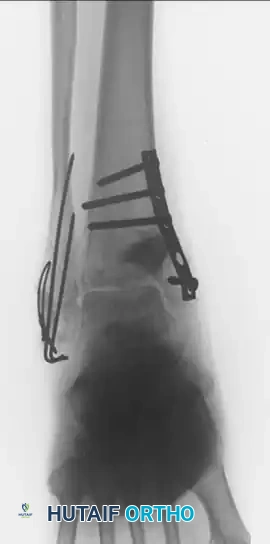
The following imaging sequence demonstrates the revision of a malunited bimalleolar ankle fracture.
Initially, the fracture was managed with interfragmentary screws in an elderly patient, which subsequently failed and progressed to a symptomatic malunion with talar shift and severe valgus tilt.
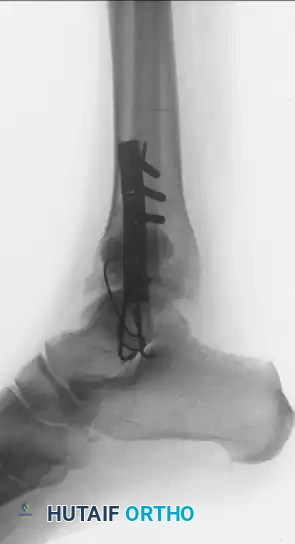
Figure A: Anteroposterior radiograph demonstrating malunion of a bimalleolar ankle fracture previously fixed with interfragmentary screws. Note the lateral talar shift and widening of the medial clear space.
Figure B: Lateral radiograph of the same malunited bimalleolar fracture, highlighting the inadequate fixation, loss of sagittal alignment, and posterior subluxation of the talus.
To salvage the joint and restore the mortise, a complex revision fixation was performed. The lateral malleolus was osteotomized through the prior fracture site, lengthened to restore the fibular station (Weber's criteria), and stabilized using a robust one-third tubular buttress plate combined with tension band fixation. The medial malleolus required structural hydroxyapatite grafting and autologous cancellous bone to fill the osseous defect created during the corrective osteotomy, followed by rigid screw fixation.
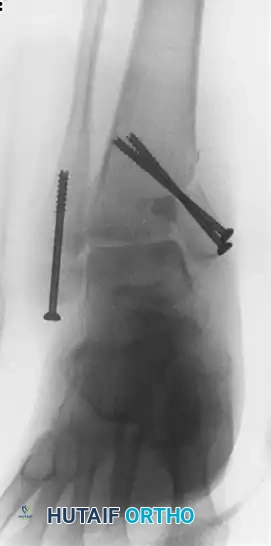
Figure C: Postoperative anteroposterior radiograph demonstrating anatomic restoration of the ankle mortise, correction of the talar shift, and robust fixation of both malleoli.
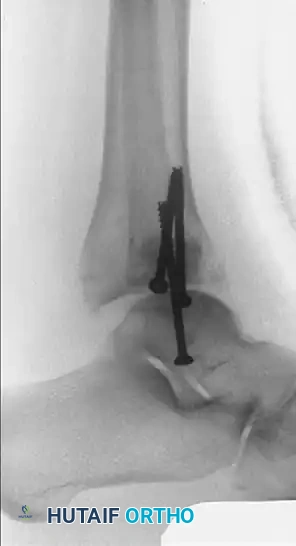
Figure D: Postoperative lateral radiograph confirming restoration of sagittal alignment and concentric reduction of the tibiotalar joint.
Complications, Incidence Rates, and Salvage Management
The surgical correction of hindfoot and ankle malunions is fraught with potential complications. The surgeon must be hyper-vigilant during the perioperative period to identify and aggressively manage these issues before they compromise the ultimate functional outcome.
| Complication | Estimated Incidence | Etiology / Risk Factors | Salvage Management / Prevention |
|---|---|---|---|
| Wound Dehiscence / Apex Necrosis | 10% - 20% | Excessive tension on the flap apex; aggressive height restoration; smoking; diabetes; poor surgical "touch". | Prevention: "No-touch" technique; flap shift. Salvage: Local wound care; negative pressure wound therapy (NPWT); rotational sural artery flap for exposed hardware/bone. |
| Deep Infection / Osteomyelitis | 2% - 5% | Progression of superficial wound breakdown; prolonged operative time; inadequate debridement of prior hardware tracks. | Salvage: Aggressive serial surgical debridement; hardware removal (if union is achieved or if hardware is loose); placement of antibiotic-impregnated cement spacers; long-term targeted IV antibiotics. |
| Nonunion / Delayed Union | 5% - 15% | Inadequate joint debridement; failure to penetrate subchondral sclerotic bone; thermal necrosis from burring; smoking. | Prevention: Subchondral drilling; rigid compression. Salvage: Revision arthrodesis with autogenous bone grafting (iliac crest); utilization of orthobiologics (rhBMP-2); optimization of host metabolic factors (Vitamin D, smoking cessation). |
| Sural Neuritis / Neuroma | 5% - 10% | Iatrogenic transection during flap elevation; traction injury during joint distraction; entrapment in post-operative scar tissue. | Prevention: Careful elevation of the full-thickness flap containing the nerve. Salvage: Gabapentinoids; targeted corticosteroid injections; surgical neurolysis or neurectomy with proximal burying of the nerve stump into muscle. |
| Hardware Prominence | 15% - 25% | Inadequate countersinking of plantar screws; use of excessively long screws penetrating the anterior talonavicular joint. | Prevention: Fluoroscopic verification of screw length and head position. Salvage: Elective hardware removal after definitive radiographic confirmation of solid osseous union (typically > 6-9 months post-operatively). |
Phased Post-Operative Rehabilitation Protocols
Postoperative protocols must be strictly tailored to the specific type of malunion corrected and the rigidity of the achieved fixation. Patient compliance is paramount, and early education regarding the prolonged nature of the recovery is essential.
Protocol for Type I Malunions (Exostectomy/Soft Tissue Only)
- Phase I (Weeks 0-3): Patients are placed in a well-padded short leg splint and kept strictly non–weight bearing. The primary goal is the protection of the surgical incision and the peroneal retinacular repair.
- Phase II (Weeks 3-6): Once the surgical wound has completely healed and sutures are removed, the patient is transitioned to a removable Controlled Ankle Motion (CAM) boot. Physical therapy is initiated, focusing on active and active-assisted range-of-motion (ROM) activities for the ankle and subtalar joints. Gentle peroneal strengthening begins. Weight-bearing is progressed from partial to full as tolerated in the boot.
- Phase III (Weeks 6-12): Transition to regular supportive footwear. Aggressive physical therapy focuses on proprioception, gait mechanics, and advanced strengthening.
Protocol for Type II and Type III Malunions (Arthrodesis/Osteotomy)
- Phase I (Weeks 0-6): Patients are kept strictly non–weight bearing with the leg immobilized in a bulky Jones dressing initially, transitioned to a fiberglass short leg cast at 2 weeks post-operatively. Strict elevation is enforced to control edema.
- Phase II (Weeks 6-12): Cast changes are performed every 4 to 6 weeks to monitor soft tissues and obtain serial radiographs to assess the progression of the fusion mass and osteotomy sites. The patient remains strictly non-weight bearing.
- Phase III (Weeks 12-16): Progression to partial weight bearing in a CAM boot is permitted only after definitive radiographic evidence of bridging trabecular bone across the subtalar fusion mass and osteotomy sites is confirmed. Physical therapy is initiated to restore ankle dorsiflexion and plantarflexion, as subtalar motion has been eliminated.
- Phase IV (Months 4-6+): Gradual transition to regular footwear, often requiring custom orthotics or a rocker-bottom shoe modification to compensate for the loss of hindfoot accommodation. Return to heavy labor or high-impact activities may take up to 12 months.
Summary of Landmark Literature and Clinical Guidelines
The evolution of surgical techniques for calcaneal and ankle malunions is deeply rooted in landmark orthopedic literature. The classification system proposed by Stephens and Sanders (1996) remains the universally accepted paradigm, directly linking the pathoanatomic presentation to the required surgical intervention. Their work definitively established that isolated lateral wall exostectomy is insufficient for patients with concurrent subtalar arthrosis or axial malalignment.
Romash's seminal work on the reconstructive osteotomy of the calcaneus with distraction bone block arthrodesis revolutionized the management of Type III malunions. By demonstrating that restoring the vertical height of the calcaneus simultaneously decompresses the subfibular space and realigns the mechanical axis of the Achilles tendon, Romash provided a biomechanically sound solution to a previously unsalvageable problem.
Further refinements by Clare and Lee emphasized the critical importance of correcting coronal plane deformities (varus/valgus) through dedicated calcaneal osteotomies prior to subtalar fixation. Their outcomes data highlighted that failure to correct a varus malunion leads to persistent lateral column overload and eventual failure of the arthrodesis.
Regarding ankle malunions, the consensus guidelines established by the AO Foundation dictate that anatomic restoration of the mortise is the singular most important factor in preventing post-traumatic osteoarthritis. While traditional dogma suggested that reconstructive osteotomies should be performed within 3 months of the initial injury, contemporary literature supports delayed reconstruction even years after the injury, provided the articular cartilage remains viable and the deformity is intra-articular and correctable without excessive tension on the neurovascular structures. The integration of
