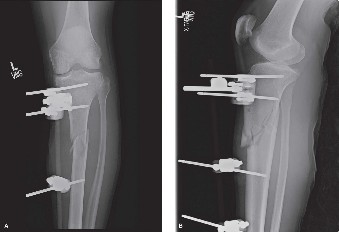
Introduction & Epidemiology
Proximal tibia fractures (PTFs) represent a diverse spectrum of injuries, encompassing simple extra-articular metaphyseal disruptions to complex intra-articular fractures involving the tibial plateau. While intra-articular fractures (tibial plateau fractures, Schatzker types I-VI, or AO/OTA 41-B) traditionally involve open reduction and internal fixation (ORIF) with plates, the management of extra-articular or meta-diaphyseal proximal tibia fractures (AO/OTA 41-A or 42-A extending proximally) has seen a paradigm shift towards intramedullary nailing (IMN). This shift is driven by the advantages of load-sharing fixation, smaller incisions, less soft tissue stripping, and improved healing rates compared to plating for certain patterns.
Epidemiologically, PTFs typically result from high-energy trauma in younger individuals (e.g., motor vehicle accidents, falls from height) or low-energy falls in the elderly, particularly those with osteopenic bone. They constitute approximately 5-7% of all tibia fractures. Associated injuries, including ligamentous knee injuries, meniscal tears, compartment syndrome, and neurovascular compromise, are common due to the energy involved and the anatomical proximity of critical structures.
The application of IMN in the proximal tibia, however, presents unique challenges due to the specific anatomy of the region. The proximal tibia's flared metaphysis, the presence of the knee joint, the patellar tendon, and the inherent anterior cortical bow of the tibia make achieving and maintaining anatomical reduction with a straight intramedullary implant difficult. Consequently, malreduction, particularly in valgus, procurvatum (apex anterior angulation), and rotation, remains a significant concern and the focus of this discussion. Understanding these deformities and mastering techniques to prevent and correct them is paramount for successful outcomes.
Surgical Anatomy & Biomechanics
Successful management of proximal tibia fractures with IMN necessitates a thorough understanding of the regional anatomy and biomechanics.
Surgical Anatomy
- Proximal Tibia Morphology: The proximal tibia is characterized by its wide metaphyseal flare, transitioning rapidly to the cylindrical diaphysis. The cortex in the metaphysis is relatively thin and cancellous, making screw purchase challenging, especially in osteoporotic bone. The intercondylar notch provides a natural entry point reference for IMN.
- Tibial Bowing: The tibia exhibits a natural anterior cortical bow, which is generally more pronounced in the distal half. However, in the proximal tibia, the intramedullary canal often trends slightly posterior relative to the anterior tibial cortex. Additionally, there is a normal valgus alignment of approximately 3-5 degrees between the mechanical axis of the knee and the anatomical axis of the tibia. Failure to account for these curves during nail insertion can lead to malreduction, particularly procurvatum (apex anterior) or apex posterior (recurvatum) deformity, and valgus malalignment.
-
Neurovascular Structures:
- Peroneal Nerve: The common peroneal nerve courses superficially around the fibular head and neck, making it vulnerable to injury during lateral dissection, plating, or external fixator pin placement.
- Popliteal Artery: Located posteriorly, the popliteal artery is at risk from fracture fragments, especially in high-energy injuries, or iatrogenically during posteromedial plating or excessive posterior reduction maneuvers.
- Anterior Tibial Artery: Passes through the interosseous membrane distally.
- Soft Tissues: The anterior aspect of the knee and proximal tibia is covered by the patellar tendon, which can be traumatized by traditional infrapatellar nailing approaches. The medial aspect has thicker soft tissue coverage, while the lateral side (where the fibula lies) has relatively thinner coverage. Swelling and blistering are common in these injuries, necessitating careful soft tissue management.
- Musculature: The origin of the tibialis anterior muscle is on the lateral condyle and proximal tibia, influencing the fracture fragment position.
Biomechanics of Intramedullary Nailing
Intramedullary nails function as load-sharing devices, providing relative stability that encourages callus formation and secondary bone healing. Unlike plates, which are load-bearing, nails are centrally placed, aligning closer to the mechanical axis of the bone, theoretically reducing bending stresses.
- Stability: IMN provides stability against bending, rotation, and shear forces. Locking screws enhance rotational and axial stability, especially in comminuted patterns.
-
Deforming Forces:
In proximal tibia fractures treated with IMN, several inherent deforming forces contribute to malreduction:
- Proximal Flare: The wide metaphysis of the proximal tibia offers less cortical contact for a straight nail, allowing the proximal fragment to drift into valgus.
- Anterior Bowing: The nail's straight trajectory attempts to straighten the natural anterior bow of the tibia, pushing the proximal fragment into procurvatum (apex anterior angulation). This is the most common malalignment.
- Patellar Tendon Tension: If an infrapatellar entry point is used, the patellar tendon can pull the proximal fragment anteriorly, contributing to procurvatum.
- Muscle Pull: Gastrocnemius and soleus pull on the distal fragment, while the quadriceps and patellar tendon influence the proximal fragment, making reduction challenging.
Understanding these biomechanical principles is critical for meticulous pre-operative planning and intra-operative execution to prevent iatrogenic deformities.
Indications & Contraindications
The decision to treat a proximal tibia fracture operatively or non-operatively, and specifically with intramedullary nailing, depends on a multitude of factors including fracture pattern, stability, articular involvement, soft tissue status, patient comorbidities, and surgeon expertise.
Indications for Intramedullary Nailing (IMN) in Proximal Tibia Fractures
Intramedullary nailing is primarily indicated for extra-articular or meta-diaphyseal proximal tibia fractures (AO/OTA 41-A, or 42-A extending proximally) where the fracture line does not significantly compromise the articular surface or metaphyseal cortical support.
-
Extra-articular Proximal Tibia Fractures (AO/OTA 41-A):
- Simple transverse, oblique, or spiral fractures of the proximal metaphysis without articular involvement.
- Segmental fractures involving the proximal metaphysis and diaphysis.
- Meta-diaphyseal Fractures (AO/OTA 42-A, B, C): When the fracture extends into the proximal metaphysis but the primary articular surface is intact or minimally involved and reducible.
- Open Fractures (Gustilo-Anderson Type I, II, IIIA): If soft tissue integrity permits and debridement has been performed. IMN offers a biologically friendly solution compared to extensive plating.
- Polytrauma Patients: Allows for early mobilization and weight-bearing in appropriate cases, facilitating overall rehabilitation.
- Pathologic Fractures: Due to tumors or metabolic bone disease.
- Impending Compartment Syndrome: While not a primary indication, stabilization of the fracture can sometimes mitigate compartment syndrome risk, and subsequent fasciotomy can be performed.
Contraindications to Intramedullary Nailing
- Significant Articular Involvement: Fractures with substantial displacement or comminution of the articular surface (e.g., Schatzker Type IV-VI, or AO/OTA 41-B/C) that require anatomical reduction and absolute stability, typically achieved with ORIF and plate fixation.
- Severe Metaphyseal Comminution: If the proximal fragment is excessively comminuted, prohibiting adequate purchase of locking screws or providing insufficient bone stock for stability.
- Active Local Infection: Relative contraindication. Infection should ideally be cleared before implanting a large metallic device.
- Severe Soft Tissue Compromise: Extensive open wounds, severe blistering, or necrotic tissue that would make nail insertion unsafe or predispose to deep infection.
- Pre-existing Hardware: If existing implants preclude or interfere with nail insertion or locking.
- Extreme Skeletal Immaturity: Open physes where a nail would damage the growth plate.
- Uncontrolled Compartment Syndrome: Nailing should be performed after fasciotomy.
Operative vs. Non-Operative Indications
| Feature | Operative Treatment (General) | Non-Operative Treatment |
|---|---|---|
| Fracture Pattern | Displaced, unstable, open fractures; articular step-off > 2mm; condylar widening > 5mm; segmental | Minimally displaced, stable, non-articular or minimally displaced intra-articular fractures. |
| Angulation | Varus/Valgus > 10 degrees; Apex anterior/posterior > 10 degrees (sagittal); > 10 degrees rotation | Minimal angulation (< 5-10 degrees), minimal rotation. |
| Length | Shortening > 1 cm. | Maintained length or minimal shortening. |
| Soft Tissues | Open fractures, impending compartment syndrome (requires fasciotomy +/- fixation). | Intact soft tissue envelope, no signs of compartment syndrome. |
| Patient Factors | Medically fit for surgery; desire for early mobilization/return to function. | Medically unfit for surgery; non-ambulatory status; very elderly with minimal displacement. |
| Associated Inj. | Neurovascular compromise; severe ligamentous injury requiring simultaneous repair. | No critical associated injuries requiring surgical intervention. |
Note: The choice between IMN and plating for operative cases depends on the specific fracture morphology as discussed above.
Pre-Operative Planning & Patient Positioning
Meticulous pre-operative planning and proper patient positioning are fundamental to preventing malreduction and ensuring a successful outcome in IMN for proximal tibia fractures.
Pre-Operative Planning
-
Radiographic Assessment:
- Plain Radiographs: AP, lateral, and oblique views of the entire tibia, including knee and ankle, are crucial to assess fracture pattern, displacement, comminution, and any pre-existing deformities.
- CT Scan: Essential for all suspected intra-articular involvement and for complex meta-diaphyseal fractures. CT provides detailed information on fracture morphology, fragment size, comminution, and helps in planning reduction strategies (e.g., identifying blocking screw trajectories, assessing articular step-off). Sagittal and coronal reconstructions are particularly useful.
- Long-leg Alignment Films: While not always routinely performed acutely, these can be helpful in complex cases to understand overall limb alignment, especially if pre-existing deformities or prior surgery exist.
-
Fracture Classification & Morphology:
Precisely classify the fracture (AO/OTA system is preferred for its comprehensiveness). Identify key fracture characteristics:
- Is it intra-articular or purely extra-articular?
- Is there significant metaphyseal comminution?
- Are there large butterfly fragments or medial/lateral wall defects?
- What are the anticipated deforming forces?
-
Nail Selection & Templating:
- Nail Type: Choose a modern intramedullary nail designed for the tibia, often with multi-planar proximal locking options, and potentially with an anatomical bend to better match the tibial bowing.
- Length: Measure the contralateral uninjured tibia if possible, or use standard anatomical landmarks. The nail should ideally extend to within 1-2 cm of the ankle joint.
- Diameter: Template on radiographs or CT. Aim for the largest diameter nail that can be safely inserted without causing iatrogenic fracture, typically 8-11mm. The intramedullary canal can be quite wide proximally.
- Entry Point & Trajectory: Plan the optimal entry point. Consider the semi-extended (suprapatellar) approach, which offers a more direct and central entry in the proximal tibia, making it easier to control procurvatum.
- Blocking Screws (Poller Screws): Based on CT analysis, pre-plan the potential placement of blocking screws to counteract anticipated valgus/varus and procurvatum malalignment. Identify safe zones for insertion, avoiding neurovascular structures.
- Soft Tissue Assessment: Evaluate the soft tissue envelope for swelling, blistering, and open wounds. Delay surgery if soft tissues are compromised; consider temporizing external fixation.
- Tourniquet: Plan for a tourniquet on the proximal thigh (often preferred for a bloodless field, especially during nail insertion and locking).
- C-arm Access: Ensure unrestricted C-arm access for AP, lateral, and oblique views of the knee and ankle without repositioning the patient.
Patient Positioning
The patient is typically positioned supine on a radiolucent table.
-
Fracture Table vs. Radiolucent Table:
- Fracture Table: Can provide continuous traction, aid in length restoration, and maintain gross alignment. However, it can restrict knee flexion, making nail insertion challenging, and may limit C-arm maneuverability.
- Radiolucent Operating Table: Offers greater flexibility in knee positioning (flexion/extension) and unrestricted C-arm access. Reduction maneuvers often rely on manual traction, external reduction clamps, or a femoral distractor. This is often preferred for proximal tibia fractures where precise control of knee flexion and C-arm views is paramount.
-
Knee Position:
- Semi-extended Position (Suprapatellar Nailing): The knee is flexed approximately 15-20 degrees, allowing for a more anatomical and central entry point through the suprapatellar region. This is highly recommended for proximal tibia fractures as it better controls procurvatum, reduces anterior knee pain, and simplifies the learning curve.
- Traditional Infrapatellar Position: Knee flexed to 90 degrees. This position can make a central entry point more challenging in very proximal fractures, often leading to a more anterior and medial entry that predisposes to procurvatum and valgus malalignment.
-
C-arm Setup:
The C-arm should be positioned opposite the surgeon, with a clear sterile field for its movement. It must be able to obtain:
- True AP view of the knee (patella centered, femoral condyles symmetric).
- True lateral view of the knee (femoral condyles superimposed).
- True AP and lateral views of the fracture site.
- True AP and lateral views of the ankle (to assess distal locking and rotational alignment).
- Sterile Prep and Drape: Extensive prep from the mid-thigh to the toes, including the foot, is critical to allow for assessment of rotational alignment and to permit distal locking. The entire leg should be draped freely to allow full manipulation.
Detailed Surgical Approach / Technique
The detailed surgical approach for intramedullary nailing of proximal tibia fractures focuses on achieving and maintaining anatomical reduction while addressing common malalignment pitfalls. The semi-extended (suprapatellar) approach is increasingly favored for these fractures.
1. Incision and Entry Point
-
Semi-Extended (Suprapatellar) Approach:
- Incision: A 2-4 cm longitudinal skin incision is made just proximal to the superior pole of the patella, slightly medial or lateral to the midline.
- Capsulotomy: The quadriceps tendon is split longitudinally, and a small arthrotomy is performed. A cannulated suprapatellar nail entry portal protector or sleeve is inserted into the joint, directing the guidewire towards the intercondylar notch.
- Guidewire Placement: Under fluoroscopic guidance (true AP and lateral knee views), a guidewire is advanced through the sleeve. The ideal entry point on AP view is in line with the lateral aspect of the medial tibial spine or slightly medial to the center of the intercondylar notch. On lateral view, it should be in line with the posterior cortex of the tibia at the level of the tibial tubercle or slightly posterior to the center of the proximal tibia. This more posterior entry point helps counteract procurvatum.
-
Traditional Infrapatellar Approach (Less Preferred for Proximal Fractures):
- Incision: A longitudinal incision is made distal to the patella, either medial or lateral to the patellar tendon, or directly through a split in the tendon.
- Guidewire Placement: The guidewire is inserted just anterior to the tibial tubercle, aiming for the junction of the middle and medial third on AP view, and just posterior to the center on lateral view. This approach is more prone to creating an apex anterior (procurvatum) deformity if not executed perfectly due to the acute angle of nail entry relative to the proximal fragment.
2. Fracture Reduction
Before reaming and nail insertion, anatomical reduction of the fracture is paramount.
- Length & Alignment: Restore length using longitudinal traction (manual or femoral distractor). Gross alignment is achieved.
- Rotational Alignment: Critically assessed by comparing the foot-patella relationship to the contralateral limb (if uninjured), or by assessing cortical overlap on AP/lateral views. Ensure the foot is perpendicular to the floor with the patella pointing superiorly.
-
Addressing Specific Deformities:
-
Valgus/Varus:
- Valgus (common): Often results from a medialized entry point or lack of support for the medial fragment. Counteract by applying a direct lateral force to the proximal fragment, or use a lateral blocking screw (Poller screw) placed eccentrically in the proximal fragment to push the nail medially. A more lateralized entry point (if infrapatellar) or an entry point aligned with the lateral border of the medial tibial spine (suprapatellar) helps.
- Varus (less common): Apply a direct medial force. A medial blocking screw can be used to push the nail laterally.
-
Procurvatum (Apex Anterior - most common and challenging):
- Prevention: Use the suprapatellar approach with a posterior-leaning entry point. Maintain continuous anterior pressure on the proximal fragment while the nail is inserted.
- Correction: Use a large anterior reduction clamp (e.g., Verbrugge clamp) compressing the anterior cortices. A femoral distractor can be used in reverse to push the proximal fragment posteriorly.
- Blocking Screws: An anterior-to-posterior blocking screw placed in the proximal fragment just anterior to the nail trajectory forces the nail posteriorly. Alternatively, a posterior-to-anterior blocking screw in the distal fragment just posterior to the nail can guide it.
- Recurvatum (Apex Posterior - less common): Usually due to an excessively posterior entry point. Apply posterior pressure on the proximal fragment. A posterior-to-anterior blocking screw in the proximal fragment can push the nail anteriorly.
-
Valgus/Varus:
3. Reaming
- Guidewire Exchange: Once the guidewire is centrally placed across the fracture site and adequate reduction is confirmed in all planes, a reaming guidewire (olive-tipped) is often exchanged.
- Progressive Reaming: Ream progressively in 0.5-1.0mm increments, usually 1-2mm larger than the intended nail diameter. Reaming should be slow and controlled, ensuring the reamer head passes through the fracture without snagging or causing iatrogenic fracture.
- Protection: Care should be taken to protect the soft tissues and guidewire from the reamers.
4. Nail Insertion
- Nail Selection: Choose a nail of appropriate length and diameter. Modern tibial nails often have an anatomical bend designed to match the natural tibial bowing.
- Insertion: The nail is carefully inserted over the guidewire, under continuous fluoroscopic visualization. Monitor reduction constantly, especially for procurvatum and valgus/varus drift.
- Reduction Maneuvers During Insertion: As the nail advances, it can tend to push fragments. Continue to apply reduction maneuvers (traction, manual pressure, clamps) to maintain alignment. If malreduction occurs, withdraw the nail, re-establish reduction, and reinsert.
5. Proximal Locking
- Confirm Reduction: Before locking, re-confirm length, rotation, and alignment on AP and lateral views. True lateral is essential for assessing procurvatum. Rotational alignment should be assessed clinically by comparing the patella-foot axis and radiographically by cortical step-off and fibula overlap.
- Proximal Screws: Proximal locking screws are critical for stability in proximal tibia fractures. Most modern nails offer multi-planar locking options (e.g., AP, ML, oblique). Utilize at least two, preferably three, proximal locking screws for maximal stability. These screws secure the proximal fragment to the nail, preventing axial collapse, rotation, and angular deformities.
- Targeting: Use a targeting guide for accurate screw placement. Ensure bicortical purchase for optimal fixation.
6. Distal Locking
- Confirm Length & Rotation: Re-confirm length and especially rotational alignment before distal locking. Small rotational malalignments become more pronounced distally.
- Distal Screws: Use at least two distal locking screws, often in different planes (e.g., AP and ML or oblique), to prevent distal fragment rotation and translation.
- Freehand Technique: If a targeting guide is unavailable or inaccurate, the freehand technique using the C-arm can be employed, though it is more challenging and time-consuming.
7. Adjunctive Fixation
-
Blocking Screws (Poller Screws):
- Mechanism: These are small, non-locking cortical screws placed parallel to the nail, eccentrically within the medullary canal, acting as "bumpers" to guide the nail centrally and block its movement towards the side of deformity.
- Valgus Correction: Place a blocking screw on the lateral side of the proximal fragment, just lateral to the intended nail path, forcing the nail medially and correcting valgus.
- Procurvatum Correction: Place a blocking screw on the anterior side of the proximal fragment, just anterior to the intended nail path, forcing the nail posteriorly and correcting procurvatum.
- Timing: Blocking screws are typically inserted after guidewire placement but before reaming.
- Placement: Ensure they are parallel to the nail trajectory and do not interfere with locking screw placement.
- Supplemental Plating: In cases of severe metaphyseal comminution or large medial/lateral wall defects, a small anti-glide plate or buttress plate (e.g., a 1/3 tubular plate or specific metaphyseal plate) can be applied percutaneously or through a small incision to provide additional stability and prevent collapse, especially on the medial side for valgus stability. This is often done after IMN to supplement the construct.
- Cerclage Wires: Rarely used in the metaphysis but can be considered for specific spiral or long oblique patterns extending into the diaphysis to achieve provisional reduction.

8. Final Assessment and Closure
- Fluoroscopic Views: Obtain final AP and lateral views of the entire tibia, knee, and ankle to confirm satisfactory alignment, length, rotation, and implant position. Ensure no intra-articular screw penetration.
- Wound Closure: Close incisions in layers. For suprapatellar approaches, repair the quadriceps tendon and joint capsule, followed by skin closure.
Complications & Management
Despite advancements in surgical techniques and implant design, intramedullary nailing of proximal tibia fractures carries a significant risk of complications, particularly malunion. Vigilance in prevention and prompt management are crucial.
Common Complications and Management Strategies
| Complication | Incidence | Management / Salvage Strategy |
|---|---|---|
| Malunion | Overall: ~20-40% | |
| Procurvatum (Apex Anterior Angulation) | Most common malunion with IMN in proximal tibia, up to 30%. |
Prevention is key:
Suprapatellar approach, central-posterior entry point, anterior reduction clamps, Poller screws (anterior in proximal fragment).
Management: Asymptomatic (<10-15 degrees) may be observed. Symptomatic or severe (>15-20 degrees) often requires corrective osteotomy (e.g., biplanar wedge osteotomy) once healed or malunion correction with hardware removal/exchange nailing if non-union or delayed union. |
| Valgus Malunion | Relatively common, ~10-20%. |
Prevention:
Ensure a more lateralized entry point (if infrapatellar) or entry point aligned with lateral border of medial tibial spine (suprapatellar), lateral Poller screws.
Management: Similar to procurvatum. Asymptomatic minor angulation observed. Symptomatic or severe (>10-15 degrees) requires corrective osteotomy. |
| Rotational Malunion | Incidence varies, potentially up to 20-30% significant rotation (>15 degrees). |
Prevention:
Careful clinical assessment of foot-patella relationship, radiographic assessment of fibula overlap and cortical step-off.
Management: Asymptomatic minor rotation observed. Symptomatic (e.g., gait disturbance, patellofemoral pain) or severe (>15-20 degrees) malrotation requires derotational osteotomy (often at the fracture site or proximally/distally if healed). |
| Shortening | Uncommon with locked nailing, more with comminution. |
Prevention:
Maintain length with traction and adequate locking.
Management: Acute lengthening with nail dynamization (if length is adequate) or osteotomy/lengthening procedure for symptomatic cases. |
| Nonunion / Delayed Union | 5-15%, higher in open or comminuted fractures. |
Prevention:
Meticulous reduction, stable fixation, healthy soft tissue.
Management: Dependent on cause. Dynamization: If stable and biomechanically appropriate. Exchange Nailing: For aseptic nonunions with a narrow canal. Bone Grafting: Autograft/allograft for bone defects. Plate Augmentation: With or without bone graft. Hardware Removal and Revision Surgery. |
| Infection | Superficial: 5-10%; Deep: 1-5%. |
Prevention:
Strict sterile technique, appropriate antibiotics, meticulous wound care.
Management: Superficial: Oral antibiotics, local wound care. Deep (acute): Debridement, irrigation, IV antibiotics, retention/exchange of hardware if stable. Deep (chronic): Debridement, hardware removal, long-term antibiotics, external fixation with antibiotic cement spacers, potentially bone reconstruction. |
| Compartment Syndrome | 5-10%, especially with high-energy injuries. |
Prevention:
Early diagnosis, avoiding constrictive dressings.
Management: Emergency Fasciotomy. Once compartments are released, the fracture can be definitively stabilized, often with IMN. |
| Anterior Knee Pain | Very common, up to 50-60% with infrapatellar approach. Less with suprapatellar. |
Prevention:
Suprapatellar approach, flush nail entry, meticulous soft tissue handling.
Management: Physiotherapy, NSAIDs. Hardware removal (nail/proximal locking screws) after fracture union for persistent symptomatic pain. This is the most common reason for secondary surgery. |
| Nerve / Vascular Injury | Rare (<1%), but devastating (peroneal nerve, popliteal artery). |
Prevention:
Careful dissection, awareness of anatomy, blunt dissection, avoiding excessive traction/manipulation, appropriate pin/screw placement.
Management: Vascular: Emergent surgical repair. Nerve: Observation for neuropraxia, exploration for neurapraxia or entrapment. |
| Hardware Failure | Rare, but possible with nonunion or extreme loading. |
Prevention:
Achieve union, appropriate implant selection.
Management: Address underlying nonunion, revision surgery with stronger implant or alternative fixation. |
| Joint Stiffness / Arthrofibrosis | Common, especially with articular involvement or prolonged immobilization. |
Prevention:
Early range of motion (ROM) exercises, active participation in physiotherapy.
Management: Aggressive physiotherapy, manipulation under anesthesia, arthroscopic or open arthrolysis for recalcitrant cases. |
Post-Operative Rehabilitation Protocols
Post-operative rehabilitation following IMN for proximal tibia fractures is crucial for optimizing functional outcomes, minimizing stiffness, and ensuring progressive return to activity. Protocols are individualized based on fracture stability, soft tissue healing, implant stability, and patient factors.
Phase 1: Immediate Post-Operative (Weeks 0-6)
- Goals: Protect the healing fracture, manage pain and swelling, initiate early range of motion (ROM), prevent complications.
-
Weight-Bearing (WB):
- Non-Weight-Bearing (NWB) or Touch-Down Weight-Bearing (TDWB) (10-15 kg): For most unstable or comminuted fractures, or if fixation is not fully rigid. Use crutches or a walker.
- Weight-Bearing As Tolerated (WBAT): For stable, simple fracture patterns with rigid fixation, often initiated early if deemed safe by the surgeon.
-
Range of Motion (ROM):
- Knee: Start active and passive knee flexion/extension exercises as pain allows, typically aiming for 0-90 degrees by 2-3 weeks, progressively increasing. Continuous passive motion (CPM) machine may be used.
- Ankle: Active ankle dorsiflexion and plantarflexion, inversion/eversion to maintain joint mobility and prevent DVT.
-
Muscle Activation:
- Quad sets, glute sets, hamstring sets.
- Straight leg raises (SLR) if tolerated and fixation is stable.
- Wound Care: Daily wound checks, dressing changes as instructed.
- Edema Management: Elevation, compression stockings.
- Pain Management: Oral analgesics, NSAIDs (with caution regarding bone healing), ice.
Phase 2: Early Healing & Progressive Loading (Weeks 6-12)
- Goals: Increase weight-bearing, improve ROM, restore muscle strength, improve gait mechanics.
-
Weight-Bearing:
- Progressive Weight-Bearing (PWB) to Full Weight-Bearing (FWB): Guided by radiographic evidence of callus formation and clinical assessment of pain. Gradual progression from TDWB/PWB to FWB with crutches/cane.
- Range of Motion: Continue to work on achieving full knee and ankle ROM. Address any stiffness aggressively.
-
Strengthening:
- Knee: Progress closed-chain exercises (mini-squats, leg presses) and open-chain exercises (quadriceps extensions, hamstring curls) with increasing resistance.
- Hip/Core: Strengthening exercises for hip abductors, adductors, and core muscles to improve stability and gait.
- Calf: Heel raises, calf stretches.
- Gait Training: Focus on normal gait pattern, minimizing limping. Discontinue assistive devices when strength and balance permit.
- Proprioception/Balance: Begin single-leg balance exercises, wobble board (if appropriate).
Phase 3: Advanced Strengthening & Return to Activity (Weeks 12+)
- Goals: Restore full strength, endurance, agility; prepare for return to desired activities/sports.
- Weight-Bearing: FWB, no assistive devices.
-
Strengthening:
- Progress to higher resistance and functional strength training.
- Plyometric exercises, sport-specific drills (if applicable).
- Continue core and hip strengthening.
- Endurance: Treadmill walking, cycling, elliptical training.
- Agility & Proprioception: Advanced balance exercises, agility ladders, sport-specific movements.
- Return to Activity: Gradual return to work, recreational activities, or sports based on strength, ROM, and radiographic union. High-impact activities should be cleared by the surgeon, often after complete radiographic union is evident (typically 4-6 months, sometimes longer for complex fractures).
- Hardware Removal: Consider removal of symptomatic hardware (e.g., prominent nail cap, screws causing anterior knee pain) after complete union, typically 12-18 months post-surgery. This decision is individualized based on patient symptoms and activity level.
Key Considerations for Rehabilitation:
*
Patient Education:
Crucial for compliance and understanding the healing process.
*
Radiographic Healing:
Progress in weight-bearing is directly tied to evidence of fracture consolidation on X-rays.
*
Soft Tissue Healing:
Monitor for wound complications, swelling, and pain.
*
Comorbidity Management:
Address any underlying conditions that might affect healing or rehabilitation (e.g., diabetes, smoking, osteoporosis).
*
Individualization:
Each patient's progress will vary, and protocols should be adapted accordingly.
Summary of Key Literature / Guidelines
The literature on intramedullary nailing of proximal tibia fractures has evolved significantly, particularly concerning the management of malunion and the adoption of novel techniques.
- Evolution of Techniques: Historically, IMN was less favored for proximal tibia fractures due to high rates of malunion, especially procurvatum and valgus. Early nails were straight, making anatomical reduction in the bowed proximal tibia challenging. The development of anatomically pre-bent nails and, crucially, the widespread adoption of the semi-extended (suprapatellar) approach , have significantly improved outcomes by allowing a more central and posterior entry point, thereby reducing the incidence of procurvatum and anterior knee pain. Studies by Kubiak et al. (2009) and later by Cole et al. (2014) demonstrated the advantages of the suprapatellar approach in controlling sagittal plane alignment.
- Blocking Screws (Poller Screws): The concept of blocking screws, popularized by Krettek et al. (1999) for metaphyseal fractures, has become an indispensable tool in preventing and correcting malalignment during IMN of proximal tibia fractures. Numerous studies and clinical series (e.g., Wang et al., 2011; Gardner et al., 2007) have reported reduced rates of sagittal and coronal malalignment when blocking screws are strategically utilized. They effectively transform a wide metaphyseal canal into a tighter, more cylindrical space, guiding the nail towards the desired axis.
- Comparison with Plate Fixation: While IMN is generally preferred for extra-articular diaphyseal and meta-diaphyseal fractures due to its load-sharing nature, smaller incisions, and reduced soft tissue disruption, the debate on its role in very proximal metaphyseal fractures or those with articular extension often pits it against plate fixation. For complex intra-articular fractures (Schatzker IV-VI, AO/OTA 41-B/C), ORIF with plates remains the gold standard, providing absolute stability for articular restoration. However, for certain less complex meta-diaphyseal patterns, IMN has demonstrated comparable or superior outcomes regarding union rates, time to union, and lower infection rates compared to plates (e.g., study by Freedman et al., 2004, comparing IMN vs. plate for tibial shaft fractures showing trends).
-
Malalignment Tolerance:
The acceptable thresholds for malalignment in the tibia are generally considered to be:
- Sagittal plane (procurvatum/recurvatum): < 10 degrees
- Coronal plane (varus/valgus): < 5-7 degrees
- Shortening: < 1-1.5 cm
-
Rotation: < 10-15 degrees
However, these are general guidelines, and patient-specific factors (e.g., activity level, pre-existing arthritis) may influence clinical tolerance and the need for correction. Symptomatic malunions often require corrective osteotomies, which have their own risks.
- Anterior Knee Pain: A well-recognized complication of IMN, particularly with traditional infrapatellar approaches. The suprapatellar approach has shown a reduction in anterior knee pain rates in multiple studies (e.g., Chan et al., 2017). This highlights the importance of minimizing patellar tendon disruption and ensuring the nail is flush with the bone proximally.
In summary, current guidelines emphasize meticulous pre-operative planning utilizing advanced imaging (CT), precise intra-operative reduction techniques (including reduction aids and blocking screws), and the increasing preference for the semi-extended (suprapatellar) nailing approach to minimize malalignment, particularly procurvatum and valgus, and reduce anterior knee pain in the management of proximal tibia fractures suitable for IMN. The literature consistently supports the effectiveness of these strategies in improving functional outcomes and reducing complication rates.
Clinical & Radiographic Imaging